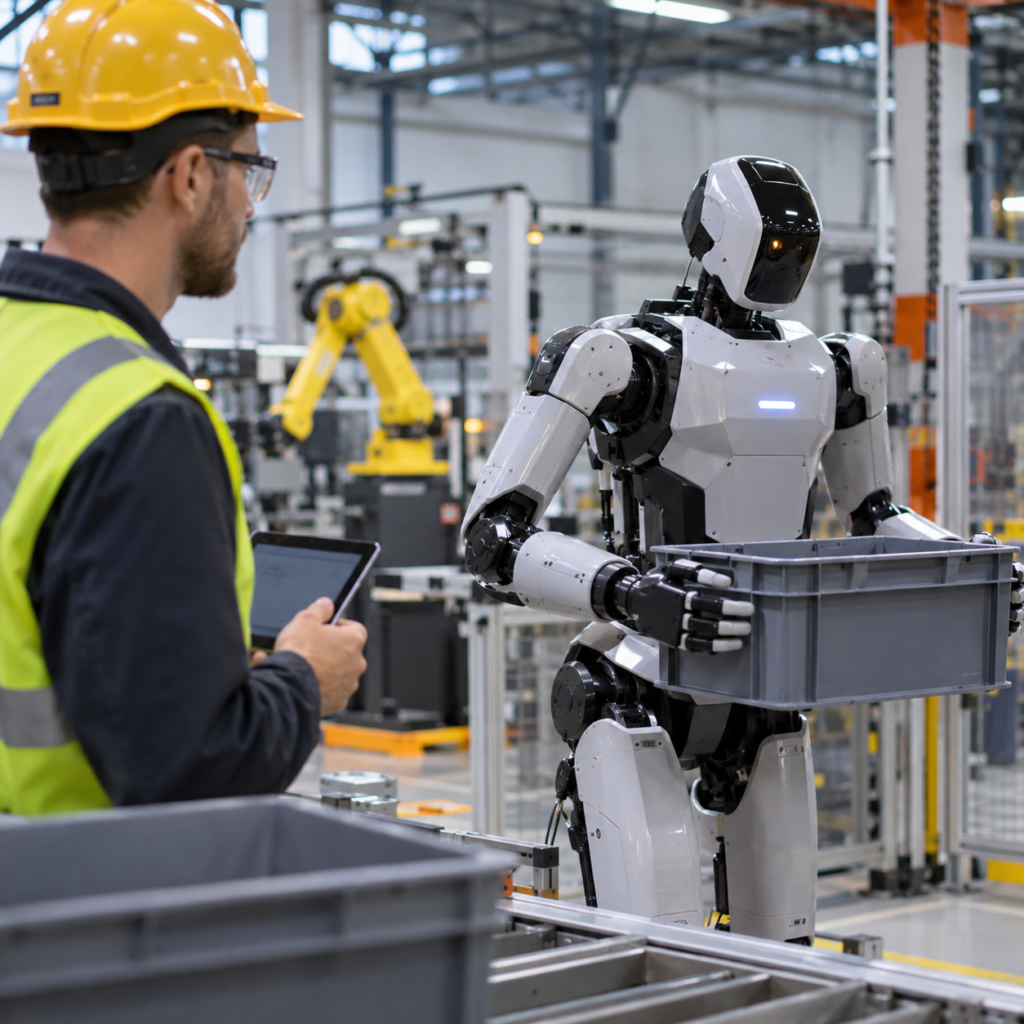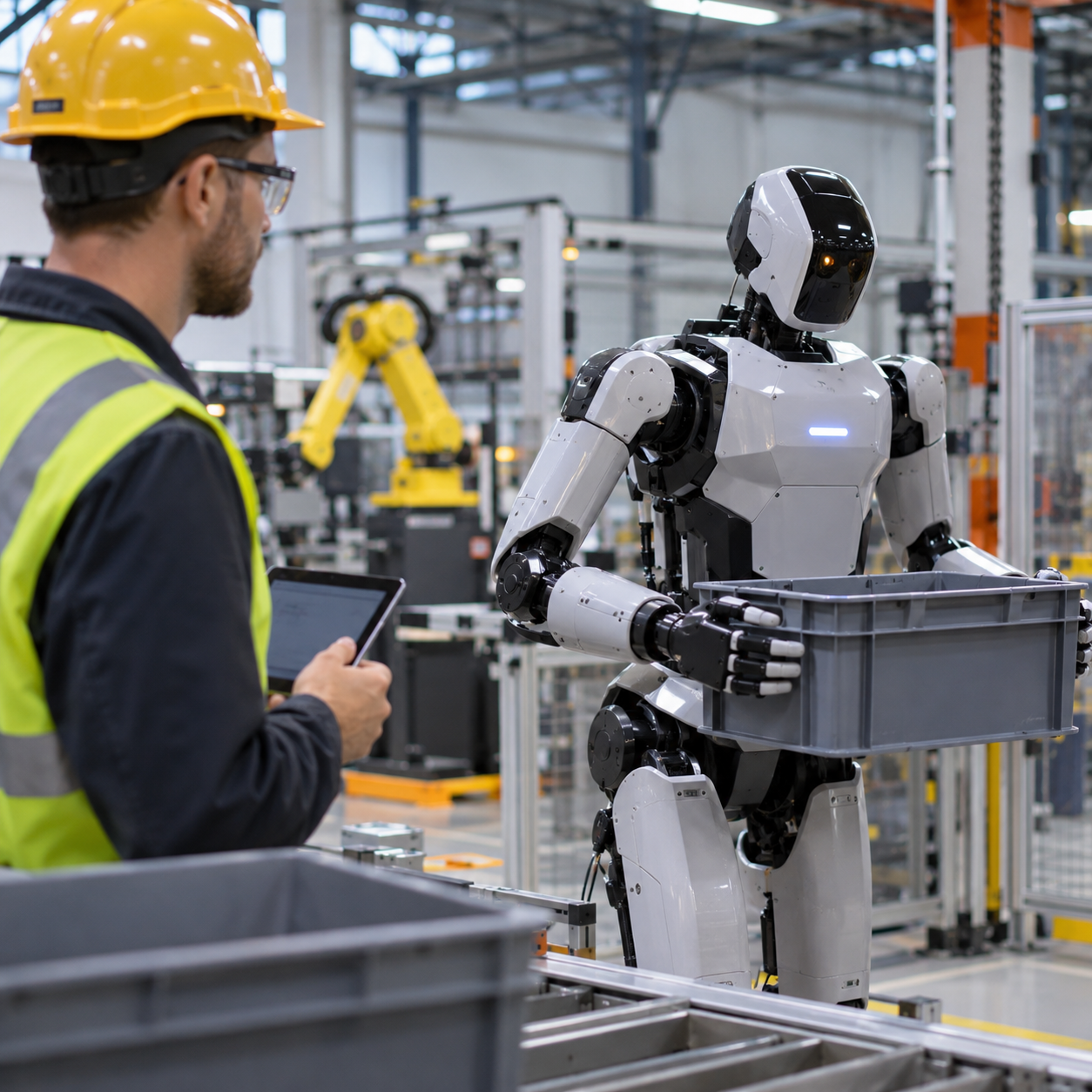
Bleu Robotics targets faster industrial robot learning
Paris-based Bleu Robotics has raised a €5 million pre-Seed round to develop software that teaches industrial humanoid robots new tasks from fewer demonstrations, according to EU-Startups. The company’s stated ambition is to reduce the full deployment process for a new task to one hour or less.
That target should be treated as a company goal, not an independently established deployment benchmark. The cited public materials do not provide third-party factory trials, customer case studies, or detailed measurements of repeatability across multiple plants. Nevertheless, the problem Bleu is addressing is commercially important: the specialist labor and production time needed to configure each robotic task can undermine the economics of automation, particularly for short runs or frequently changing processes.
Why fewer demonstrations could reduce integration costs
Internet-scale AI training benefits from enormous collections of text, images, and video. Industrial robot learning has no equivalent supply of standardized task data. Factory operations are physical, site-specific, and often proprietary. A manipulation sequence can depend on the robot, tooling, camera position, component tolerances, line speed, and safety layout. Collecting demonstrations can also consume operator and engineering time or interrupt production.
Few-shot imitation learning seeks to reduce that burden by allowing software to infer a task from a limited number of demonstrations. Bleu’s official materials describe learning new industrial tasks in less than an hour and present the technology as robot-agnostic. Its Bleu 0.1 introduction also emphasizes data-efficient task learning.
If this approach works reliably under production conditions, manufacturers could spend less on demonstration collection, task-specific programming, and repeated integration work. It could make automation more practical where products or processes change too often to justify a lengthy conventional deployment.
Fewer demonstrations do not automatically mean lower total integration cost, however. Training is only one part of deployment. Tooling, sensor calibration, robot communications, line controls, safety validation, and acceptance testing can still dominate the schedule. Buyers should therefore ask exactly what starts and stops the claimed one-hour clock. A laboratory task-learning interval is not equivalent to a production-ready installation.
What remains unproven publicly
The available sources do not establish how many demonstrations are needed for specific tasks, the success rate over extended production runs, or how performance changes when parts, lighting, or work-cell geometry vary. They also do not provide detailed public evidence about failure recovery, safety-system integration, data retention, or the engineering work required for each supported robot platform.
Robot-agnostic software is an attractive proposition, but compatibility has several layers. A model may transfer conceptually across robots while still requiring platform-specific adapters, motion constraints, end-effector configuration, and safety approval. Manufacturers should request a named list of supported hardware and a clear division of responsibility among Bleu, the robot supplier, and the system integrator.
Pilot checklist for manufacturers
- Setup time: Define the timed process before the pilot. State whether it includes cell mapping, sensor calibration, software installation, robot connection, training, safety checks, and acceptance testing.
- Demonstrations required: Record the number, duration, and quality of demonstrations needed for each task. Test whether a regular operator can provide them or whether a robotics specialist is required.
- Task repeatability: Measure success rate, cycle-time distribution, and intervention frequency over a production-relevant run. A short successful demonstration is not evidence of sustained operation.
- Process variation: Introduce realistic changes in part position, orientation, lighting, packaging, and component tolerances. Establish the operating envelope and identify which changes require retraining.
- Failure recovery: Test dropped, missing, misaligned, and damaged parts. Determine whether the robot retries, pauses safely, or requests human intervention, and document how production resumes.
- Safety integration: Confirm how the software interacts with safety-rated controllers, guarding, emergency stops, and plant risk-assessment procedures. AI task software should not be assumed to replace certified safety functions.
- Cross-platform compatibility: Repeat the task on every robot platform under consideration. Document additional integration code, calibration work, sensors, and compute required for each.
- Data governance: Determine whether demonstrations, images, or telemetry leave the factory, where they are processed and retained, and whether customer data can be used to improve shared models.
Evidence buyers should request
A credible evaluation should include task-level pilot results, precise definitions of deployment time, demonstration counts, and unassisted success rates. Buyers should request logs of failures and human interventions rather than relying only on successful demonstrations. Results should cover multiple shifts and representative process variation.
Commercial due diligence should address software pricing, compute and networking dependencies, update policies, cybersecurity responsibilities, data ownership, and support arrangements. These details are not established in the cited public sources. Contracts should also state who is responsible when a software update, robot change, or production-line modification requires retraining or revalidation.
Bleu Robotics is pursuing a relevant bottleneck: industrial automation cannot depend on the volume of training data available to consumer AI. Its one-hour objective offers a useful benchmark for a pilot, but not yet a basis for assuming production readiness. Procurement decisions should turn on repeatable factory evidence and total integration effort, not task-learning time alone.
Transparency: This assessment is based on company documentation and published reporting. MakeBusiness.eu has not conducted first-hand testing, and the performance ambitions described here have not been independently validated in the cited sources.