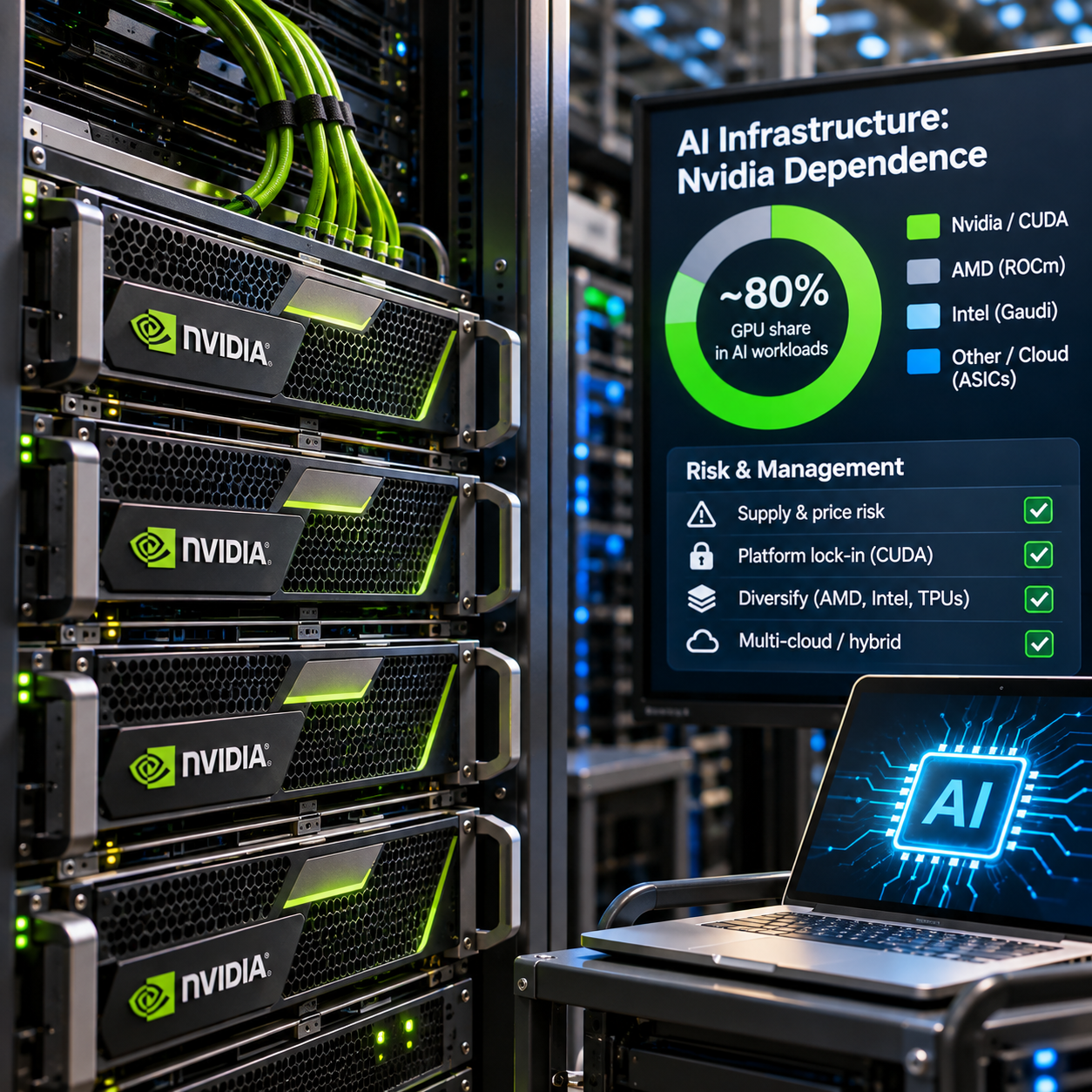
Two reported developments sharpen an increasingly important enterprise question: how much of an AI stack should depend on one interconnected ecosystem? TechCrunch reports that Amazon has sharply expanded its order for Nvidia chips in response to demand. Separately, TechCrunch reports that Nvidia is closing in on an acquisition of Hugging Face, the widely used platform for models, datasets, and developer collaboration. The latter remains a reported transaction, not a completed acquisition.
Viewed together, these developments suggest potential concentration across several layers: Nvidia accelerators, hyperscale cloud capacity built around them, model distribution, open-source assets, and development workflows. Enterprises can benefit from this alignment through greater capacity, mature software, and easier access to models. But dependence can become expensive to unwind if architecture, contracts, data, and operational knowledge all settle around the same platform.
Why the two developments matter together
Amazon’s reported expansion of Nvidia GPU capacity addresses an immediate constraint: organizations need access to accelerated computing to train, fine-tune, and run demanding models. More capacity may improve availability for customers using Amazon’s cloud, although a larger chip order alone does not guarantee lower prices, preferred instance access, or capacity in every region.
The reported Hugging Face transaction concerns a different layer. Hugging Face is important not merely as a catalogue of models. Its platform supports discovery, distribution, collaboration, datasets, libraries, and integrations used throughout AI development. Nvidia already occupies a central position in accelerated computing and its associated software environment. Ownership of a major developer platform could therefore connect infrastructure supply more closely with the places where teams select and operationalize models.
That combination could deliver useful ecosystem integration. It could also reduce enterprise bargaining power when several dependencies reinforce one another. A workload designed for Nvidia-specific libraries, deployed through one cloud, sourced through one model hub, and managed with platform-specific tools is not represented by four independent choices. It is one compound dependency.
No specific governance, licensing, pricing, or access changes should be assumed from a transaction that is only reported. The prudent response is not to predict such changes, but to identify which ones would materially affect the business and prepare accordingly.
Availability gains do not eliminate procurement risk
Enterprises should distinguish access to capacity from control over capacity. Amazon’s reported order expansion may increase the pool of Nvidia hardware available through its services, yet customers can still face limits involving regions, instance types, quotas, reservations, and contract duration. Capacity secured through a hyperscaler also remains subject to that provider’s commercial and technical framework.
Procurement teams should map three forms of exposure. First is physical concentration: which accelerators and cloud regions run critical workloads? Second is commercial concentration: what percentage of AI spending sits with one cloud or hardware ecosystem? Third is operational concentration: could another environment run the workload without a substantial rewrite?
Reserved capacity may be sensible for predictable production demand, while on-demand access can suit variable experimentation. Long commitments can improve planning but weaken leverage if alternatives become cheaper or technically sufficient. Contracts should therefore cover more than unit prices. Relevant terms include capacity guarantees, service-level commitments, renewal mechanics, data-egress charges, termination rights, migration assistance, and remedies when promised capacity is unavailable.
Cost monitoring must also capture the full workload. GPU-hour rates can distract from storage, networking, idle endpoints, orchestration, support, and duplicated environments. Teams should track cost per business-relevant unit—such as an inference, completed task, or processed document—alongside utilization and latency. This reveals whether ecosystem convenience is producing operational value or merely hiding inefficient consumption.
Portability must be demonstrated, not declared
Many organizations describe their architecture as portable because they use containers or open-source models. Neither guarantees practical mobility. A containerized service may still rely on accelerator-specific kernels, proprietary managed endpoints, cloud identity services, networking conventions, or an orchestration layer that is difficult to reproduce elsewhere.
A credible portability assessment starts with the workload’s dependency graph. Record the model and version, weights, tokenizer, inference runtime, accelerator libraries, drivers, orchestration components, storage formats, identity controls, observability tools, and external APIs. Mark every component that is specific to Nvidia hardware, one cloud, or one model platform.
Alternative accelerators should be evaluated by workload rather than by headline specifications. Compatibility, model accuracy after conversion, throughput, latency, engineering effort, and operational maturity all matter. The objective is not to maintain identical performance everywhere. It is to establish whether a business-critical service can operate at an acceptable level on another accelerator or cloud.
Open formats reduce friction when they encompass the complete asset chain. Enterprises should keep exportable copies of model weights where licences permit, configuration files, prompts, evaluation sets, dataset documentation, fine-tuning artefacts, and deployment definitions. A link to a hosted repository is not a backup. Neither is a model copy sufficient if the tokenizer, preprocessing code, licence record, or evaluation baseline is missing.
Prepare for possible changes in model-platform governance
A reported Nvidia acquisition of Hugging Face would warrant governance review because model hubs mediate access to community and commercial assets. Enterprises should not assume that repositories will disappear, licensing will change, or particular hardware will receive preferential treatment. Instead, they should ask how each plausible platform change would affect current operations.
Key questions include whether automated pipelines depend on platform APIs; whether private repositories can be exported in a usable form; whether access controls and audit logs can be preserved elsewhere; and whether model cards, licences, dataset lineage, and security scans are retained internally. Teams should also document which projects depend on libraries maintained within the broader ecosystem and what would be required to pin, fork, or replace them.
Open-source access deserves particular attention. “Open source” does not automatically mean independent of a hosting platform. Availability can be affected by repository policies, account controls, API changes, bandwidth restrictions, or the continued maintenance of supporting libraries. Maintain an internal artefact registry for approved production dependencies and verify their licences rather than relying solely on platform labels.
Governance monitoring should have named ownership. Legal, security, architecture, and procurement teams need a shared trigger list covering material changes to terms, model access, data treatment, API behaviour, repository controls, or interoperability. This converts an abstract concentration concern into an operational review process.
An enterprise review checklist for Nvidia-linked stacks
- Map critical dependencies: Identify where Nvidia hardware, cloud-specific services, Hugging Face assets, proprietary runtimes, and specialist skills appear in each production workflow.
- Test workload portability: Run one representative workload on another accelerator, cloud, or self-managed environment. Measure conversion effort, accuracy, latency, throughput, and operating cost.
- Review exit terms: Check termination rights, notice periods, minimum commitments, data-egress fees, capacity reservations, migration support, and deletion obligations.
- Qualify alternatives: Maintain at least one technically assessed alternative for critical workloads. “Available in the market” is not equivalent to validated compatibility.
- Back up models and datasets: Preserve permitted weights, tokenizers, code, configurations, prompts, evaluation data, lineage records, licences, and deployment manifests outside the primary platform.
- Prefer open, documented interfaces: Use exportable model and data formats where feasible, while recording any hardware-specific optimizations that would complicate migration.
- Monitor total cost: Track utilization and cost per business output, including storage, network transfer, managed services, support, and idle capacity.
- Exercise continuity plans: Simulate loss of a region, instance family, model repository, or platform API. Establish recovery objectives and confirm that credentials, artefacts, and staff procedures work.
The right objective is not to avoid Nvidia, Amazon, or Hugging Face. Their capabilities and ecosystems may offer substantial practical benefits. The objective is to make dependence visible, priced, contractually manageable, and technically reversible. Enterprises that secure capacity while preserving artefacts, testing alternatives, and negotiating credible exits can capture ecosystem advantages without treating concentration risk as an afterthought.