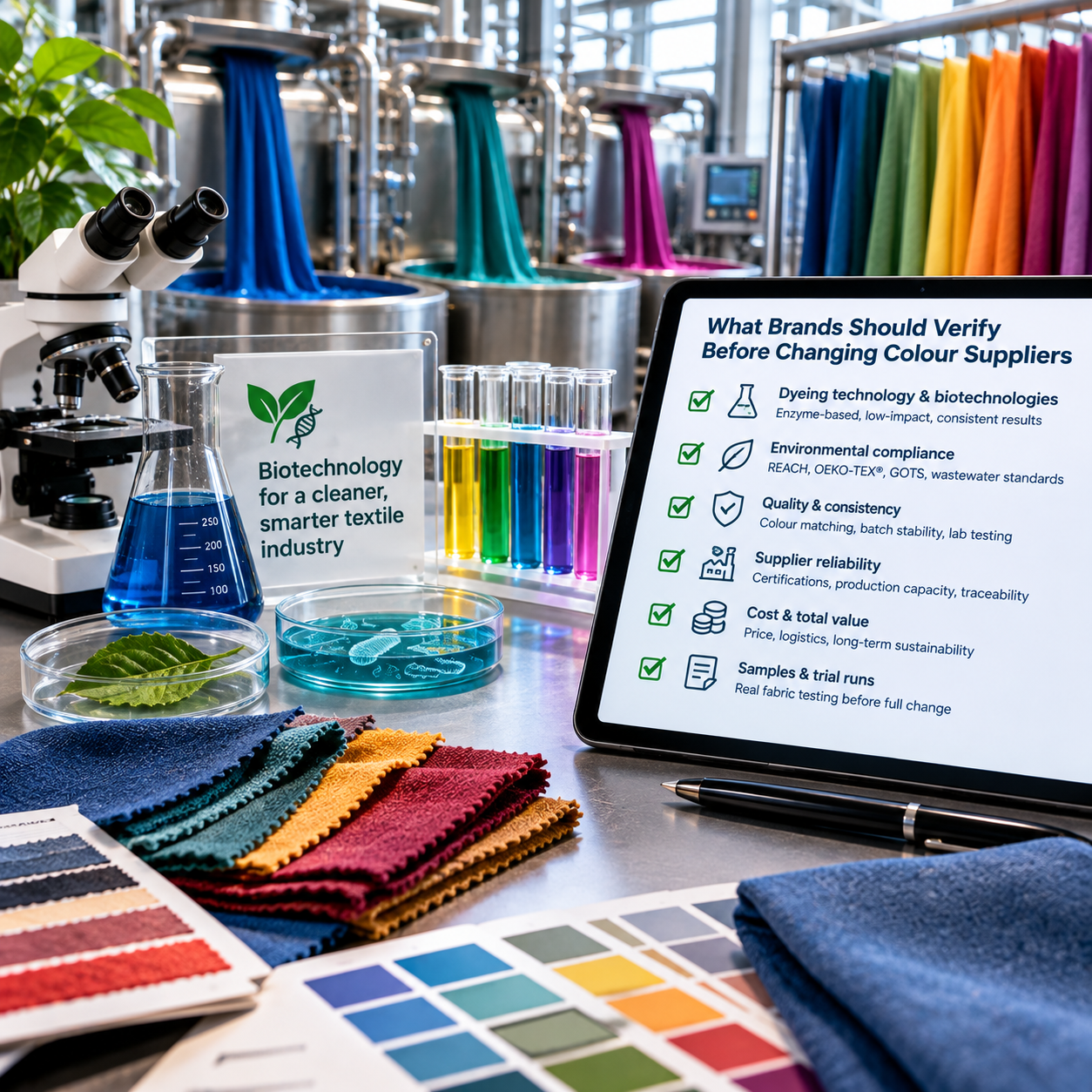
Biotechnology-based colour could help textile companies reconsider how dyes are produced, but changing colour suppliers is not simply a sustainability decision. It can affect shade approval, fibre performance, mill throughput, compliance, delivery dates and the consistency of future collections.
Vienna Textile Lab’s biotechnology approach to sustainable textile dyeing, discussed in EU-Startups’ interview with founder and CEO Karin Fleck, provides a useful starting point for this procurement question. However, an interview or promising sample cannot establish whether a new dye is ready for a brand’s materials, machinery and production volumes. The framework below is a practical synthesis for procurement, product development and manufacturing teams; it does not attribute unreported performance or environmental results to Vienna Textile Lab.
Translate an attractive colour into a production specification
The first test is repeatability. A laboratory sample may look compelling under one light source and on one fabric, yet a commercial supplier must reproduce an approved shade across batches, mills and seasons. The buyer should define the target using instrumental colour measurements and physical standards rather than relying on photographs or descriptive names.
Ask the supplier to produce several independent batches of the same shade. Compare colour difference against the brand’s agreed tolerance, check metamerism under relevant illuminants and assess variation within each dyed lot. Establish whether the biological production route introduces variability linked to feedstock, fermentation conditions, purification or storage. The supplier should explain how it controls those variables and releases each batch.
Colour performance must also survive use. Required tests depend on the product, but may include fastness to washing, rubbing, perspiration, light, water, heat or dry cleaning. Sportswear, children’s clothing, upholstery and fashion accessories do not have identical exposure profiles. Buyers should therefore specify the intended end use, test method and pass criteria before requesting a quotation.
Test the dye as part of a fibre-and-process system
A dye is not compatible with “textiles” in general. Its performance can change across cotton, wool, silk, regenerated cellulose, synthetics and blends. Fibre pretreatments, finishes and recycled content may also alter uptake and final appearance. Brands should request a compatibility matrix identifying what has been demonstrated, what remains experimental and what requires a different formulation or process.
Trials need to use the actual production substrate. A result on laboratory-grade cotton says little about a planned polyester-cotton blend with a water-repellent finish. Test fabric from the intended supplier, including representative variation between rolls. For blends, determine whether both components take up the colour evenly and whether existing colour-matching assumptions still apply.
The mill should then map the proposed recipe against its equipment. Important questions include required temperature, pH, liquor ratio, treatment time, auxiliaries, pre- and post-washing, filtration and effluent handling. Clarify whether the colour can run in existing jet, package, yarn or garment-dyeing equipment and whether tanks, dosing systems or lines require dedicated cleaning.
A process using different conditions may create costs outside the dye price. Longer cycles can reduce capacity; additional rinsing can affect utilities and wastewater; unfamiliar materials can increase cleaning or changeover time. Conversely, any claimed operational simplification should be demonstrated on the buyer’s process rather than assumed from a laboratory procedure.
Verify scale, lead time and quality controls
The key commercial question is not whether the supplier can make pigment, but whether it can deliver qualified material in the right quantity and window. Ask for current batch capacity, realistic output available to your account and the lead time for samples, first production and repeat orders. Separate present capability from planned expansion.
Procurement should investigate capacity bottlenecks across biological production, downstream processing, formulation and packaging. Which stages are performed internally? Which depend on contract manufacturers or single-source inputs? How much qualified inventory is held, and how quickly can a rejected batch be replaced?
The supplier’s quality documentation should define identity, strength, purity, moisture or other relevant release parameters, along with test methods and acceptance ranges. Request certificates of analysis for trial lots and determine whether retained samples and batch traceability are available. Agree how colour strength differences will be corrected at the mill and who bears the cost of failed material, redyeing, delayed production or unusable fabric.
Minimum order quantities deserve scrutiny during scale-up. A low sample threshold does not guarantee commercially workable quantities for each shade. Ask whether custom colours require separate development fees or minimums, how long colour matching takes and whether repeat shades remain available when the biological process or formulation changes.
Demand evidence behind safety and environmental claims
“Biotechnology-based,” “natural” and “sustainable” are not interchangeable with safe or lower-impact. Claims should be assessed for the finished colourant and its application process, not inferred from its biological origin.
Request a complete safety data sheet, chemical composition disclosures appropriate to confidentiality constraints, applicable restricted-substance test results and evidence relevant to the destination market and product category. Review impurities, residual processing substances, sensitisation or exposure concerns, worker handling requirements and disposal instructions. The mill’s chemical-management team should participate before production trials begin.
Environmental substantiation requires equally precise boundaries. Ask what comparison is being made: the colourant’s manufacture, the dyeing recipe, or the finished textile? Determine whether evidence includes energy, water, feedstocks, auxiliaries, wastewater, toxicity, yield and waste at a representative scale. Third-party testing, documented methods and transparent assumptions are stronger than broad claims unsupported by a defined baseline.
Marketing teams should use only claims that the evidence supports. A material’s innovative production route does not automatically justify statements about biodegradability, non-toxicity, lower water consumption or reduced emissions. Contracts should specify who supplies substantiation and how the brand may describe the technology publicly.
Use staged validation rather than a supplier-wide switch
A controlled programme limits both technical and commercial exposure.
- Desktop qualification: Review technical data, safety documentation, regulatory status, compatible fibres, available shades, capacity, ownership of formulations and business continuity. Record unresolved claims.
- Repeat laboratory samples: Request independently produced lots of target shades on actual substrates. Measure colour variation and conduct end-use fastness tests.
- Pilot at the nominated mill: Run the intended machinery with production operators. Record recipe, cycle time, yield, rework, cleaning, wastewater implications and deviations from normal practice.
- Limited commercial order: Select one product, colour and market with manageable demand. Preserve a conventional alternative until testing and delivery are complete.
- Post-production review: Compare approved standards with bulk goods, inspect customer-use performance and calculate total landed and conversion cost—not merely price per kilogram.
- Conditional expansion: Add fibres, shades or volumes only after predefined technical, compliance, delivery and cost gates are passed.
Each gate should have a named decision owner. Product teams approve appearance and use performance; mills confirm process capability; compliance teams assess chemical and claims evidence; procurement evaluates supply and contractual risk.
Make the contract reflect the real switching risk
Pricing should cover development fees, colour matching, testing, freight, storage, process changes and potential yield loss. Buyers also need to understand whether prices depend on production scale or feedstock costs and how long quotations remain valid.
Contractual specifications should attach approved standards, tolerances, test methods, release requirements and change-notification duties. Require advance notice of alterations to organism, production site, feedstock, purification, formulation or subcontractor where those changes could affect performance or compliance. Define remedies for off-specification deliveries and establish traceability and recall cooperation.
Finally, assess resilience. Review financial stability, insurance, intellectual-property position, disaster recovery, alternate manufacturing options and dependence on key people or facilities. For a young technology supplier, dual sourcing or reserved conventional capacity may be prudent during early seasons.
The right decision is therefore not “biotech versus conventional” in the abstract. It is whether a specific colourant, on a specified fibre and mill process, can repeatedly meet defined quality, safety, substantiation, delivery and cost requirements. A staged programme converts biotechnology’s promise into evidence that a textile business can responsibly buy against.