AI adoption can fail even when the technology works. Customers may doubt claims they cannot verify, while employees may resist tools that affect their work without clear safeguards or recourse. The operational mistake is to treat those reactions as a communications problem to be solved with more ambitious messaging.
Two recent TechCrunch articles illustrate the tension. One reports skepticism toward Mark Zuckerberg’s vision of an AI-rich future; another presents Anthropic CEO Dario Amodei’s argument that backlash against AI is fundamentally a crisis of trust. These are reported viewpoints and discussions, not proof of universal public opinion. Yet they highlight a practical issue for operators: a promise about what AI may eventually achieve does not answer what a specific system does today, how reliably it does it, or who is accountable when it fails.
Trust, therefore, is not a brand attribute applied after launch. It is an operating condition built through bounded claims, inspectable evidence, intervention rights and visible accountability.
Replace the grand vision with a bounded use case
Ambitious narratives ask people to trust a destination before they can inspect the route. A credible deployment begins at a smaller scale: a named user, a defined task and an explicit boundary around the system’s authority.
“AI will transform customer service” is not an operational proposition. “The tool will draft responses to routine delivery-status questions for agents to review” is. The second statement identifies the workflow, the user and the role of human judgment. It can also be tested.
Before approving a launch, write a one-page use-case contract covering:
- Purpose: What specific problem is the system intended to solve?
- Users and affected parties: Who operates it, and whose work, access or choices could it influence?
- Permitted actions: May it recommend, draft, rank or execute?
- Prohibited actions: Which decisions must never be made without human authorization?
- Operating conditions: Which languages, markets, document types or customer groups are inside scope?
- Exit condition: What evidence would trigger suspension, rollback or redesign?
This contract prevents a pilot’s limited evidence from being stretched into an enterprise-wide claim. It also gives employees and customers something concrete to evaluate instead of asking them to accept a general vision of AI.
Make every material claim traceable to evidence
Operators should separate three categories that marketing often blends together: demonstrated performance, reasonable expectations and aspiration. Only the first should support firm claims about present capability.
Evidence must also resemble the deployment environment. A benchmark score may say little about performance on a company’s own documents, customer vocabulary or unusual cases. Likewise, an average result can conceal consequential failures among particular user groups or task categories.
Create a claim register before launch. For every external promise or internal business-case assumption, record the supporting test, test population, evaluation method, known exclusions and owner. If the evidence supports only assisted drafting under review, do not describe the product as autonomous resolution.
Useful outcome measures depend on the use case. They might include correction rates, false approvals, unresolved cases, time saved after review, successful escalations or complaints tied to AI-assisted decisions. Pair efficiency measures with failure measures. A faster process is not a successful process if it quietly transfers error detection to customers or frontline staff.
Claims should be revised as conditions change. Model updates, new data, workflow changes and expansion into another language can invalidate previous testing. Evidence is not a launch artifact; it requires versioning and revalidation.
Disclose the data and limitations people need to act safely
Transparency does not mean publishing every technical detail. It means giving each affected person enough information to understand the system’s role, make an informed choice where appropriate and challenge a harmful outcome.
For a workplace tool, employees should know what information it receives, whether their inputs are retained, whether outputs contribute to performance evaluation and whether vendors may use company data to improve models. For a customer-facing product, users should be told when they are interacting with AI if that fact could affect their decisions or expectations.
A deployment record should answer:
- Which data sources are used at inference time?
- Is personal, confidential or employee data included?
- Where is information stored, and for how long?
- Which parties can access prompts, outputs and logs?
- What important limitations have testing revealed?
- Which uses are unsupported or expressly forbidden?
Limitation notices must be placed where decisions occur. A warning hidden in policy documentation will not help an employee deciding whether to rely on a generated compliance summary. State the limitation beside the output and connect it to a required action, such as checking the cited source or obtaining specialist approval.
Design human oversight as a working control
“Human in the loop” is credible only if the human has time, authority, information and a clear intervention point. Requiring an employee to approve hundreds of outputs rapidly can turn oversight into a ceremonial click.
Map intervention rights across the workflow. Identify who can correct an output, reverse a decision, pause the system and disable it entirely. Specify which cases must escalate automatically—for example, low-confidence outputs, requests involving sensitive data or decisions with significant consequences.
Reviewers need access to relevant source material and an explanation appropriate to the task. They must also be protected from automation bias. Interface design should not present uncertain suggestions as settled facts, and operating targets should not punish people for slowing down to investigate an anomaly.
For customers, recourse should be direct rather than theoretical. Provide a clearly labelled route to human review, explain what information is required and set an internal service standard for resolving disputed outcomes. Repeated requests for intervention are not merely support costs; they are evidence about where the system or its boundaries are failing.
Assign accountability before the first error
AI accountability becomes vague when responsibility is distributed among a model provider, software vendor, technical team and business function. Users should not bear the burden of working out which party owns a failure.
Name one business owner for the deployment. That person need not personally investigate every incident, but must own the outcome, risk acceptance and decision to continue operating. Supporting roles should include a technical owner, a data or privacy contact, a frontline escalation owner and an executive empowered to suspend the system.
Define incident severity in advance. A stylistic error in an internal draft is not equivalent to disclosure of confidential data or denial of a service. Each level should have a response path, evidence-preservation requirement, notification rule and deadline for deciding whether the system remains active.
Vendor contracts do not eliminate the operator’s accountability to employees or customers. Procurement should establish access to audit information, notification of material model changes, data-handling obligations, incident cooperation and practical exit options. If the organization cannot investigate an important error because the relevant logs or model details are unavailable, that is a deployment risk to address before launch.
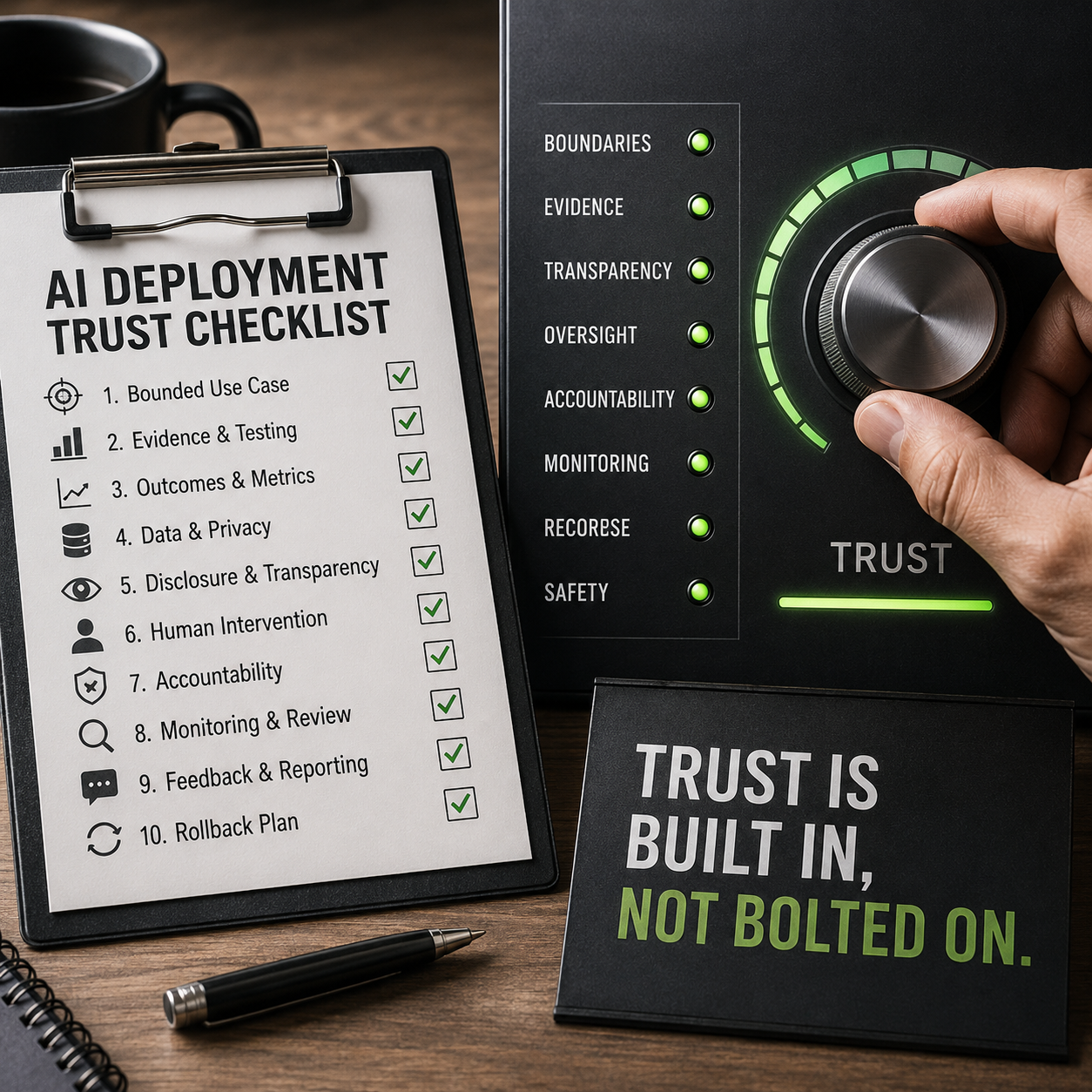
Launch with a trust-control checklist
A credible rollout is staged, monitored and reversible. Before moving from pilot to production, operators should be able to answer these questions with records rather than assurances:
- Scope: Is the task bounded, and are prohibited uses explicit?
- Evidence: What testing supports each capability claim in the real operating context?
- Outcomes: Which benefit and failure metrics will determine whether deployment continues?
- Data: What information enters the system, who can access it and how long is it retained?
- Disclosure: Do affected people understand the AI’s role and relevant limitations?
- Intervention: When can a human review, correct, reverse or stop an outcome?
- Responsibility: Who owns errors, complaints, incident response and the final go/no-go decision?
- Monitoring: How will harms, overrides, edge cases and complaints be categorized and reviewed?
- Feedback: Can employees and customers report problems without navigating the technical organization?
- Rollback: Can the business return to a safe process if performance deteriorates?
Begin with a limited cohort and publish an internal review date. At that review, compare observed outcomes with the claim register, examine complaints alongside quantitative metrics and ask frontline users where formal procedures differ from real work. Expand only when the evidence supports expansion.
The practical lesson from the current debate is not that bold AI visions are necessarily wrong. It is that vision cannot substitute for proof at the point of adoption. Customers and employees are more likely to rely on a system when they can see what it does, where it stops, how to challenge it and who will answer when it causes harm. Those conditions are created by operations, not slogans.