Employers can buy an AI system faster than they can earn permission—social, managerial or practical—to rely on it. That gap matters because deployment succeeds only when employees use the system appropriately, managers can defend its outcomes and customers understand when it affects them.
Recent TechCrunch coverage frames resistance to ambitious AI visions as a problem of trust rather than simply a failure to appreciate the technology. One article reports Anthropic CEO Dario Amodei’s interpretation of AI backlash as a crisis of trust; another examines why people may not accept Mark Zuckerberg’s vision of an AI-centered future. These are reported perspectives, not proof that every workforce or customer group holds the same view. For employers, the useful lesson is narrower: enthusiasm and technical capability do not substitute for evidence, accountability and control.
A credible rollout should therefore begin with a bounded operational decision—not a promise to “transform the business.” The following plan turns skepticism into design requirements.
Identify whose trust the deployment requires
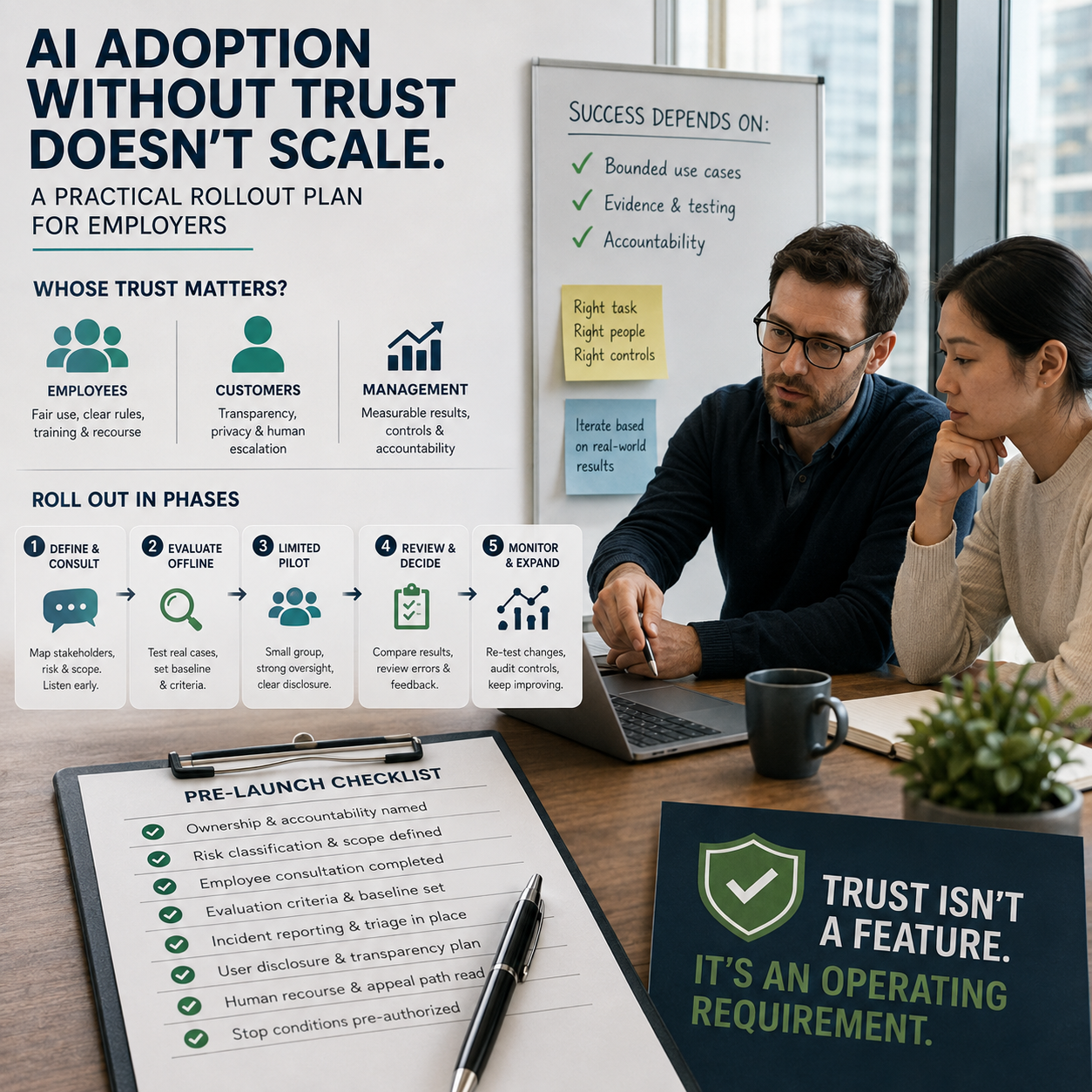
“Trust in AI” is too broad to manage. Employees, customers and management face different risks and need different evidence.
Employees need to know how the tool changes their work, whether its output will be used to evaluate them and who bears responsibility for mistakes. A writing assistant may raise concerns about monitoring or job redesign; a scheduling or performance tool can affect income and opportunity. Employee trust depends on consultation, understandable rules, training and a meaningful way to challenge outcomes.
Customers need evidence that the system will not quietly reduce service quality or prevent access to a person. Their concerns become acute when AI provides consequential advice, handles sensitive information or makes decisions about eligibility, price or complaints. Disclosure, privacy safeguards and a functioning human escalation route matter more than internal claims about model sophistication.
Management needs a defensible business case. Leaders should ask whether the tool improves a defined outcome, what new liabilities it creates and whether performance can be audited. Management trust should rest on measured results and control effectiveness, not a persuasive demonstration under ideal conditions.
Map these groups before selecting a pilot. If a proposed deployment needs all three groups to accept major uncertainty at once, it is probably too ambitious for the first phase.
Replace sweeping claims with a scoped use case
Exaggerated claims create an expectation gap. Calling a tool “reliable,” “autonomous” or “human-level” encourages users to infer capabilities that may not have been tested in their context. A better business case defines a task, user, boundary and intended outcome.
For example, “introduce AI into customer service” is not a usable scope. “Draft replies to low-risk delivery-status questions for trained agents, with every message reviewed before sending” is. The second formulation identifies who acts, what the system may do and where human accountability remains.
Classify each proposed use case by consequence. A low-risk application may summarize internal meeting notes that users verify. A medium-risk application might draft customer communications or recommend work schedules. High-risk uses include decisions affecting employment, access to services, safety, legal rights or significant financial outcomes. Risk classification should determine approval authority, testing depth, disclosure and the degree of human review.
Do not begin with the use case offering the largest theoretical labor saving. Start where errors are detectable, reversible and inexpensive to correct. Early deployment should generate evidence about performance and operating controls, not maximize organizational dependence.
Design human oversight as a control, not a slogan
“A human is in the loop” means little unless that person has time, authority and information to intervene. Rubber-stamping AI output is not oversight.
For each workflow, name an accountable owner and specify what reviewers must check. Give them access to the original inputs, the system output and any relevant policy. Define when they must reject, edit or escalate an answer. If management measures only speed or throughput, reviewers will be pushed to approve outputs without scrutiny; quality and intervention metrics must carry weight too.
Escalation paths should cover at least three situations: uncertain output, suspected harm and repeated failure. Front-line users need a simple reporting channel that does not require proving the technical cause. The product or process owner should triage incidents, preserve relevant records and route privacy, security, legal or employment issues to the appropriate specialists.
Stop conditions belong in the plan before launch. Examples include a serious harmful outcome, an unresolved data exposure, performance below an agreed acceptance threshold, a pattern of biased or inconsistent results, or an inability to provide required human review. Predetermined conditions make suspension an operating decision rather than a political argument after harm occurs.
Test the workflow, including its uncomfortable cases
A vendor benchmark does not establish that a tool is suitable for a particular employer. Evaluate it using representative business inputs, including incomplete requests, unusual wording, conflicting instructions and cases where the correct action is to abstain or escalate.
Set evaluation criteria before seeing pilot results. Depending on the use case, these may include factual accuracy, policy compliance, inappropriate disclosure, successful escalation, correction time, customer complaints, employee override rates and time saved after review. Compare results with the existing process; otherwise, a pilot may celebrate AI performance without showing that it improves operations.
Separate output quality from business impact. A system can produce fluent drafts while increasing review time, or reduce handling time while creating more rework later. Measure the entire workflow and segment results by case type. Aggregate averages can conceal failure in rare but consequential cases.
Testing should also examine whether users understand the system’s limits. Ask employees what they believe the tool can do, observe where they over-rely on it and revise training or interface language accordingly. Opaque systems require stronger procedural transparency: even if the model cannot explain itself reliably, the employer can explain what data enters the workflow, who reviews outputs and how decisions can be challenged.
Roll out in phases with evidence gates
Phase 1: Define and consult. Assign a business owner and a risk owner. Document the task, affected groups, prohibited uses and risk classification. Consult employees who perform or are affected by the work; ask about edge cases, workload implications and potential misuse. Determine whether customers or other users require disclosure.
Phase 2: Evaluate offline. Test representative and adversarial cases without affecting live decisions. Establish baseline performance for the existing process and approve evaluation criteria. Confirm data handling, access controls, record retention, incident routing and contractual responsibilities.
Phase 3: Run a limited pilot. Restrict users, case types and duration. Require meaningful human review and visibly label AI-generated recommendations internally. Where customers interact directly with AI or its use materially affects the interaction, provide clear disclosure and an accessible route to a person.
Phase 4: Review and decide. Compare the pilot with its baseline. Examine errors, overrides, complaints and near misses—not only productivity. Gather separate feedback from employees, customers and management because one group’s acceptance does not establish another’s trust. Expand only if outcome and control criteria are met.
Phase 5: Monitor after expansion. Re-test after model, vendor, policy or workflow changes. Publish internal ownership and reporting routes. Audit whether human review remains substantive as volume grows.
Pre-launch checklist for accountable adoption
- Ownership: Name the executive sponsor, operational owner, risk owner and incident decision-maker.
- Risk classification: Record the consequences of errors and prohibit uses beyond the approved scope.
- Employee consultation: Involve affected staff before workflow design is finalized; document concerns and responses.
- Evaluation: Set baseline, quality, compliance and business-outcome criteria before the pilot.
- Incident reporting: Provide an easy channel, triage deadlines and routes for privacy, security, legal and employment issues.
- User disclosure: Explain AI involvement when people interact with it directly or when it materially shapes an outcome.
- Human recourse: Give employees and customers a practical way to question, correct or appeal an output.
- Stop conditions: Pre-authorize suspension for serious harm, data exposure, inadequate review or failed performance thresholds.
The objective is not to eliminate skepticism. It is to answer reasonable skepticism with bounded claims, observable evidence and enforceable accountability. Employers that cannot state who owns an AI-assisted decision, how it is tested and when it will be stopped are not ready to scale it.