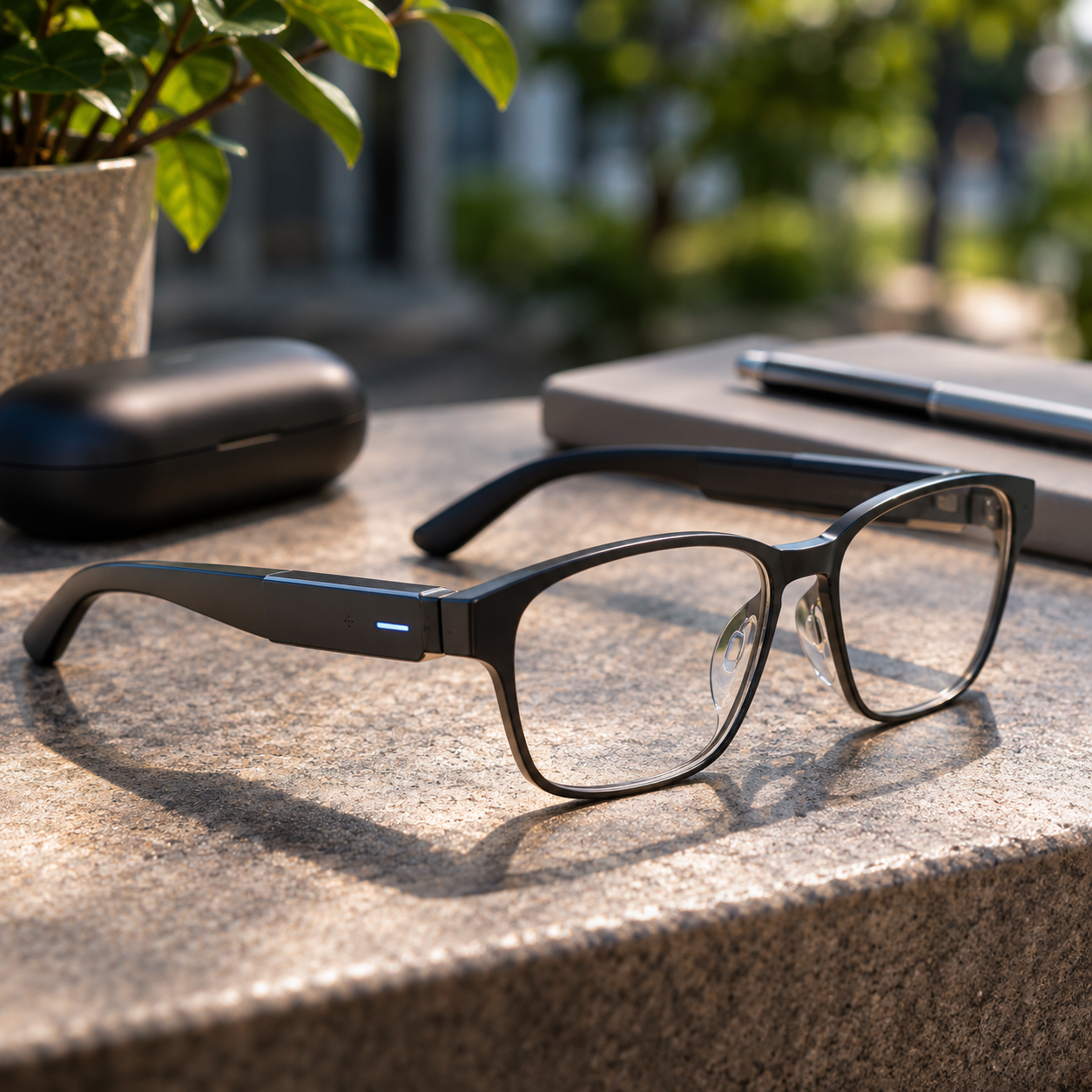
Accessibility technology can fail in practice even when its core function works. A device may be uncomfortable during a full shift, awkward to use around customers, incompatible with protective equipment or too conspicuous for an employee who would prefer discretion. Legato Frames point toward a different product strategy: embedding hearing assistance in eyewear, a familiar object that many people already wear every day.
TechCrunch reports that hearing-technology startup Legato has emerged from stealth with $12 million in funding and a preview of AI hearing glasses incorporating patented hearing-assistance technology into the arms of the frames. That is an intriguing design direction, not proof of workplace performance. Employers, procurement teams and customer-facing businesses should therefore treat the concept as an emerging category to evaluate—not as a finished answer to hearing accessibility.
Why the eyewear form factor changes the accessibility discussion
Moving assistive functionality into glasses could reduce the number of separate objects a user must carry, charge and manage. It may also make assistance feel less conspicuous because the technology is integrated into an established consumer form. Those are potential advantages rather than verified outcomes for Legato Frames.
The form factor also introduces its own trade-offs. Eyewear must fit the face, remain stable during movement and suit the wearer’s visual needs and preferences. Electronics in the arms could affect weight distribution, heat, controls or repairability. A person who does not otherwise wear glasses may not consider frames convenient at all. Discretion is similarly subjective: one employee may welcome an everyday appearance, while another may prefer a different assistive device.
This matters for inclusive workplace programs because adoption depends on more than technical specifications. If an employee finds a product tiring, aesthetically unsuitable or difficult to operate, nominal access does not become practical access. Procurement should therefore assess the complete wearing experience rather than classifying the product as just another audio device.
Test performance where work actually happens
Promotional demonstrations rarely reproduce a busy shop floor, a reverberant meeting room or a windy outdoor service area. Any trial should use representative tasks and environments, with the participating employee defining what successful support means.
Evaluation scenarios could include one-to-one conversations, group meetings, video calls, reception desks, vehicle noise, machinery, public announcements and interactions through screens or service windows. Teams should observe whether assistance remains useful when speakers change position, several people talk or background noise fluctuates. They should also examine latency, control simplicity and the effort required to switch between settings.
The appropriate measures are task-based rather than medical: Can the user follow a meeting with less repetition? Are controls manageable during customer service? Does the battery last through the required working period? How often does connectivity interrupt a task? Does wearing the frames create fatigue by the end of a shift? These questions do not establish clinical effectiveness, but they can reveal operational fit.
Workplace safety must remain a separate gate. Employers should not assume that an assistive wearable is compatible with roles requiring situational awareness, hearing protection or safety-certified equipment. Relevant occupational-health and safety specialists should assess those conditions before deployment.
Privacy and compatibility need early scrutiny
Technology designed to process speech or surrounding sound can create privacy concerns for wearers, colleagues and customers. Before a pilot, buyers should ask what data the device captures, whether audio is stored, where processing occurs, which accounts or mobile applications are required and whether data is used to improve models. They should also establish retention and deletion rules, access controls, security-update practices and procedures for loss or theft.
Visible indicators and clear explanations may be important in customer-facing settings, especially if observers could mistake hearing assistance for recording. Legal and data-protection review should reflect the actual product architecture and jurisdiction rather than assumptions based on the word “AI.” Employers also need a workable policy for sensitive meetings and restricted environments.
Compatibility testing should go beyond pairing with a phone. Relevant questions include whether the glasses work reliably with company-managed devices, conferencing platforms and approved operating-system versions. Physical compatibility may matter even more: safety helmets, headsets, protective eyewear, masks and uniforms can all interfere with eyewear arms. Prescription-lens options, lens replacement and fit adjustments should be clarified if the product reaches commercial procurement.
Calculate ownership cost beyond the frame
No responsible cost case can be built from purchase price alone—and the supplied report does not establish availability or pricing. Buyers should instead define the cost categories they would need vendors to disclose.
Those categories include fitting, prescription lenses, accessories, device management, training, replacement batteries where applicable, repairs, accidental damage and shipping. Internal time also counts: IT onboarding, privacy assessment, manager training, troubleshooting and administering replacements can outweigh apparent savings from a compact form factor.
Durability deserves particular attention because glasses are handled frequently and can be dropped, bent or exposed to dust, rain and temperature changes. Ask about warranty coverage, expected service life, repair turnaround, loan units, software-support periods and what happens if the vendor changes its application or cloud service. A product that combines vision and hearing functions could create a concentrated failure point: if the frames need repair, the user may temporarily lose both.
The business case should compare the wearable with realistic alternatives, including existing accommodations, room equipment, communication practices and other personal devices. The decision is not whether hearing glasses seem innovative; it is whether they support the individual’s work reliably, acceptably and at a defensible lifetime cost.
Run an employee-led pilot, not a technology showcase
Begin with voluntary participation and informed consent. Accessibility teams should work directly with intended users to define desired outcomes, acceptable trade-offs and situations that should remain outside the trial. Offer alternatives rather than making one wearable the default accommodation. Employee choice is essential because hearing needs, comfort and attitudes toward visible technology vary.
Next, establish pass-and-fail criteria before receiving demo units. Cover full-shift comfort, task performance, battery endurance, physical and digital compatibility, privacy, reliability and vendor support. Use several representative environments and document interruptions, support requests and maintenance needs. Avoid collecting sensitive information that is unnecessary for the evaluation.
Finally, separate three decisions: whether the category has promise, whether a particular product meets requirements and whether it is suitable for a particular person. Legato’s reported approach may encourage product teams to consider how accessibility can be integrated into familiar objects rather than added as an obvious attachment. Yet integration should not become invisibility by default: accessible products still need understandable controls, repair paths and transparent data practices.
For now, employers should monitor evidence, prepare evaluation questions and resist premature standardization. If Legato Frames or comparable products become available, a controlled, employee-led pilot can test the operational proposition without confusing startup momentum with proven accessibility. The strongest result may be a purchase, a request for product changes or a decision that another accommodation works better—all are valid outcomes of responsible evaluation.