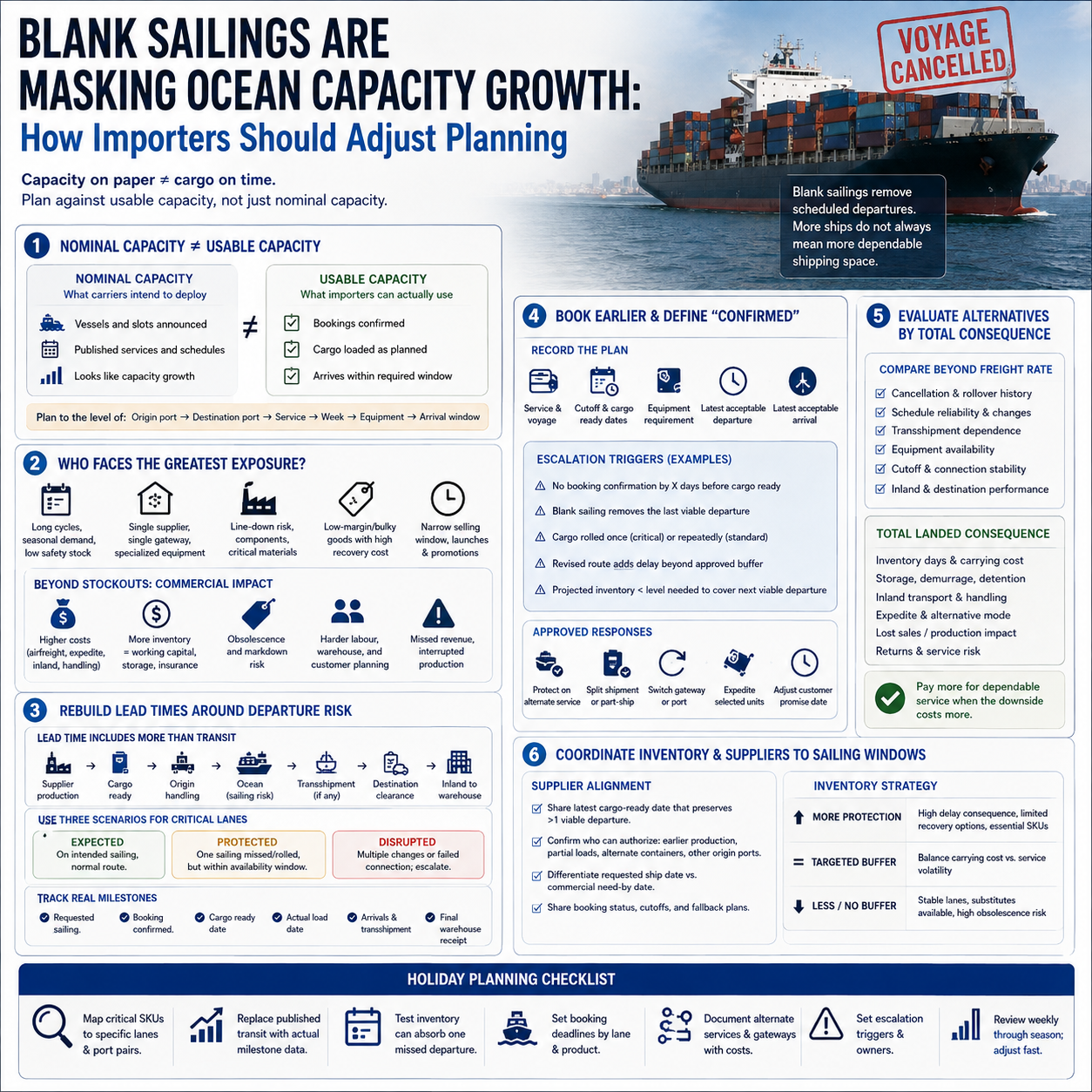
More ships or slots in the market do not automatically give importers more dependable shipping space. Carriers can add nominal capacity while simultaneously cancelling scheduled voyages—known as blank sailings—to manage supply, demand, and network performance. Supply Chain Dive reports that uneven capacity growth and blank sailings are contributing to longer lead times and reduced schedule reliability. For importers, the practical issue is therefore not how much capacity exists on paper, but how much can be booked, loaded, and delivered within a usable time window.
This distinction affects purchasing deadlines, inventory availability, working capital, customer commitments, and margins. Businesses should not respond by adding buffer everywhere. They need to identify where unreliable departures create the greatest commercial exposure and then adjust booking, routing, inventory, and supplier coordination accordingly.
Nominal capacity is not the same as usable capacity
Nominal capacity describes the space carriers intend to deploy through vessels and published services. Usable capacity is the portion an importer can realistically secure and move through the network with acceptable reliability. A blank sailing removes an entire scheduled departure. Cargo may be rolled to a later vessel, transferred to another service, or delayed while containers and documents wait for a revised plan.
This means a trade lane can show capacity growth without offering a comparable improvement in shipment options. Capacity may also be unevenly distributed by route, port pair, week, or service. An importer looking only at fleet additions or aggregate market capacity can therefore underestimate execution risk at the precise origin and destination it uses.
The right planning unit is not simply “ocean capacity.” It is dependable capacity for a specific port pair, service, departure week, equipment type, and required arrival window. Procurement and logistics teams should assess whether bookings are being confirmed, whether confirmed cargo is being loaded as planned, and whether arrival performance supports the inventory promise made to the business.
Which importers face the greatest exposure?
The impact is most severe where one missed departure cannot be absorbed easily. Importers with long production cycles, narrow selling seasons, low safety stock, or a single approved supplier have fewer recovery options. The same applies to businesses relying on one gateway port, one carrier service, specialized containers, or components that can stop an assembly line.
Commercial exposure also depends on the product. A delay involving low-margin, bulky goods may make emergency airfreight uneconomic. Seasonal merchandise can lose value rapidly if it arrives after a launch or promotional window. Components may be inexpensive individually but costly when their absence interrupts production or prevents completion of a higher-value product.
The risks extend beyond stockouts. Earlier booking may require purchase decisions sooner. Additional inventory ties up working capital and increases storage, insurance, obsolescence, and markdown exposure. Alternative routings can introduce higher inland transport costs, extra handling, customs complexity, or longer container dwell. Meanwhile, unreliable arrival dates make labour, warehouse, and customer-delivery planning harder.
Importers should rank lanes and products by consequence rather than treating every shipment as equally urgent. A useful segmentation considers revenue at risk, substitution options, time sensitivity, replenishment frequency, recovery cost, and the operational effect of missing one sailing.
Rebuild lead times around departure risk
Lead-time assumptions should include more than port-to-port transit. The planning clock starts when goods are ready and ends when inventory is available for use or sale. It should account for booking lead time, origin handling, possible departure rollover, transshipment, destination clearance, and inland delivery.
Instead of relying on one average, planners can maintain three internal scenarios for critical lanes:
- Expected: the shipment moves on the intended sailing and follows the normal route.
- Protected: one departure is missed or the cargo is rolled, but inventory remains within the required availability window.
- Disrupted: multiple schedule changes or a failed connection require management escalation.
These are operating scenarios, not forecasts. Their purpose is to expose where the current purchase order date leaves no room for recovery. If missing one weekly departure would create a stockout, the planned order-release date or inventory policy is too dependent on schedule reliability.
Review actual milestones rather than accepting a carrier’s published transit time as the full lead time. Track requested and confirmed departure dates, cargo-ready dates, actual load dates, transshipment changes, actual arrivals, and final warehouse receipt. This reveals whether delays originate with suppliers, equipment availability, booking confirmation, blank sailings, or destination processes.
Book earlier, but define what “confirmed” means
Earlier booking can improve the chance of securing space, but it is not a complete answer. A booking confirmation does not guarantee that a sailing will operate or that cargo will avoid rollover. Importers should establish a booking schedule by lane and product criticality, with earlier action for shipments that have few substitutes or expensive recovery options.
Teams should record the intended service, voyage, cutoff, equipment requirement, latest acceptable departure, and latest acceptable arrival. That makes it possible to distinguish a harmless schedule adjustment from a change that threatens the business requirement.
Escalation triggers should be explicit. Examples include:
- No booking confirmation by a defined number of days before cargo readiness.
- A blank sailing removes the last departure compatible with the required arrival date.
- Cargo is rolled once on a critical order or repeatedly on a standard order.
- A revised route introduces a transshipment or delay beyond the approved buffer.
- Projected inventory falls below the level needed to cover the next dependable replenishment opportunity.
Each trigger should name an owner and an approved response, such as requesting protection on another service, splitting the shipment, switching gateways, using a faster mode for selected units, or changing the customer promise date. Without predetermined authority, teams lose valuable days seeking approval after disruption is already visible.
Evaluate alternatives by reliability and total consequence
An alternative service is useful only if it improves the probability of meeting the business need. Compare carriers and routes using actual performance on the relevant port pair, not broad network claims. Review cancellation frequency, rollover experience, transshipment dependence, schedule changes, equipment access, cutoff stability, and inland connections.
A direct service may reduce connection risk but offer fewer weekly recovery opportunities. A transshipment option may provide more departures while creating another point of failure. A different destination port could bypass a vulnerable service, yet add drayage distance, congestion exposure, or customs coordination. Dual-carrier allocation can reduce concentration, although spreading small volumes too widely may weaken commercial leverage and operational control.
Cost comparisons should include more than freight rates. Consider additional inventory days, storage, demurrage or detention exposure, inland transport, handling, expediting, lost sales, production interruption, and markdown risk. Paying more for a dependable option may protect margin; paying less for a service that misses the selling window may not.
Coordinate inventory and suppliers around sailing windows
Suppliers need visibility into the latest cargo-ready date that preserves more than one viable departure. A production completion date aligned with a single vessel creates a fragile plan: a small factory delay or blank sailing can shift the shipment by an entire service interval.
Share booking status, cutoff changes, documentation deadlines, and fallback instructions with suppliers. For critical orders, confirm who can authorize earlier production, partial loads, alternate container arrangements, or delivery to another origin port. Purchase orders should also distinguish the requested ship date from the commercial need-by date.
Inventory buffers should be selective. Increase protection where the financial consequence of delay exceeds the carrying cost and where schedule recovery options are limited. Avoid automatically raising stock for stable lanes, substitutable products, or goods with high obsolescence risk. In some cases, a modest stock buffer combined with earlier booking and a secondary service is safer than relying on inventory alone.
The immediate planning priority is to map critical products to specific lanes, replace published transit assumptions with end-to-end milestone data, and test whether inventory can absorb one missed departure. Then set booking deadlines, document alternative services, and define escalation triggers before the next cancellation. Blank sailings make headline capacity an incomplete planning signal; importers should manage against the shipping space and arrival performance they can actually use.