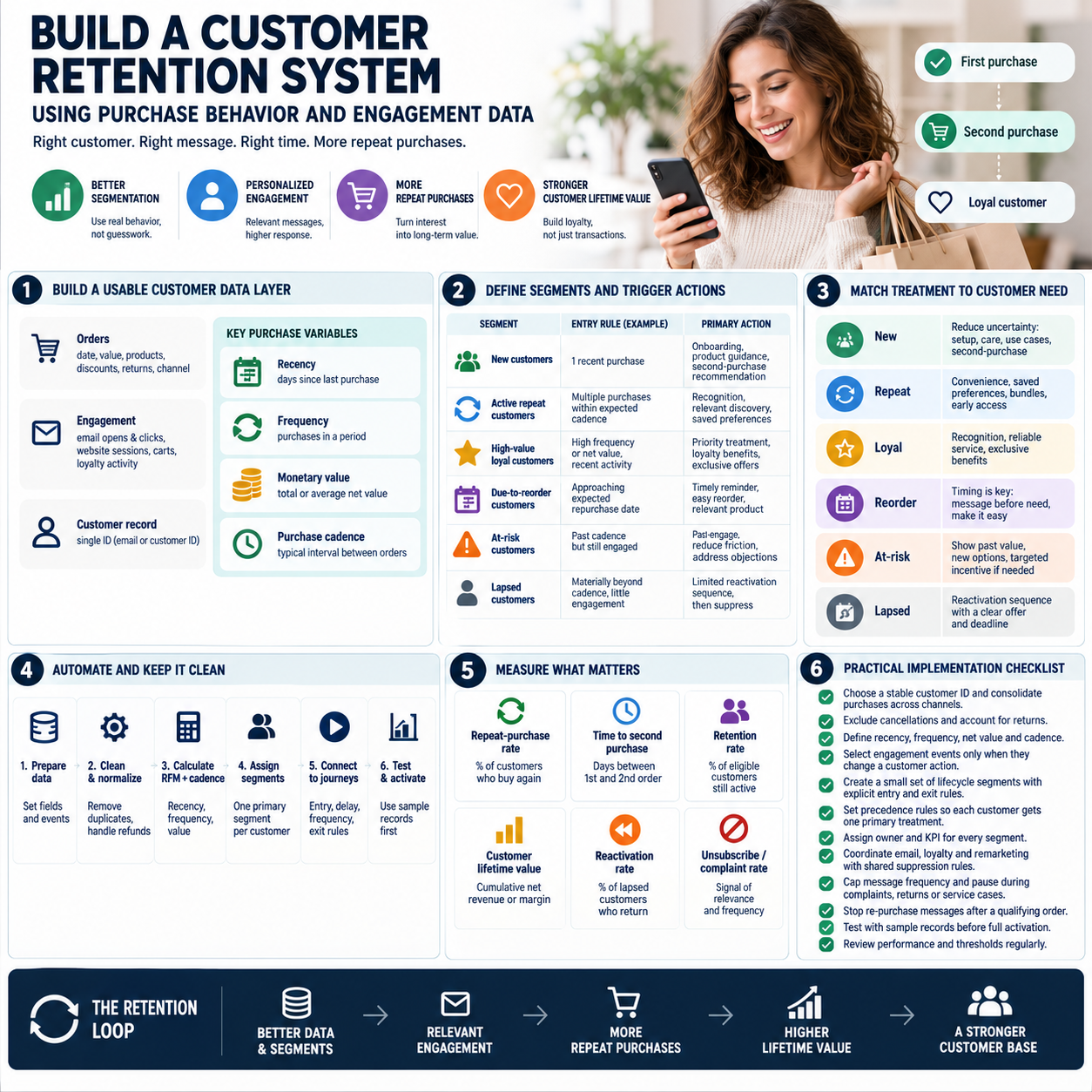
Customer retention becomes manageable when it is treated as an operating system rather than a sequence of promotions. The system should answer three questions every day: which customers need attention, what action fits their current behavior, and whether that action produces another profitable purchase.
A small business does not need an advanced data platform to begin. It needs reliable purchase records, a few engagement signals, explicit segment rules, and automations with clear stop conditions. Consumer purchasing habits provide the behavioral foundation, while customer engagement techniques help translate those signals into useful interactions rather than indiscriminate reminders.
Start with a usable customer data layer
Create one customer record keyed to a stable identifier, usually an email address or customer ID. Bring together order date, order value, products or categories purchased, discounts used, returns, and channel. Then add engagement events such as email clicks, loyalty activity, website sessions, cart creation, and responses to previous campaigns.
Calculate four core purchase variables on a regular schedule:
- Recency: days since the most recent completed purchase.
- Frequency: number of completed purchases within a defined period.
- Monetary value: total or average net order value after refunds.
- Purchase cadence: the typical interval between a customer’s orders.
Cadence makes recency actionable. Forty days without an order may indicate churn for a weekly-use product but normal behavior for an item replaced twice a year. Where possible, calculate cadence by product category and compare each customer with an appropriate baseline.
Do not ingest every available event. Choose signals that can alter a decision. If an email open does not change treatment, it need not drive segmentation. Clicks, product views, loyalty redemptions, and carts often indicate stronger intent, but they should still be interpreted alongside purchases.
Define segments that trigger distinct actions
A useful segment is not simply descriptive. It must have an owner, an entry rule, a treatment, and an exit rule. Begin with a small set that reflects the customer lifecycle.
- New customers: one recent purchase. Guide them toward successful product use and a logical second order.
- Active repeat customers: multiple purchases within their expected cadence. Reinforce convenience, recognition, and relevant discovery.
- High-value loyal customers: strong frequency or net value with recent activity. Protect the relationship with priority treatment and loyalty benefits.
- Due-to-reorder customers: approaching their expected repurchase date. Use a timely replenishment message rather than a generic sale.
- At-risk customers: past their normal cadence but still showing engagement. Reduce friction and address likely objections.
- Lapsed customers: materially beyond expected cadence with little engagement. Run a limited reactivation sequence, then suppress them.
Set thresholds from your own distribution. For example, rank customers by recency, frequency, and net value, then inspect where behavior changes meaningfully. Review the resulting segment sizes before launching anything. A rule that classifies nearly everyone as “at risk” is not a useful rule.
What most people miss
Segment membership must be mutually prioritized. A valuable customer can simultaneously qualify as loyal, due to reorder, and at risk. Without precedence rules, that person may receive three conflicting campaigns. Establish an order such as service recovery first, transactional lifecycle messages second, retention journeys third, and broad promotions last. Recalculate membership after purchases and key engagement events so customers leave obsolete journeys promptly.
Match treatment to the customer’s likely need
Design one primary objective for each segment. New-customer communication should reduce uncertainty: setup guidance, care instructions, use cases, and a second-purchase recommendation based on the first order. Active repeat buyers may benefit from saved preferences, loyalty progress, bundles, or early access. High-value customers require recognition and reliable service more than constant discounts.
For due-to-reorder customers, timing is the value proposition. Trigger the message shortly before the predicted need, present the relevant product, and make repurchasing easy. At-risk customers need a different sequence: remind them of prior value, surface complementary or updated options, and reserve an incentive for customers who do not respond to non-discount messaging.
Coordinate channels by role. Email can carry education and product context. A loyalty program can recognize sustained behavior. Remarketing can reinforce a recently viewed or abandoned item, but it should not continue after purchase. Use suppression rules so a customer in an active service case, return process, or post-purchase onboarding flow is not simultaneously pushed to buy again.
Build the automation and measurement loop
Implement the system in a simple sequence. First, document fields and event definitions. Second, clean duplicate identities and normalize completed orders, cancellations, and refunds. Third, calculate recency, frequency, value, and cadence. Fourth, assign each customer to one prioritized segment. Fifth, connect each segment to one journey with entry, delay, frequency, and exit rules. Finally, test every path using sample customer records before activation.
Measure outcomes at segment and journey level, not only across the entire customer base. Core KPIs include:
- Repeat-purchase rate: the share of customers who complete another purchase during the measurement window.
- Time to second purchase: the interval between first and second completed orders.
- Retention rate: the share of eligible customers who remain active under your cadence definition.
- Customer lifetime value: cumulative net revenue or, preferably, contribution margin associated with a customer over time.
- Reactivation rate: the share of lapsed customers who return after entering a reactivation journey.
- Unsubscribe, complaint, and suppression rates: indicators that contact pressure or relevance is deteriorating.
Use a holdout group where volume permits. Compare eligible customers who receive a journey with similar customers who do not. Revenue attributed to clicks alone can overstate impact because some customers would have purchased anyway. Track incremental repeat orders, net revenue, and margin after incentives.
Practical implementation checklist
- Choose a stable customer ID and consolidate completed purchases across channels.
- Exclude cancellations and account for returns when calculating customer value.
- Define recency, frequency, net value, and purchase cadence in writing.
- Select engagement events only when they can change a customer action.
- Create a small set of lifecycle segments with explicit entry and exit rules.
- Set precedence rules so each customer receives one primary retention treatment.
- Give every segment one objective, one journey owner, and one core KPI.
- Coordinate email, loyalty, and remarketing through shared suppression rules.
- Cap message frequency and pause promotions during complaints, returns, or service cases.
- Stop replenishment and remarketing messages immediately after a qualifying purchase.
- Test identities, triggers, delays, links, incentives, and exits with sample records.
- Review repeat-purchase rate, lifetime value, reactivation, margin, and opt-outs by segment.
- Use holdouts or controlled tests to distinguish incremental retention from purchases that would occur anyway.
- Revisit cadence thresholds and journey performance on a fixed monthly or quarterly schedule.