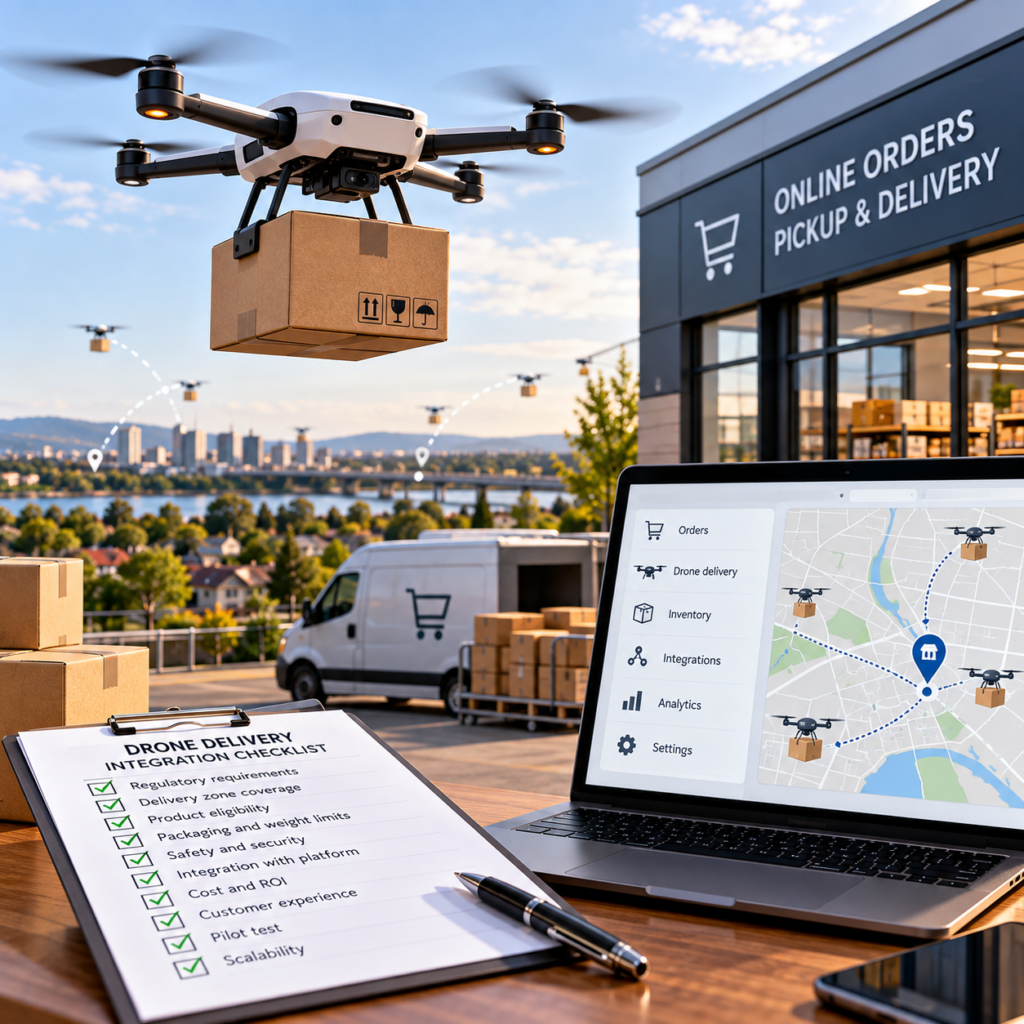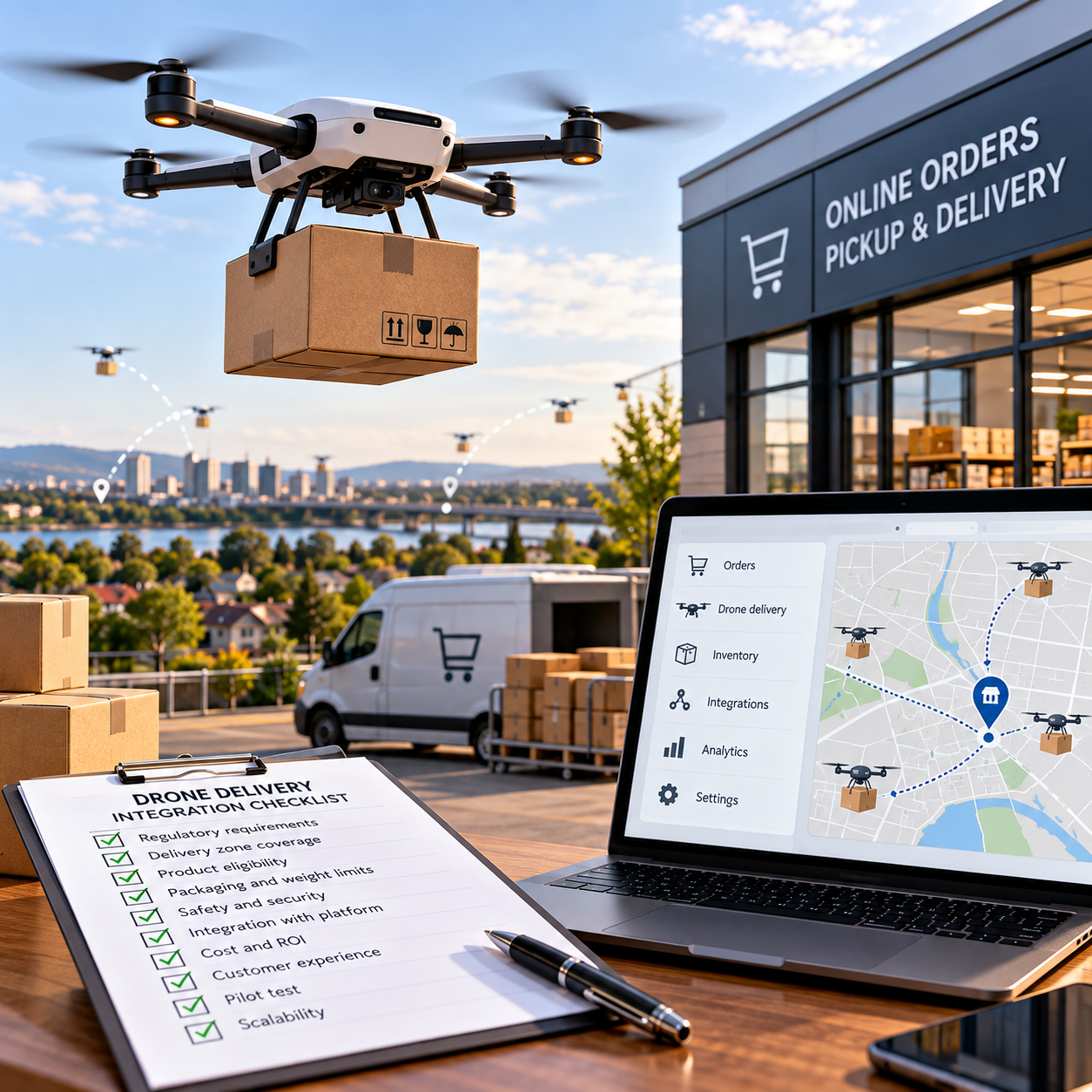
Amazon’s plans to expand its drone-delivery reach sixfold and launch the service in metro Atlanta, Chicago and Cleveland make aerial fulfilment harder for e-commerce operators to dismiss as a distant experiment. As reported by Supply Chain Dive, the expansion signals broader availability, but it does not mean drone delivery is automatically suitable for every merchant, product or destination.
The immediate task is not to build a drone programme in anticipation of universal coverage. It is to identify the narrow combinations of orders, customers and locations where aerial delivery might create enough value to justify the operational complexity. Merchants also need to define how the channel would appear in their order systems, what customers must do to receive an order and who bears responsibility when a flight cannot be completed.
Begin with the order, not the aircraft
A merchant should first map its catalogue and order history against the eligibility rules supplied by the prospective drone operator. Those rules may cover package characteristics, product restrictions, destination coverage and delivery-site conditions. Operators’ actual requirements should govern the assessment; merchants should not assume limits based on demonstrations or services in other markets.
Catalogue screening needs to occur at SKU and basket level. An individually eligible item may become ineligible when combined with another product, special packaging or promotional insert. Relevant questions include:
- Can the product travel safely in its normal retail packaging, or does it require additional protection?
- Is the item fragile, temperature-sensitive, regulated, hazardous or especially vulnerable to movement?
- Can a mixed basket be delivered intact, or must it be split between drone and conventional fulfilment?
- Does the order originate at a facility connected to the service area?
- Can the promised delivery destination satisfy the operator’s handoff requirements?
Merchants should create a live eligibility flag rather than a one-time list. Availability can depend on inventory location, basket composition, address and service status. A product-level badge saying “drone eligible” is misleading if the option disappears after the customer adds another item or enters an uncovered address.
Define where aerial delivery adds commercial value
Speed alone is not a business case. Drone delivery is most relevant when a customer values urgency, the order is operationally suitable and a faster conventional option is unavailable, less predictable or less attractive. Potential use cases could include urgently needed replacement items, time-sensitive household products or small purchases whose value comes from rapid arrival. These are hypotheses for merchants to test, not claims about Amazon’s service scope.
Compare the channel with same-day courier, local van delivery and collection using the same criteria: total fulfilment cost, geographic reach, cutoff times, delivery predictability, basket eligibility, customer effort and exception rates. Avoid comparing an ideal drone flight with the average performance of another channel. The fair comparison is the complete customer journey, including picking, dispatch, failed attempts, support contacts and refunds.
A controlled analysis can segment historical orders by urgency signals, eligible basket characteristics and destination. That reveals the addressable share of demand without presuming customers will select the option. Merchants can then test willingness through surveys, checkout experiments or limited pilots, while clearly distinguishing a hypothetical service from an available one.
Make eligibility a real-time checkout decision
Drone delivery should be offered only after the system has confirmed the whole order can use it. The decision engine may need inputs from the product information system, inventory and order-management platforms, warehouse location, address validation and the operator’s availability interface.
Before integration, document how the following states will be represented: eligible, temporarily unavailable, destination unsupported, basket incompatible, awaiting confirmation, dispatched, interrupted, completed and failed. Each state should have an owner and an approved customer message.
The checkout presentation must explain what the customer is choosing without overstating certainty. It should show the applicable delivery window or service promise provided by the operator, any preparation required at the destination and what happens if conditions prevent completion. If an order will be split, disclose that before payment and identify which items will arrive through each channel.
Merchants should also determine when the delivery method becomes locked. A stock substitution, address correction or fraud review could invalidate eligibility after checkout. The system needs a rule for whether to request customer approval, switch automatically to another method or cancel the affected item.
Design the receiving experience and support script
Aerial delivery can require customers to follow destination-specific instructions. The merchant should reproduce only current, operator-approved guidance and place it at several points: checkout, confirmation, pre-arrival notification and order tracking. Critical instructions must not be buried in general terms and conditions.
Customer communications should answer practical questions: Where will the package be placed? Does the recipient need to be present? What conditions must the delivery area meet? How will arrival be signalled? What should the customer do if the designated area is obstructed? The exact answers will vary by operator and location, so they must be verified rather than inferred.
Support teams need visibility into more than a generic “shipped” status. Agents should be able to see whether the order was accepted by the drone service, whether an interruption occurred and what recovery action is underway. Scripts should separate problems controlled by the merchant—such as wrong items or poor packaging—from flight availability and destination issues handled with the operator.
Set exception, refund and fallback rules before launch
Weather and other service interruptions are foreseeable operating conditions, even if their timing is not predictable. A pilot should therefore be judged partly on recovery quality, not just successful deliveries.
Agree in advance what happens when a delivery cannot proceed before dispatch, is interrupted after dispatch or cannot be completed at the destination. Possible responses include holding the order, transferring it to conventional rapid delivery, rescheduling it or cancelling and refunding it. The correct response depends on product condition, customer promise and the operator agreement.
Responsibility must be explicit. Determine who notifies the customer, who authorises a fallback, how proof of delivery is recorded, how lost or damaged packages are investigated and whether delivery charges are refunded when the original method fails. Customer-service policy should also cover perishable or urgent items for which a delayed replacement no longer solves the customer’s need.
Test these paths with simulated failures before exposing the option publicly. A technically successful booking interface is not sufficient if a service interruption leaves the order stranded between systems.
Use a gated pilot rather than betting on future coverage
Amazon’s announced expansion is an immediate reason to evaluate readiness in relevant markets, especially for merchants whose customers or fulfilment operations overlap the planned metro areas. It is not evidence that every postcode, product category or external merchant will gain access on a particular timetable. Wider merchant participation, new commercial models and broader geographic coverage remain future possibilities unless confirmed by the provider.
A responsible pilot should have narrow eligibility, a defined customer group and measurable exit criteria. Track successful completion, fallback frequency, support contacts, refunds, order splitting, customer selection and repeat use. Compare these results with conventional rapid delivery for similar orders rather than with network-wide averages.
Before integration, merchants should be able to answer five questions: Which exact baskets and destinations qualify? What customer problem does the channel solve better? Can every eligibility and status change flow through existing systems? Are receiving instructions clear? Is there an owned, tested recovery path for every failure state? If any answer remains vague, the next step is process design or a limited test—not a broad checkout launch.