Retailers increasingly depend on electronic data interchange (EDI) to move purchase orders, acknowledgements, shipment notices, invoices, and related documents between trading partners. When a vendor sends incomplete, late, duplicated, or incorrectly mapped data, the failure does not remain inside the supplier’s system. It becomes a retailer problem: orders require manual intervention, receiving teams cannot reliably match shipments, invoices enter dispute queues, and inventory records lose accuracy.
A sponsored Retail Dive article presents vendor EDI compliance as an increasingly firm retail requirement. That framing is a useful news peg, but making compliance enforceable requires more than adding penalties to a contract. Procurement, operations, and IT leaders need a staged program that distinguishes critical failures from minor defects, gives vendors a workable route to readiness, and protects supply continuity while standards are tightened.
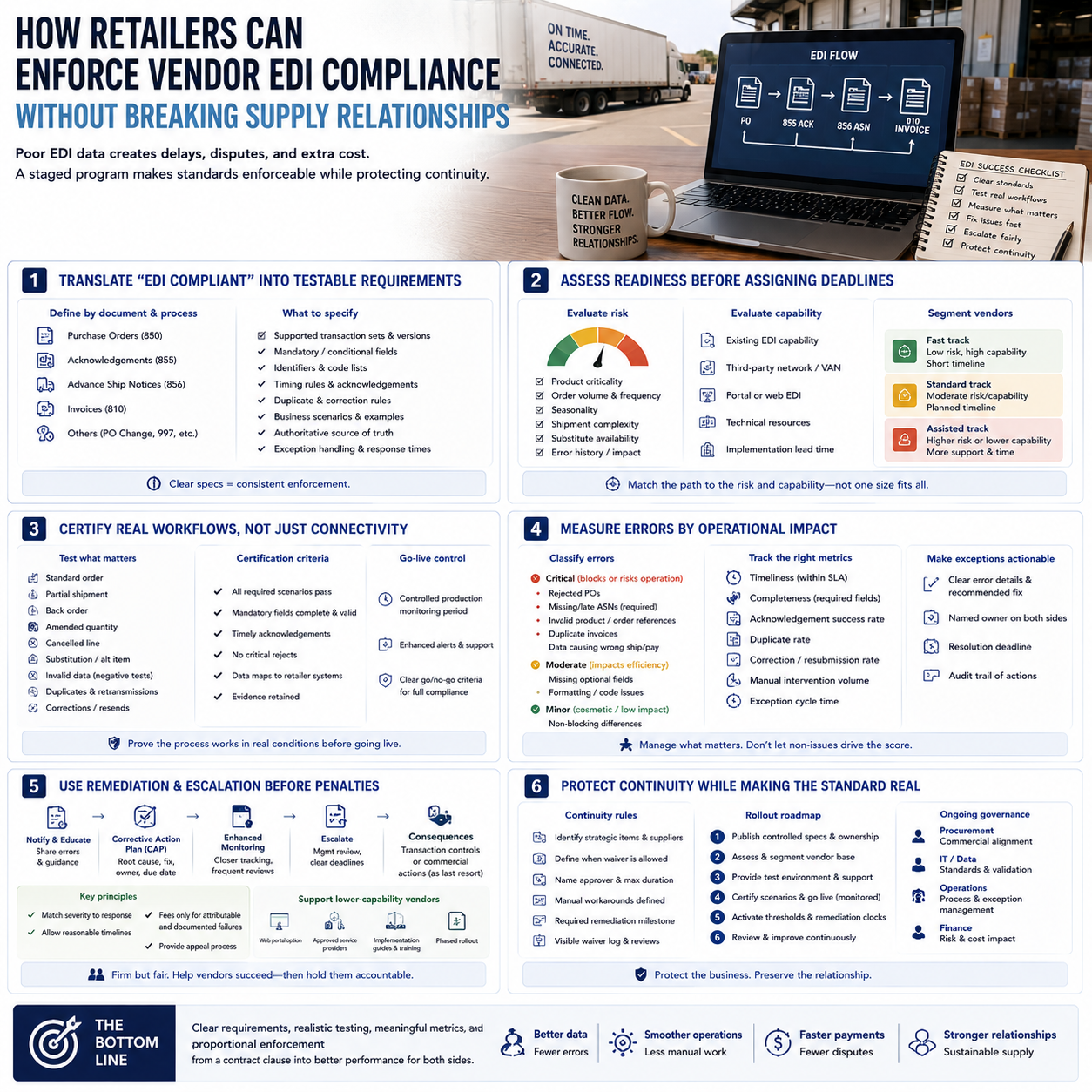
Translate “EDI compliant” into testable requirements
A mandate cannot be enforced consistently if the underlying requirement is ambiguous. Retailers should define compliance for each document type and business process rather than asking vendors to be generically “EDI capable.” A supplier might successfully receive purchase orders but be unable to return acknowledgements within the required window or produce advance ship notices containing the fields needed at receiving.
The requirements pack should identify supported transaction sets and versions, mandatory and conditional fields, identifiers, code lists, timing rules, acknowledgement expectations, duplicate controls, and the retailer’s approach to corrections. It should also show how transactions connect. For example, the purchase-order number and line references used in a shipment notice or invoice must correspond to the original order in a defined way.
Technical specifications alone are insufficient. Add business examples covering routine orders, substitutions, partial shipments, back orders, cancellations, quantity changes, and returns where relevant. State which system is authoritative when records conflict, who owns each exception, and how quickly the vendor must respond.
Version control matters as well. Every specification should have an owner, effective date, change log, and notice period. Retailers undermine enforceability when undocumented mapping changes create failures that are then attributed to vendors.
Assess readiness before assigning a compliance deadline
Uniform standards do not require uniform onboarding paths. Segment vendors according to operational risk and implementation capability before setting deadlines or consequences.
Risk factors can include product criticality, order frequency, seasonal importance, shipment complexity, current error history, and the availability of substitute suppliers. Capability factors include whether the vendor already uses EDI, relies on a third-party network, needs a web portal, or has limited technical support.
This produces practical cohorts. A high-volume vendor with established EDI capability may move quickly into certification. A smaller supplier that is commercially important but lacks integration resources may need a portal, managed-service option, or longer implementation period. A vendor with repeated errors in a process that affects receiving or payment may deserve earlier intervention even if its total volume is modest.
The assessment should record the documents each vendor can exchange, its software or service provider, testing contact, internal business owner, expected lead time, and known gaps. Procurement should validate commercial importance; operations should identify process risk; IT should evaluate connectivity and mapping. No single function has enough information to set a responsible deadline alone.
Certify real workflows, not just successful connectivity
A test environment should be separate from production and should reproduce the retailer’s validation rules closely enough to make certification meaningful. Passing a connectivity test only proves that a message can travel between endpoints. It does not prove that the document is complete, timely, correctly mapped, or usable by downstream systems.
Build test cases around actual failure modes. Vendors should demonstrate successful handling of standard orders and relevant exceptions, such as amended quantities, split shipments, cancelled lines, invalid product identifiers, retransmissions, and corrected documents. Negative testing is important: the process should show what happens when a required field is absent or a duplicate message arrives.
Certification criteria should specify which scenarios must pass, which warnings are acceptable, and what evidence is retained. After formal testing, use a controlled production period with closer monitoring before declaring the vendor fully compliant. This catches differences between sample data and live operating conditions without exposing the entire flow to unmanaged risk.
Retailers should also control their own changes. If a specification, endpoint, or validation rule changes, affected vendors may need regression testing. Compliance cannot reasonably mean permanent certification against a moving, undocumented target.
Measure errors according to their operational impact
An overall pass rate can conceal the defects that matter most. Define error thresholds by document type, severity, and consequence instead.
Critical errors might include rejected purchase orders, missing shipment notices where they are required for receiving, unusable product identifiers, duplicate invoices, or data that could cause an incorrect shipment or payment. Lower-severity issues might include optional information that does not block processing. The exact classification should reflect the retailer’s workflows rather than a borrowed scorecard.
Track more than message acceptance. Useful measures include timeliness, completeness of mandatory fields, acknowledgement status, duplicate frequency, correction frequency, and the amount of manual handling created. Attribute failures carefully: defects can originate in retailer master data, mapping rules, networks, or internal systems as well as at the vendor.
Exception handling needs a named route. Each alert should identify the failed rule, affected transaction, required action, owner, and resolution deadline. Vendors should be able to view or receive actionable error information instead of a generic rejection code. Retail teams also need procedures for releasing urgent orders, receiving essential goods, or processing valid invoices while a technical defect is investigated.
Use remediation and escalation before financial penalties
Proportionate enforcement makes standards credible without turning every defect into a supplier dispute. A staged ladder can begin with notification and technical guidance, move to a documented corrective-action plan, then introduce enhanced monitoring, executive escalation, temporary transaction controls, or commercial consequences for persistent and attributable non-compliance.
Remediation timelines should reflect severity. A critical defect affecting active orders may require immediate containment, while a non-blocking mapping issue can follow a planned correction cycle. The plan should state the root cause, interim control, permanent fix, responsible parties, test requirement, and target date. Repeated extensions should require approval rather than becoming the default.
Fees or chargebacks, where contracts permit them, should be tied to clearly documented requirements and reliable evidence. They should not punish a vendor for retailer-caused failures or for a specification changed without reasonable notice. An appeal route helps resolve disputed attribution before commercial action damages the relationship.
Smaller vendors require particular care. Offering a web-based option, approved service-provider route, implementation documentation, office hours, or phased document coverage can preserve access without weakening the underlying data standard. The objective is not to excuse poor data indefinitely; it is to provide a feasible compliance path.
Protect continuity while making the standard real
Before enforcement begins, establish continuity rules for strategically important products and suppliers. Decide who can approve a temporary waiver, how long it lasts, what manual control replaces the failed transaction, and what remediation milestone is required. Waivers should be visible, time-limited, and reviewed; otherwise exceptions become a permanent parallel process.
A practical rollout starts by publishing controlled specifications and assigning owners. Next, assess and segment the vendor base, prioritising high-risk transaction flows. Provide a representative test environment, certify business scenarios, and monitor an initial production period. Only then should the retailer activate documented thresholds, remediation clocks, and escalating consequences.
Governance should continue after launch. Procurement can own supplier communication and contractual alignment, IT can own technical standards and validation, and operations can verify whether the program is reducing manual work and order disruption. Regular reviews should examine recurring errors, disputed causes, expiring waivers, vendor support needs, and retailer-side defects.
EDI compliance becomes enforceable when vendors know precisely what success means, can prove readiness, receive actionable feedback, and face predictable consequences for failures within their control. That approach is firmer than a vague contractual mandate—and less likely to interrupt the supplier relationships on which retail continuity depends.