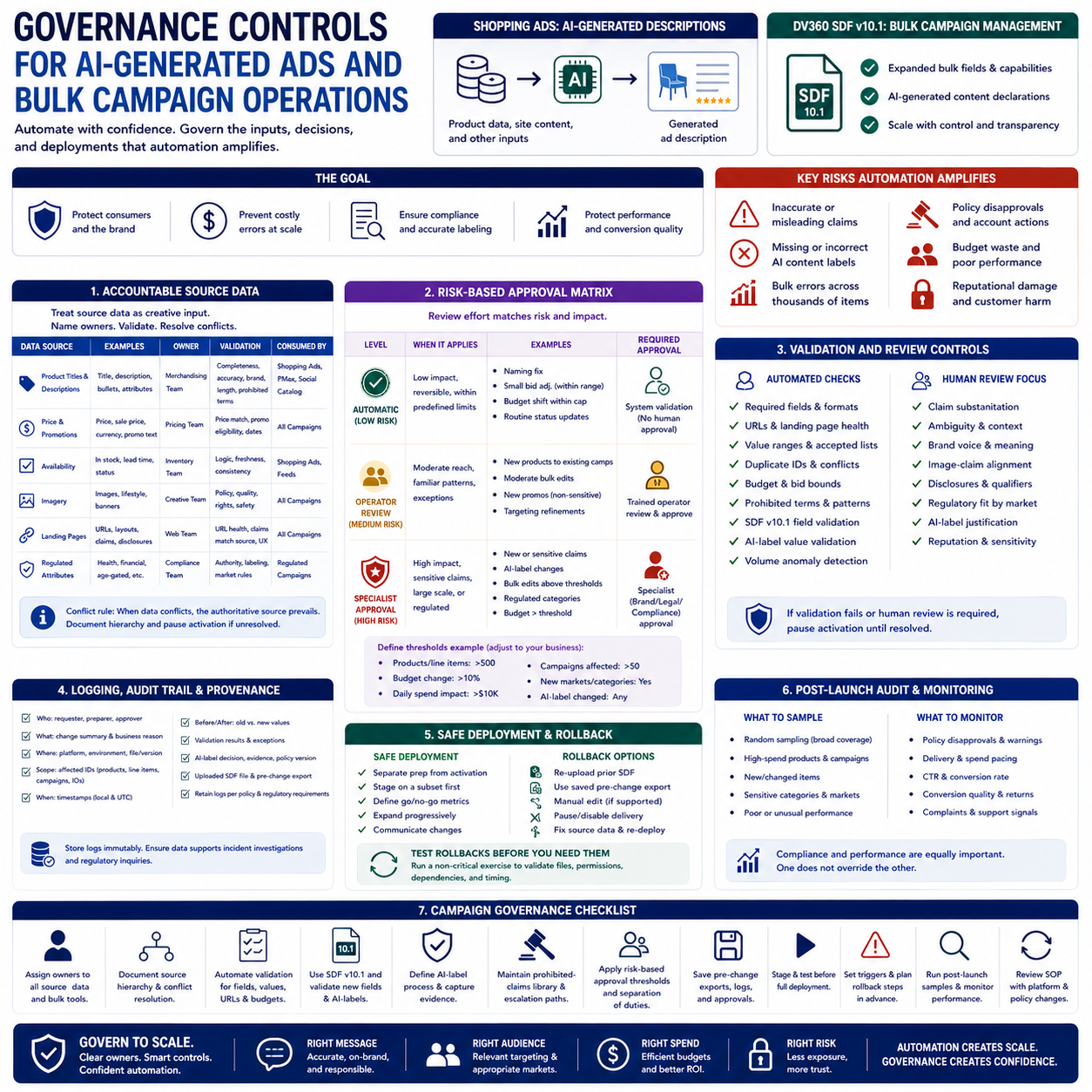
AI-generated ad copy and bulk campaign tools create the same operational challenge at different scales: a small input or configuration error can be reproduced across many impressions, products, or line items before anyone notices. Google’s testing of AI-generated descriptions in Shopping ads makes product data a creative input, while Display & Video 360 Structured Data Files (SDF) v10.1 adds bulk-management fields, including fields connected to AI-generated content declarations.
The right response is not to block automation. It is to govern the inputs, decisions, and deployment paths that automation amplifies. Teams need named owners, risk-based approval thresholds, reliable logs, and a tested rollback process. The following framework can be incorporated into campaign-management standard operating procedures without forcing every routine edit through the same review queue.
Start with accountable source data
Shopping automation turns feed attributes, landing-page content, and other product information into potential messaging inputs. That means feed governance is now creative governance. Assign an accountable owner for each source: product titles and descriptions, price and availability, promotional language, imagery, landing pages, and regulated-product attributes. “Marketing” is not an owner; use a role or named team with authority to correct the source.
Create a source register showing where each field originates, who may edit it, how it is validated, and which campaigns consume it. Define a hierarchy for conflicts. If the feed, landing page, and internal product system disagree, operators should know which source prevails and whether activation must pause.
Automate checks for missing fields, formatting, broken URLs, price discrepancies, unexpected volume changes, and disallowed terms. Human reviewers should retain responsibility for substantiation, ambiguity, brand meaning, and context-sensitive claims. A technically valid product description can still be misleading or off-brand.
Use risk-based approval thresholds
Do not review every operation identically. Classify changes by reach, reversibility, claim sensitivity, and financial exposure. Low-risk actions might include a validated naming update or a small bid adjustment within an approved range. High-risk actions include publishing new claims, changing AI-content declarations, editing many line items, entering regulated categories, or modifying settings that affect large budgets.
A workable approval matrix has three levels:
- Automatic: Pre-approved, reversible changes that pass validation and remain within explicit volume and budget limits.
- Operator review: Changes with moderate reach, familiar creative patterns, or exceptions that require inspection but not legal approval.
- Specialist approval: New or sensitive claims, regulated products, material brand changes, AI-label uncertainty, or bulk operations above defined spend and object-count thresholds.
Set thresholds in measurable terms: number of products, campaigns, insertion orders, or line items affected; percentage of budget changed; markets entered; and expected spend before the next review. Separate preparation from activation for high-risk bulk files so the person uploading or generating a file cannot be its only approver.
Separate automatable controls from human judgment
Automation is effective at detecting known patterns. Use it to validate required fields, accepted values, identifiers, naming conventions, budget bounds, duplicate records, prohibited phrases, destination URLs, and version compatibility. For SDF v10.1, validation should also confirm that newly supported fields are intentionally populated and that AI-related declarations use the correct permitted values.
Human review remains necessary where meaning matters. Reviewers should assess whether product descriptions overstate benefits, imply unsupported comparisons, omit a material qualification, or create reputational risk when combined with an image. Maintain a prohibited-claims library covering absolute claims, unsubstantiated superlatives, guarantees, health or financial outcomes, competitor references, and market-specific restrictions. It should contain escalation instructions, not merely blocked keywords.
What most people miss
AI labeling is not just a creative-team responsibility. In bulk workflows, a declaration may be represented as a field whose value can be copied across thousands of records. The governance control therefore belongs in both the content policy and the file-generation process. Record who determined the label, the evidence used, the applicable platform definition, and the file version carrying the declaration. If provenance is unclear, stop the upload rather than defaulting to a convenient value.
Build logging and rollback into deployment
Every production change should leave a record that can reconstruct intent and scope. Capture the requester, preparer, approver, timestamp, platform, file or job version, affected object IDs, old and new values, validation results, and business reason. Preserve the exact uploaded SDF and, where feasible, a pre-change export. For AI-generated Shopping descriptions, log detected examples, review outcomes, source-data corrections, and escalation decisions.
Rollback must be designed before activation. Define which changes can be reverted through a prior file, which require manual platform edits, and which can only be mitigated by pausing delivery or correcting source data. Assign an incident owner and establish triggers such as incorrect claims, widespread disapprovals, missing labels, budget anomalies, or a sharp deterioration in conversion quality.
Use staged deployment for high-impact changes: test on a limited set of products or campaign objects, observe results, and expand only after checks pass. A rollback exercise using a non-critical campaign can reveal missing exports, permissions, or dependencies before an actual incident.
Audit outcomes, not only configurations
Pre-flight validation cannot show every rendered creative or downstream combination. Establish sampling audits after launch. Use random samples for broad coverage and targeted samples for high-spend products, sensitive categories, new markets, recently changed records, and items with unusual performance.
Inspect the live ad experience where available, not only the input file. Compare generated descriptions with approved product facts and landing pages. In DV360, confirm that uploaded values were accepted as intended and that declarations, targeting, budgets, and status fields match the change request.
Monitor performance alongside compliance. Track disapprovals, policy warnings, delivery, spend pacing, click-through behavior, conversion rate, conversion quality, return metrics appropriate to the business, and complaint or support signals. Use alert bands and minimum sample requirements rather than reacting to every short-term fluctuation. Performance improvement never overrides a substantiation or labeling failure.
Campaign-governance checklist
- Assign a named owner to every product-data and bulk-management source.
- Document the authoritative source when feed, site, and internal data conflict.
- Add automated validation for required fields, URLs, values, duplicates, budgets, and prohibited phrases.
- Update SDF procedures to require the intended version and validate v10.1 fields.
- Document AI-label decisions and escalate uncertain classifications before upload.
- Maintain prohibited-claims rules with market, category, and escalation guidance.
- Define automatic, operator-review, and specialist-approval thresholds.
- Require separation of preparation and approval for high-risk bulk changes.
- Save pre-change exports, uploaded files, validation reports, approvals, and affected IDs.
- Stage high-impact deployments on a limited inventory or object set.
- Set pause and rollback triggers for claims, labels, disapprovals, spend, and performance.
- Run post-launch random and risk-based samples of rendered outputs.
- Compare performance with compliance and customer-quality indicators.
- Review the SOP whenever platform fields, AI definitions, or internal policies change.