For a small business, accounting software is not just a bookkeeping tool. It becomes the system that shapes how quickly you can invoice, reconcile cash, track tax obligations, and prepare for funding or expansion. The wrong choice can create manual work that grows with revenue instead of disappearing.
The practical question is not which package has the longest feature list. It is which package fits your current workflow, your transaction volume, and the level of financial visibility you need over the next 12 to 24 months.
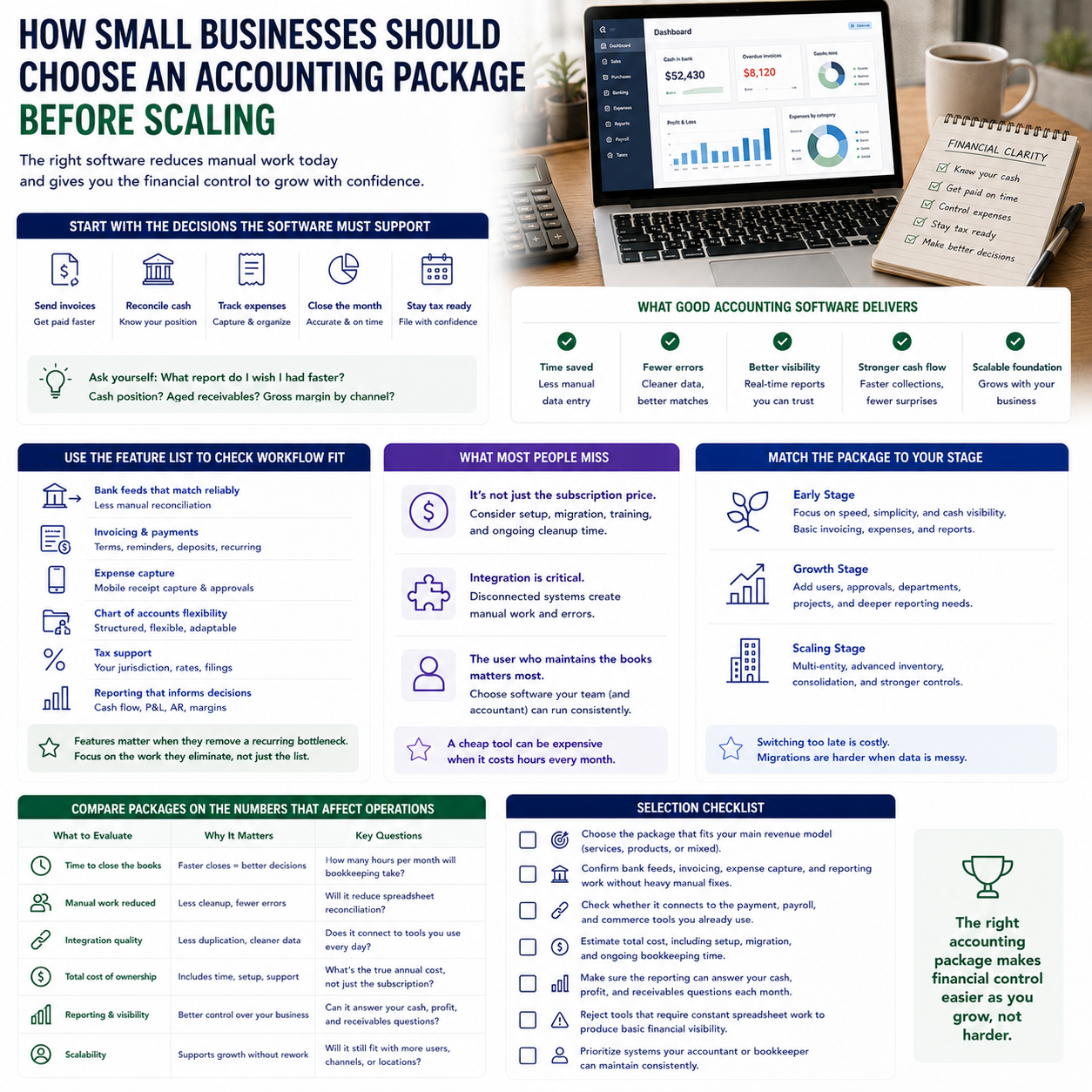
Start with the decisions the software must support
The best accounting package is the one that supports the business decisions you actually make every week. If you are a service business, you may need clean invoicing, deposits, recurring billing, and simple project tracking. If you sell physical products, inventory, bank reconciliation, and sales tax handling may matter more.
Before comparing products, map the operational moments that create accounting friction. Common ones include sending invoices, matching payments, tracking expenses, collecting receipts, and closing the month. If a package does not reduce work in those areas, it will not pay for itself, even if the interface looks polished.
One useful test is to ask: what report do I wish I had faster? For many founders, that report is cash position, aged receivables, or gross margin by channel. A package that produces those numbers without spreadsheet cleanup is usually worth a closer look.
Use the feature list to check workflow fit, not prestige
The article on accounting packages highlights how many options exist, but small businesses should compare them through operational fit. Focus on whether the software handles your everyday process with as few workarounds as possible.
Look for these core functions:
- Bank feeds that reliably match transactions without constant manual correction
- Invoicing that supports your payment terms and reminder workflow
- Expense capture that lets staff submit receipts quickly from mobile
- Chart of accounts flexibility without requiring an accountant to rebuild it every quarter
- Tax support that reflects your jurisdiction and filing needs
- Reporting that gives a usable view of cash flow, profit, and outstanding invoices
Features matter most when they remove a recurring bottleneck. For example, if your team loses time chasing receipt images at month-end, a package with better mobile expense capture may save more labor than a cheaper subscription saves in fees.
What most people miss
Most founders compare subscription prices and stop there. That misses the real cost structure.
The true cost includes setup time, cleanup time, migration effort, and the hours spent teaching the software to your team. A low monthly fee can become expensive if you need an outside bookkeeper to fix exports, rebuild reports, or manually import data from other systems.
Another overlooked factor is integration. If your accounting package does not connect cleanly to your payment processor, e-commerce platform, payroll tool, or CRM, you end up recreating a system by hand. That means more chances for errors in revenue recognition, fees, and taxes.
Finally, think about the person who will actually maintain the books. A founder may tolerate a complicated setup for a few months, but a bookkeeper or operations manager will need a system they can run consistently. Simplicity is not a luxury if you want monthly numbers to arrive on time.
Match the package to the stage of the business
At very early stage, a business often needs basic invoicing, expense tracking, and a clean view of cash in and out. A package that is fast to implement may be better than one with advanced features you will not use yet.
As the business grows, priorities change. You may need multi-user controls, approval flows, department tracking, or integration with sales and inventory systems. That is when switching too late becomes a problem. The data migration, training, and process changes can be disruptive if your books are already messy.
For e-commerce operators, the accounting package must handle more than simple invoices. Payment fees, refunds, marketplace settlements, and inventory movement can distort reports if the software is not set up carefully. In that case, the question is not whether the package is popular, but whether it can support the business model without hidden manual work.
Compare packages on the numbers that affect operations
To compare options properly, founders should look beyond monthly subscription fees and assess operational cost. A package that reduces month-end close time, shortens invoice collection, or cuts reconciliation work can be cheaper in practice even if the sticker price is higher.
Think in terms of business outcomes:
- How many hours per month will bookkeeping take with this package?
- Will it reduce the need for manual spreadsheet reconciliation?
- Can your accountant or bookkeeper work inside it without extra exports?
- Does it support the reports you use to make spending decisions?
- Will it still fit if you add channels, users, or locations?
These questions help you compare tools based on operating leverage rather than feature marketing. A package that improves visibility and reduces cleanup work can give a founder better control over cash, vendor payments, and tax readiness.
Use a short selection checklist before you commit
If you are choosing an accounting package now, keep the decision narrow and practical. The goal is not to find the perfect platform. The goal is to pick the one that supports your current workflow and does not block growth.
- Choose the package that fits your main revenue model: services, product sales, or mixed operations.
- Confirm that bank feeds, invoicing, expense capture, and reporting work without heavy manual fixes.
- Check whether it connects to the payment, payroll, and commerce tools you already use.
- Estimate total cost, including setup, migration, and ongoing bookkeeping time.
- Make sure the reporting can answer your cash, profit, and receivables questions each month.
- Reject tools that require constant spreadsheet work to produce basic financial visibility.
- Prioritize systems your accountant or bookkeeper can maintain consistently.
For a small business, the right accounting package is the one that makes financial control easier as the business becomes more complex, not harder.