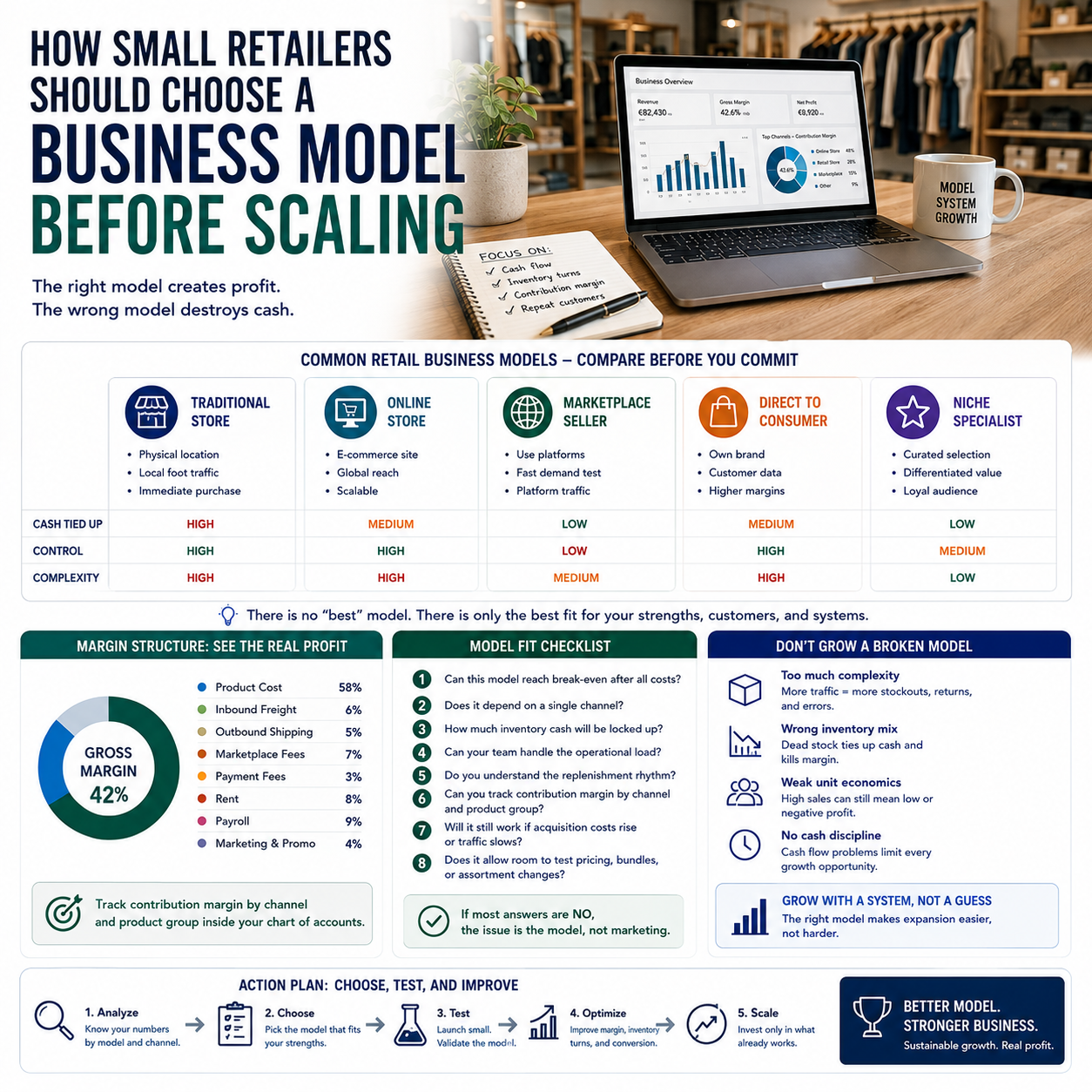
Retail growth is often framed as a marketing problem, but the real constraint is usually the business model. A store that sells the wrong mix of products, carries the wrong amount of inventory, or depends on the wrong sales channel can look busy while quietly leaking cash. The decision is not whether to grow, but which retail model can support profitable growth with the team and systems you actually have.
Start with the model, not the merchandise
The candidate source on retail business models is the right place to begin because model choice shapes everything downstream: cash conversion, buying frequency, storage needs, staffing, and how quickly you can test new offers. A traditional storefront, a hybrid online-offline setup, a direct-to-consumer brand, a marketplace seller, or a niche specialist all carry different operational loads.
If you choose a model that depends on constant foot traffic, you need a location strategy and in-store execution discipline. If you choose a model that depends on online acquisition, you need margin room for paid traffic, returns, fulfillment, and customer support. The wrong fit is expensive because it forces you to solve the wrong problems with more effort instead of better design.
Compare models by cash, control, and complexity
A useful way to evaluate retail models is to look at three operator questions: how much cash is tied up, how much control you have over demand, and how much complexity the model adds to daily operations.
For example, a curated niche store may need less assortment breadth, which can simplify purchasing and merchandising. But it may also need stronger brand positioning to win enough volume. A marketplace-first seller can test demand quickly, but fees and platform dependence reduce control. A multi-channel retailer gains reach, but inventory synchronization and returns management become harder.
Instead of asking which model is best in theory, ask which one matches your current strengths. If you are better at sourcing than branding, a specialist buying model may outperform a broad general store. If you are strong in content, community, and repeat purchase behavior, a direct-to-consumer model may be a better path than relying only on walk-in sales.
Use margin structure to decide what you can actually sustain
Retail founders often focus on revenue per month without enough attention to gross margin after channel costs. The model matters because some structures leave room for growth after inventory, shipping, payment fees, rent, and labor; others do not. A model with weaker gross margin can still work, but only if operations are tight and inventory turns are fast.
This is where the article on how to make a chart of accounts becomes operationally useful. A retail business should not bury model-related costs inside broad expense buckets. Separate product cost, inbound freight, outbound shipping, marketplace fees, card processing, rent, payroll, and promotional spend. Once those numbers are visible, you can compare model performance by channel and by product type rather than by intuition.
That accounting structure also helps answer a more practical question: what should be scaled first? If one channel has better contribution margin, the business can expand there before adding complexity elsewhere. If another channel drives volume but weakens cash flow, it may need stricter buying rules or a higher average order value to justify the effort.
What most people miss
The most common mistake is treating retail model selection as a branding choice instead of an operating system choice. Operators may fall in love with the idea of being a boutique, a concept store, or a multi-channel brand, but the real test is whether the model matches replenishment cycles, staffing capacity, and order economics.
This is where the action-plan article on increasing retail sales matters. Sales growth tactics are only useful after the model is stable enough to absorb them. If the model creates too much complexity, more traffic can actually make performance worse by increasing stockouts, returns, or fulfillment errors. In other words, revenue growth without model fit just increases the speed of the problem.
Pick the model that fits your operating reality
For founders and operators, the best retail model is usually the one that can be repeated without adding fragile dependencies. A model should be simple enough to manage, but strong enough to support experimentation in assortment, pricing, and channel mix. The more expensive the mistake becomes, the more important this decision is before scaling.
Use the following criteria before committing to a model or expanding the one you already have:
- Can this model reach break-even with your current gross margin after rent, labor, shipping, fees, and returns?
- Does it depend on a single channel, or can it survive if one sales source slows down?
- How much inventory cash will be locked up at the start of each buying cycle?
- Can your current team handle the operational load without constant firefighting?
- Do you understand the replenishment rhythm well enough to avoid stockouts and dead stock?
- Can you track contribution margin by channel and product group inside your chart of accounts?
- Will the model still work if customer acquisition costs rise or foot traffic softens?
- Does this model give you room to test pricing, bundles, or assortment changes without breaking operations?
If the answer to most of those questions is no, the issue is not marketing. It is the model itself.
Choose the path that makes expansion easier, not harder
The strongest retail models do not just sell well; they make the business easier to operate as it grows. That is the real decision founder-operators need to make. A model that creates cleaner accounting, simpler inventory planning, and better cash discipline will usually outperform one that looks more exciting but is operationally fragile.
Before adding locations, channels, or new product lines, make sure the model is already doing the work of a system. Growth should be an extension of that system, not a way to hide its weaknesses.


