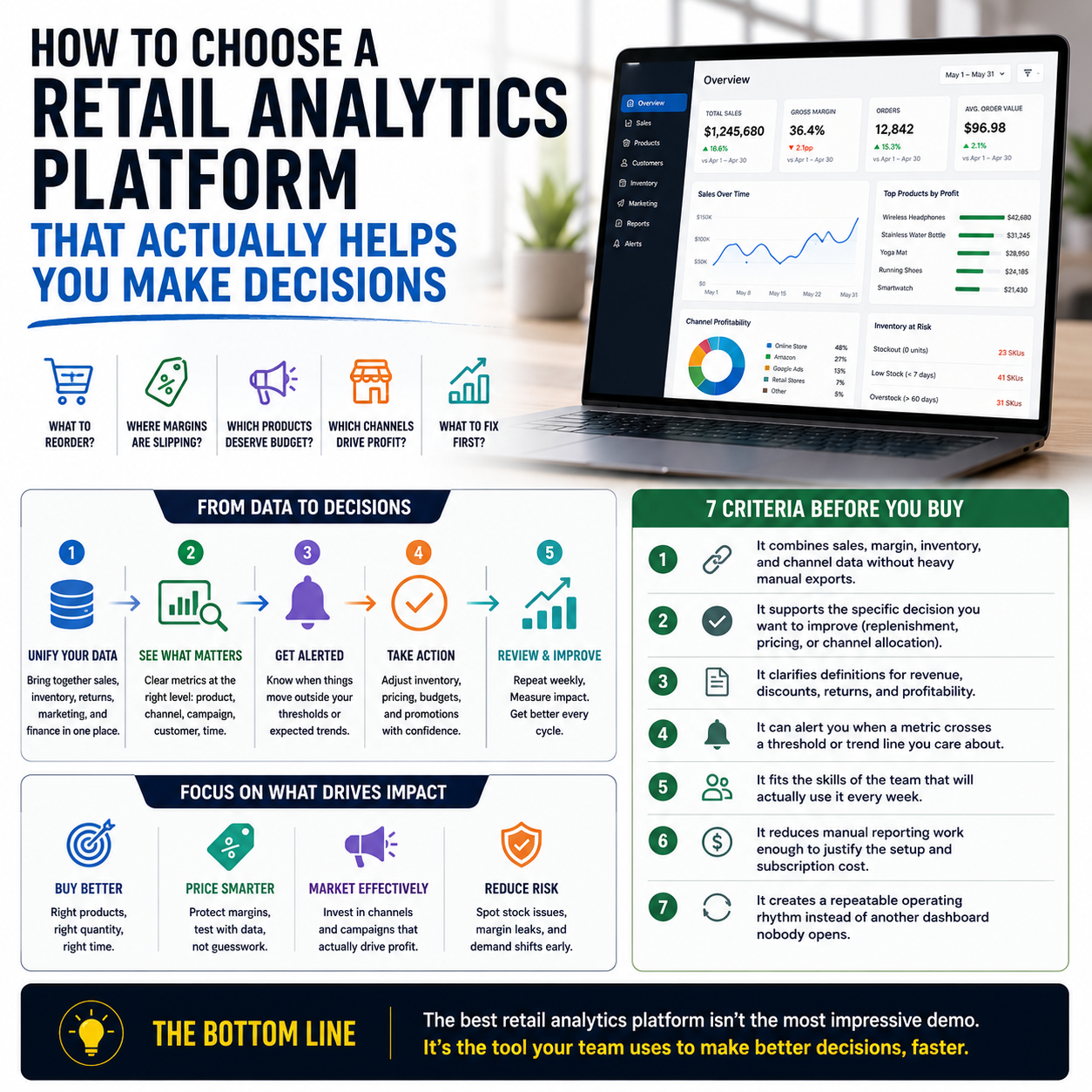
For many small retailers and e-commerce operators, analytics software becomes a reporting layer that looks useful but does not change decisions. The right platform should answer specific questions: what to reorder, where margins are slipping, which products deserve budget, and which channels are producing profitable sales. That means the buying decision should start with workflows, not features.
Start with the decisions you need the software to support
Before comparing platforms, map the decisions that happen every week or month in your business. For a product business, those usually include inventory replenishment, promo planning, channel performance review, and SKU pruning. If a tool cannot support those decisions with data you trust, it is just a nicer interface over spreadsheet work.
List the reports your team already builds manually and identify the point where the process breaks. Maybe your team can see sales by SKU but cannot combine that with gross margin, stock cover, returns, or ad spend. That gap is often the real reason to buy analytics software. The buying criterion is not “does it have dashboards?” but “does it reduce manual reconciliation and improve the speed of a specific decision?”
What most people miss
Most platform comparisons focus on surface features like charts, connectors, and visual customization. The real issue is data model quality. If a tool cannot unify product, channel, order, and margin data cleanly, your team will still spend time disputing numbers instead of acting on them.
Another common miss is ownership. Analytics often fails because no one is responsible for keeping the definitions consistent: what counts as net sales, how returns are handled, whether discounts are allocated, and which time zone closes the day. Choose a platform only if you can maintain those definitions without creating a permanent dependency on a technical person.
Separate reporting tools from decision tools
Some platforms are built to display information. Others are built to change an operating workflow. That distinction matters because a reporting tool may be enough for a founder who wants visibility, while a decision tool is better when stock, pricing, or campaign budgets need to be adjusted quickly.
In practice, you want to know whether the platform can do three things: show the right metric at the right level of detail, alert you when performance moves outside a threshold, and make it easy to act on that alert. If the tool only produces dashboards, your team still needs to notice the issue, interpret it, and then act elsewhere. If it supports alerts, annotations, and repeatable views for weekly reviews, it can become part of the operating system.
Compare the tool against your data stack and team size
Retail analytics platforms vary widely in implementation effort. Some work best for businesses with a dedicated analyst or operations lead. Others are designed for owners who need a cleaner view of sales, products, and channels without building internal reporting processes.
Check how the platform connects to your actual stack: store platform, POS, marketplace accounts, ad channels, accounting system, and inventory tools. If data import requires ongoing manual exports, the tool may create more work than it removes. Also look at how many people need access and whether the interface supports different roles. A founder, buyer, and marketing manager rarely need the same default dashboard.
For smaller teams, the best fit is often the platform that reduces the number of separate views you maintain. For larger operators, the better choice may be the one that handles segmentation, product hierarchy, and custom reporting without constant rework.
Price it as an operations expense, not a software subscription
The monthly fee is only one part of the cost. The real expense includes setup time, training time, data cleanup, and the internal labor required to keep the system accurate. A lower-priced tool can be more expensive if it forces your team to rebuild reports every week.
Compare platforms using three cost questions. First, how long will setup take before the team can use it in live decisions? Second, how much manual work disappears after implementation? Third, what workflows become faster or more reliable? If a platform saves only vanity reporting time, the return may not justify the switch. If it reduces inventory errors, bad replenishment, or wasted marketing spend, the business case becomes easier to defend.
Use the platform to tighten the weekly operating rhythm
The best analytics tools are the ones that get used in recurring meetings. A weekly review should not be a tour of charts. It should be a short sequence of decisions: what changed, what needs attention, who owns the fix, and what gets checked next week. That is where retail analytics creates leverage.
Build dashboards around action categories rather than broad reporting themes. For example, a buying view, a margin view, a traffic-to-order view, and a stock-risk view are more useful than a generic business overview. If your team keeps asking the same questions in the same meeting, the platform should make those questions faster to answer and easier to compare over time.
Decision criteria before you buy
- It combines sales, margin, inventory, and channel data without heavy manual exports.
- It supports the specific decision you want to improve, such as replenishment, pricing, or channel allocation.
- It clarifies definitions for revenue, discounts, returns, and profitability.
- It can alert you when a metric crosses a threshold or trend line you care about.
- It fits the skills of the team that will actually use it every week.
- It reduces manual reporting work enough to justify the setup and subscription cost.
- It creates a repeatable operating rhythm instead of another dashboard nobody opens.
If a platform does not help you make one better decision faster, it is probably not the right one for your business. The best retail analytics software is not the most impressive demo; it is the tool your team can use to buy better, sell smarter, and spot problems before they become expensive.