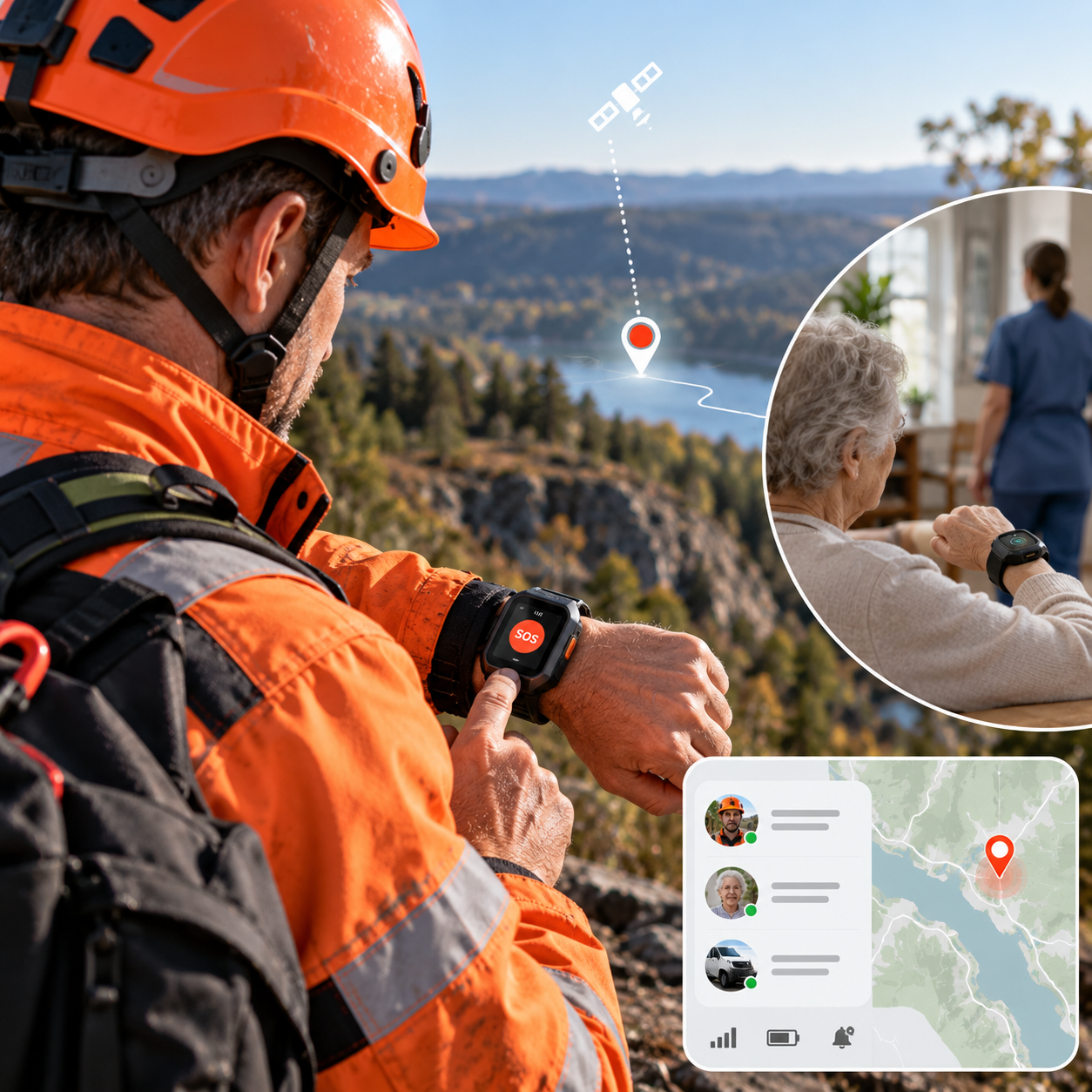
A connected safety device is useful only if it works at the moment a person cannot reach a phone. That is the practical question raised by Luffu Link, an LTE health and safety band launched by Fitbit’s founders and reported by TechCrunch. Its combination of continuous sensing, voice logging, location awareness and trusted-contact alerts points to a category between consumer wearables, lone-worker devices and supported-care technology.
For employers and care providers, the news is not simply that another wearable exists. A standalone LTE band may remove dependence on a nearby, charged and correctly configured smartphone. But it also creates a new operational system involving cellular coverage, charging, alert triage, consent, data retention and escalation. Buyers should therefore assess the complete safety workflow—not the feature list alone—and avoid interpreting wellness sensing as proven medical diagnosis.
Start with the safety gap, not the wearable
A phone-free wearable has the strongest rationale where existing controls fail because a phone is inaccessible, inconvenient or routinely left behind. A lone technician working with both hands, a home-care recipient moving between rooms, or a field employee whose phone is stored under protective clothing may benefit from an alert channel worn continuously on the body.
Four scenarios deserve evaluation without assuming the same product fits all of them:
- Lone-worker programs: A wearable could provide a more immediate way to request assistance or notify trusted contacts when an employee is isolated.
- Home-care services: Location and alerts could supplement scheduled visits and established welfare-check procedures, subject to informed consent and clear responsibility for responding.
- Field operations: Voice logging and connectivity may help workers record context when stopping to type or call is impractical.
- Family-supported care: Alerts could connect a vulnerable person with selected relatives or carers without requiring regular smartphone use.
The procurement team should document the precise failure it wants to prevent. Is the problem that workers cannot unlock a phone, that supervisors learn about incidents too late, or that a vulnerable person does not carry a handset? If the principal gap is poor response discipline, unreliable staffing or absent procedures, adding a wearable will not solve it.
Standalone connectivity changes the coverage test
LTE capability reduces reliance on phone pairing, but it does not make connectivity universal. Coverage must be tested where people actually work or receive care: basements, lifts, plant rooms, rural properties, construction interiors and routes between appointments. A network coverage map is only a screening tool; procurement should include supervised field tests across representative locations and times.
Buyers should ask what the band does when service disappears. Relevant questions include whether it visibly indicates lost connectivity, stores voice logs or events for later transmission, retries alerts, and reports an offline device to an administrator. The answers affect whether the device is a primary alert mechanism or merely a supplementary channel.
Location awareness also needs careful interpretation. Outdoor positioning, indoor positioning and a last-known location are not equivalent. An escalation team must know the likely accuracy, update frequency and limitations before using location data to dispatch help. Instructions should require responders to confirm context rather than treating a map marker as certainty.
Design the alert workflow before deployment
A band can detect or transmit an event, but people and procedures determine the outcome. Map every alert from initiation to closure: who receives it, through which channel, how quickly it must be acknowledged, who takes over if the first contact does not respond, and when emergency services or an internal incident team are involved.
Continuous sensing may generate automated alerts, while voice logging may provide context. Neither eliminates ambiguity. Movement, work tasks, device fit or user error can contribute to false alarms; genuine incidents can also go undetected. Run trials to classify common alert types and measure acknowledgement, escalation and resolution—not just the number of notifications.
Trusted contacts must understand that accepting the role creates an operational expectation. Personal contacts may sleep, travel or silence notifications. Employers should not shift an occupational safety duty informally onto employees’ relatives. Care providers likewise need written boundaries between family support, professional monitoring and emergency response.
Existing incident procedures should remain authoritative. Define how wearable alerts enter case-management, control-room or health-and-safety records; who closes an event; and what evidence is retained. Staff need scenario-based training covering manual activation, accidental alerts, failed connectivity, suspected device failure and situations requiring a conventional call for help.
Privacy and consent are operating requirements
Location, voice and health-related signals are sensitive because they can reveal routines, behaviour and personal circumstances. Organisations should identify a lawful and clearly communicated purpose for each data stream rather than enabling every available feature by default.
Employees need to know whether location is collected continuously or only during an alert, who can view it, whether managers can use it for performance monitoring, and how long records remain available. In care settings, consent must be meaningful and revisited if a person’s circumstances or decision-making capacity changes. Family access should not automatically imply unrestricted access to all data.
Apply data minimisation at configuration level. Restrict dashboards by role, use strong administrator authentication, record access where possible and establish deletion schedules. Contracts should clarify data hosting, subprocessors, security updates, breach notification, export options and deletion when a device is reassigned or service ends. Voice logging requires particular scrutiny because recordings may capture bystanders or confidential workplace and household conversations.
Calculate reliability and cost as a service
The purchase price is only one component of total operating cost. Include LTE subscriptions, monitoring or platform fees, accessories, replacement bands, device loss, support, administrator time, integration work, training and periodic testing. Response labour can become material if false alarms are frequent.
Battery life should be evaluated under realistic connectivity and sensing conditions rather than treated as a fixed specification. Establish who charges each device, where chargers are kept, how low-battery warnings are handled and what happens during long shifts or overnight use. Shared devices require documented cleaning, assignment and handover checks; personally assigned units need rules for leave and replacement.
Procurement should also examine remote device management: inventory status, software versions, connectivity health, battery reporting, policy configuration and secure decommissioning. Ask for the support response when LTE service, an app, cloud processing or alert delivery fails. A safety deployment needs maintenance ownership and outage procedures, not merely a warranty.
A practical pilot and procurement checklist
Run a limited pilot with representative users and difficult locations before committing to scale. Set pass-or-fail criteria tied to the identified safety gap.
- Verify cellular availability indoors, outdoors and along common routes.
- Test offline indicators, queued events and recovery after coverage returns.
- Measure battery performance and compliance with charging routines.
- Record false alarms, missed or delayed alerts and their causes.
- Time acknowledgement, fallback escalation and incident closure.
- Confirm the meaning and limitations of displayed location data.
- Define governance for location, voice logs and health-related signals.
- Document consent, access controls, retention and acceptable use.
- Assess device management, updates, reassignment and decommissioning.
- Train users, supervisors, carers and trusted contacts through scenarios.
- Integrate alerts with existing incident and emergency procedures.
- Model full operating cost, including response and administration.
A standalone LTE band is most compelling when phone dependence is a demonstrated weak point and the organisation can operate the response system around it. If coverage is inconsistent, charging cannot be assured or nobody owns escalation, the wearable may create confidence without dependable protection. The decision should rest on tested end-to-end performance and governance—not on the presence of sensors or connectivity alone.