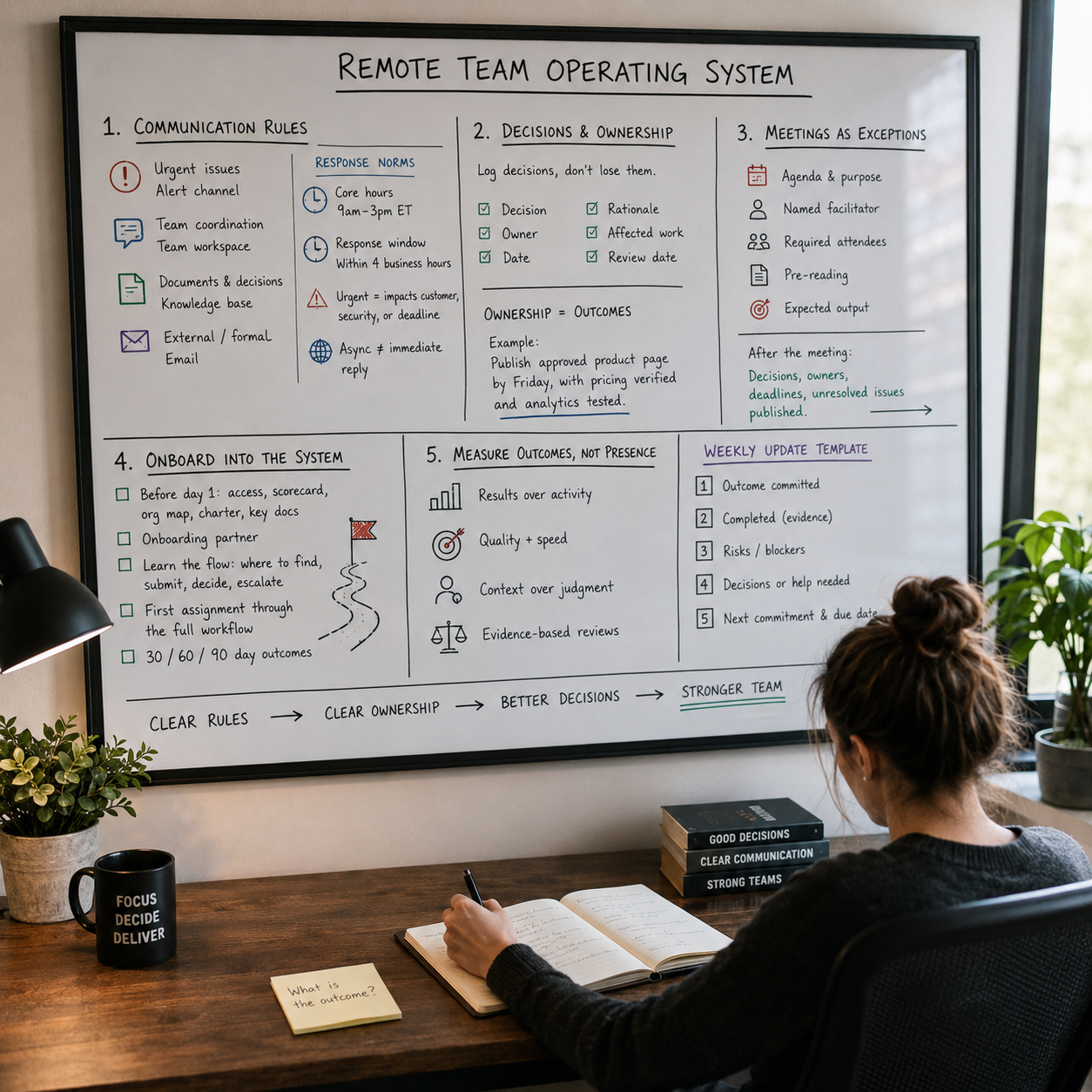
Remote work becomes difficult when employees must guess where to communicate, who owns a decision, how quickly to respond, or what good performance looks like. For a small company, these ambiguities quickly reach the owner: routine questions become meetings, decisions disappear in chat, and managers confuse online presence with progress.
The solution is not more software or surveillance. It is a lightweight operating system: a shared set of rules for coordinating work when people are not in the same room. General remote-team guidance emphasizes communication, trust, suitable tools, and connection. The practical challenge is translating those principles into routines employees can follow without constant managerial interpretation.
Start with communication rules, not communication volume
Define which interactions are synchronous—requiring people to participate at the same time—and which are asynchronous. Synchronous communication should be reserved for situations where immediate exchange creates clear value: resolving a live incident, discussing a sensitive personnel matter, handling complex disagreement, or making a time-critical decision.
Use asynchronous channels for status updates, requests, proposals, routine feedback, and information that others may need later. This protects focus time and creates a searchable record. A message should contain enough context for the recipient to act without arranging another call: the issue, relevant background, requested action, owner, and deadline.
Create a one-page channel map. For example, urgent operational interruptions go to an agreed alert channel; normal coordination stays in the team workspace; durable procedures and decisions belong in the knowledge base; formal approvals live in the relevant project or business system. Email can remain appropriate for external or formal communication, but it should not become a second internal task manager.
Response-time norms also need precision. “Be responsive” is not an operating rule. Define core collaboration hours, the expected response window for ordinary messages, what qualifies as urgent, and how urgency is signaled. Include rules for different time zones and explicitly state that an asynchronous message does not imply an immediate reply. These norms should match the company’s customer commitments rather than imitate an always-online culture.
Turn discussions into decisions and outcomes
Remote teams need a reliable boundary between conversation and record. A chat thread may help reach a decision, but it is a poor permanent repository. Use a simple decision log containing the decision, date, decision owner, participants consulted, rationale, affected work, and review date where applicable. Link supporting discussion rather than copying every message.
Ownership should attach to outcomes, not vague activities. “Coordinate the launch” leaves room for conflicting interpretations. “Publish the approved product page by Friday, with pricing verified and analytics tested” identifies the result and completion conditions. Every meaningful work item should have one directly accountable owner, even when several people contribute.
Managers can maintain visibility with a compact weekly update. Each owner reports:
- the outcome committed for the period;
- what was completed, with a link to the evidence;
- what remains at risk or blocked;
- the decision or assistance needed;
- the next commitment and due date.
This replaces repeated requests for updates with a predictable reporting rhythm. It also makes dependencies visible before missed deadlines become surprises.
Design meetings as exceptions with explicit outputs
A remote meeting should have a purpose that cannot be met efficiently through a written update. Require an agenda, named facilitator, required attendees, pre-reading, and the decision or output expected. If no decision, collaborative work, or sensitive conversation is needed, cancel the meeting and post an update instead.
A practical cadence for a small company might include brief team planning, targeted one-to-ones, and a periodic review of priorities and results. The exact frequency should follow the pace and interdependence of the work. Avoid creating recurring calls merely to demonstrate activity.
After each necessary meeting, publish decisions, owners, deadlines, and unresolved issues in the relevant system. Recordings can supplement notes but should not replace them: expecting employees to watch an entire recording makes information retrieval needlessly expensive.
Protect cohesion separately from operational reporting. One-to-ones should cover workload, obstacles, feedback, development, and wellbeing—not simply duplicate project updates. Optional social sessions, peer demonstrations, and recognition of useful contributions can build connection, but managers should not equate attendance at virtual social events with commitment.
Onboard people into the system, not just the software
A remote employee cannot absorb working conventions by observing an office. Onboarding must therefore explain how work moves through the company. Before the start date, provide equipment and access, a role scorecard, an organization map, the communication charter, key procedures, and a schedule for the first week.
Assign an onboarding partner for practical questions. During the first days, demonstrate where employees find authoritative information, how they submit work, how decisions are recorded, and how to escalate a blocker. Give the new hire a small, real assignment that travels through the complete workflow. This tests the system while the stakes are manageable.
Set 30-, 60-, and 90-day outcomes appropriate to the role. Assess whether the employee can navigate documentation, communicate with sufficient context, meet commitments, surface risks early, and improve a process—not whether a status indicator remains green. Managers should review onboarding gaps as system failures first: repeated questions often reveal missing, outdated, or hard-to-find documentation.
Measure performance without monitoring presence
Intrusive monitoring can collect activity while obscuring value. Screen captures, keystroke counts, or online time do not establish whether a customer problem was solved, a project was delivered correctly, or a process became more reliable. They can also encourage visible busyness instead of sound judgment.
Build each role’s scorecard around controllable outcomes. Depending on the job, evidence might include completed deliverables, quality or error measures, agreed service levels, customer outcomes, cycle time, forecast accuracy, and documented process improvements. Balance speed with quality so that one metric does not reward damaging shortcuts.
Review results alongside context. A missed outcome may arise from weak execution, an unplanned dependency, an unrealistic commitment, or a changed priority. The manager’s job is to distinguish these causes and agree on corrective action. Performance visibility should enable decisions, coaching, and resource allocation—not continuous observation.
A 30-day rollout and the operations staffing decision
Days 1–7: Audit current channels, meetings, recurring reports, and undocumented decisions. Ask employees where information gets lost and which requests regularly interrupt focused work. Draft the channel map, urgency definition, response norms, and core collaboration hours.
Days 8–14: Introduce outcome ownership, a decision-log format, and one weekly update template. Select a single team or workflow for the pilot. Remove at least one status meeting that the written update can replace, while preserving meetings needed for decisions or sensitive discussion.
Days 15–21: Build the onboarding path and role scorecards. Document the most frequently repeated processes first rather than attempting to capture everything. Review access controls so employees can reach what they need without exposing unnecessary information.
Days 22–30: Evaluate the pilot. Check whether decisions are findable, owners are unambiguous, blockers surface earlier, meetings produce documented outputs, and employees understand response expectations. Revise the rules, assign a maintainer, and set a regular review date.
If these routines require more coordination than existing managers can sustain, an operations associate may be appropriate. The remote-operations source informs this staffing dimension, but a company should define its own role before recruiting. Decide whether the person will maintain documentation, coordinate projects, prepare operating reports, track commitments, support onboarding, administer tools, or improve workflows. Specify decision rights and escalation boundaries; otherwise the role can become a catch-all for unresolved ownership.
Look for capabilities that match the operating model: concise written communication, reliable follow-through, process mapping, documentation discipline, comfort with project systems, careful handling of access and data, and the judgment to escalate exceptions. Give candidates a realistic work sample, such as converting a messy discussion into a decision record and action plan. Hire only after the operating rules exist. An operations associate can maintain and improve a clear system, but should not be expected to invent accountability that leadership has avoided defining.