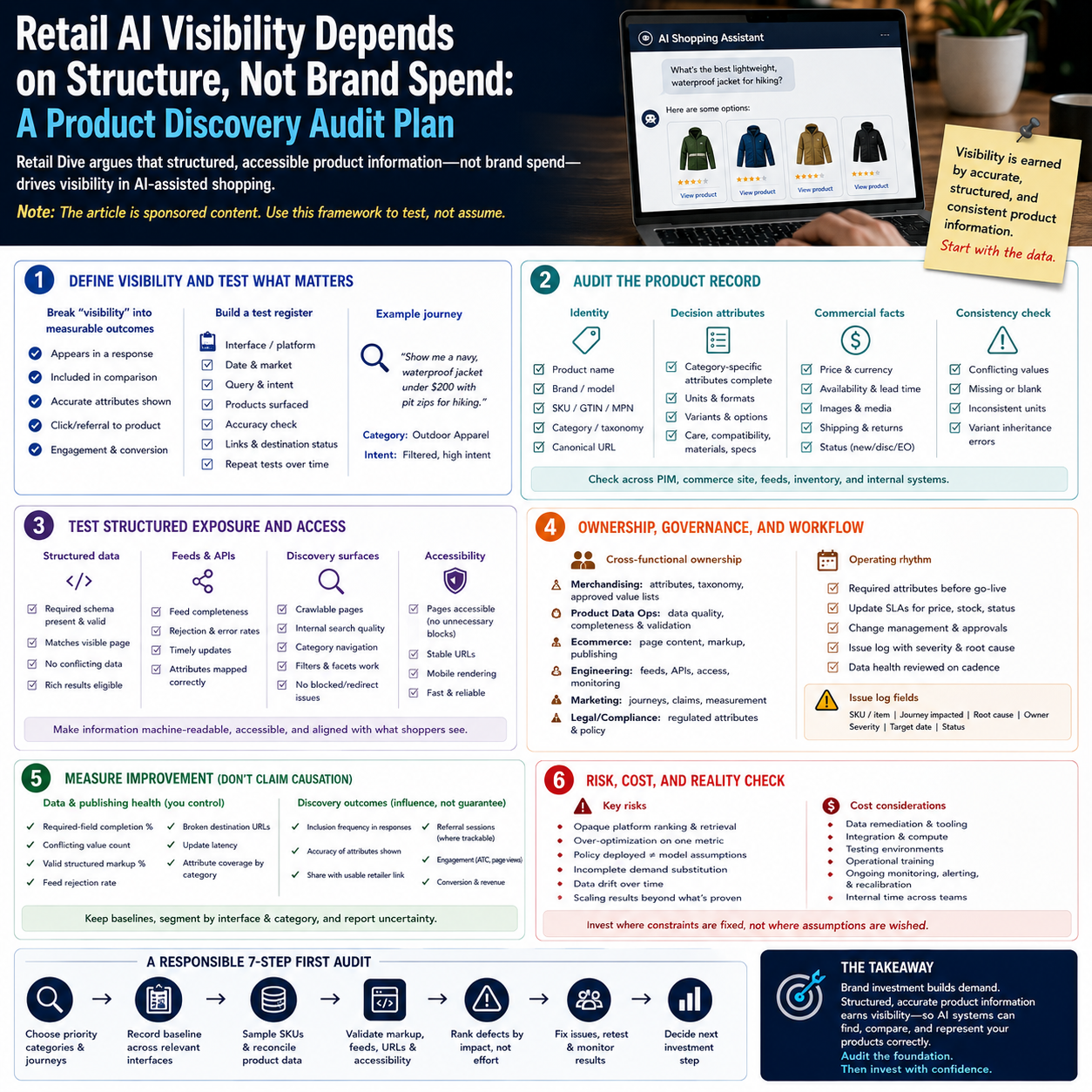
Retailers accustomed to buying reach may assume that strong brand equity, large media budgets and polished campaigns will also secure visibility when shoppers use AI-assisted discovery. The supplied Retail Dive article challenges that assumption, arguing that structured, accessible product information matters more than brand spend alone. Importantly, the article is sponsored content, so its argument should be treated as a vendor-backed perspective rather than independent proof of how every AI platform selects products.
The practical implication is not that marketing investment has become irrelevant. It is that retailers should audit the product-information foundation before funding a new “AI visibility” initiative. If product attributes are inconsistent, incomplete or difficult to access, additional campaign spending may create awareness without improving whether relevant products can be identified, compared and represented accurately in AI-mediated shopping experiences.
Define visibility before trying to improve it
“AI visibility” is too vague to manage as a single objective. It can mean appearing in a conversational answer, being included in a comparison, having the correct product details summarized, or receiving a referral that leads to a product page. These outcomes are not equivalent, and no audit can responsibly promise rankings across interfaces whose retrieval and presentation mechanisms are not fully disclosed.
Begin by choosing the shopping journeys that matter commercially. Examples might include a customer searching for a jacket with a particular material and fit, comparing appliances by dimensions and energy characteristics, or looking for cosmetics that exclude a specified ingredient. Each journey should be tied to a product category, customer intent and observable outcome.
Create a test register with the interface tested, date, location or market, query wording, account state where relevant, products shown, factual accuracy, links presented and destination-page status. Repeat tests rather than relying on one screenshot. Responses can vary, and a single result does not establish durable visibility.
This baseline separates three different problems: the product was not surfaced; it appeared but was described incorrectly; or it appeared accurately but generated weak engagement or conversion. Each requires a different response.
Audit the product record, not just the product page
The sponsored source’s structure-over-spend argument points retailers toward the underlying product record. The broader implementation guidance is straightforward: inspect whether the same product is represented consistently wherever systems or customers may encounter it.
Select a manageable sample covering bestsellers, high-margin lines, new products, variants, seasonal inventory and known problem items. For each stock-keeping unit, compare the product information management system, commerce platform, structured page markup, merchant or marketplace feeds, inventory data and visible page copy.
Check identity fields first: product name, brand, model, global identifiers, SKU, category and canonical URL. Then examine decision attributes specific to the category. Apparel may require size, fit, fabric, colour and care information; furniture needs dimensions, materials and assembly details; electronics may require compatibility, capacity and technical specifications.
Look for conflicts as well as blanks. “Navy” in one system and “blue” in another may be harmless to a person but weaken reliable filtering and comparison. A dimension stated without units is incomplete. A variant that inherits the parent product’s image, price or availability can produce a materially wrong representation.
Also verify that price, stock status, delivery information and product URLs remain current. Structured attributes cannot compensate for stale commercial facts or inaccessible destinations.
Test whether structured information is exposed correctly
Complete data inside an internal system is not useful if relevant external interfaces cannot access or interpret it. Review the paths through which product information is published: crawlable product pages, structured markup, feeds, APIs where intentionally provided, category navigation and retailer search.
Validate that structured fields match what shoppers see. Markup claiming an item is in stock while the page says unavailable is a governance failure, not an optimization opportunity. Check canonicalization, redirects, blocked pages, variant URLs and rendering dependencies that might prevent important information from being available in a stable form.
Do not assume that adding more schema fields or longer descriptions guarantees inclusion in an AI response. Platform-specific ranking and retrieval behaviour may be opaque and change over time. The defensible goal is narrower: make accurate, category-relevant information consistent, machine-readable where appropriate and accessible through approved channels.
Prioritize attributes that help shoppers distinguish products. Repeating brand language across hundreds of descriptions is less useful than supplying missing compatibility, material, dimensions or usage constraints. Free-text copy still matters for explanation and persuasion, but it should not be the only place where a critical product fact exists.
Assign ownership across commerce and marketing
AI-assisted discovery crosses organizational boundaries. Marketing may own messaging and campaign budgets, while merchandising, e-commerce, product-data teams and engineering control the information that supports discovery. Without explicit ownership, teams may observe a visibility problem but lack authority to correct its source.
Define one accountable owner for each data domain. Merchandising can approve category attributes and controlled vocabulary; product-data operations can manage completeness and validation; e-commerce can own page publication and structured markup; engineering can address access and feed reliability; marketing can define priority journeys and evaluate representation of claims. Legal or compliance review may be required for regulated or sensitive attributes.
Establish service rules for product launches and changes. Required attributes should be completed before publication, not added after campaign traffic arrives. Price, availability and discontinued status need update expectations. Changes to naming conventions or taxonomy should trigger checks downstream rather than silently breaking feeds or filters.
A useful issue log records the affected products, discovery journey, root cause, owner, severity and correction date. This turns “we are not showing up” into actionable work such as missing attributes, contradictory feeds, inaccessible pages or weak category coverage.
Measure improvements without claiming causation
Use two measurement layers. The first covers data and publishing health: required-field completion, conflicting values, valid structured markup, feed rejection rates, broken destinations, update latency and attribute coverage by category. These metrics are within the retailer’s control.
The second covers discovery outcomes: inclusion frequency across a defined query set, accuracy of product descriptions, share of responses containing a usable retailer link, referral sessions where identifiable, engagement, add-to-cart activity and conversion. Segment results by interface, category, query intent and device when the data permits.
A change in visibility after correcting product data is evidence worth monitoring, but it does not necessarily prove causation. Interfaces can change independently, tests can vary and external factors can influence traffic. Keep dated baselines, change one major variable at a time where practical and report uncertainty.
Before reallocating budget, ask whether the proposed initiative fixes an observed constraint. Paid content or specialist tooling may be justified when it improves feed quality, monitoring or execution capacity. It is harder to justify when basic records remain contradictory or teams cannot identify who owns corrections.
A responsible sequence for the first audit
- Choose priority categories and define specific customer discovery journeys.
- Record a repeatable baseline across the AI-assisted and conventional interfaces relevant to those journeys.
- Sample representative SKUs and reconcile identity, category, variant and decision attributes across systems.
- Validate markup, feeds, URLs, accessibility and agreement between structured data and visible content.
- Rank defects by customer impact and commercial importance rather than fixing easy fields first.
- Assign owners and deadlines, then retest after corrections.
- Compare data-health and discovery-outcome metrics before approving additional visibility spend.
The key decision is not whether brand investment or product structure matters more in every circumstance. It is whether the retailer has made its product catalogue sufficiently accurate, differentiated and accessible to justify further investment. Audit that foundation first; then fund initiatives against measured gaps rather than assumptions about what brand recognition should deliver.