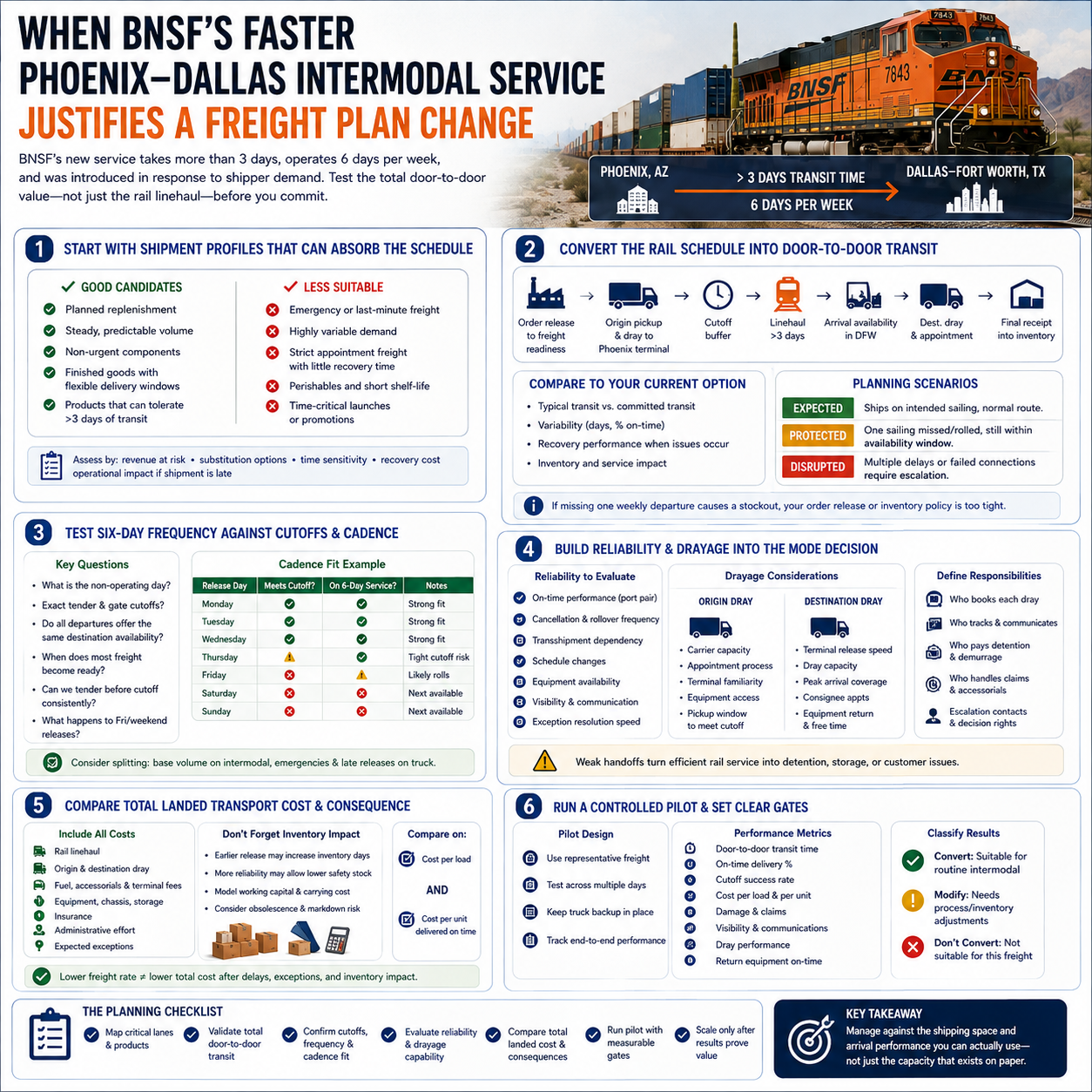
BNSF’s faster intermodal service between Phoenix and Dallas-Fort Worth gives Southwest shippers another reason to revisit freight that may currently move by truck or through a different rail plan. According to Supply Chain Dive, the Phoenix-to-Dallas-Fort Worth route takes more than three days, operates six days per week, and was introduced in response to shipper demand.
Those facts make the service worth evaluating, but they do not prove that a shipper should change modes or providers. The relevant comparison is not the published rail journey alone. It is the performance and cost of the complete movement—from the origin shipping door, through drayage and terminal cutoffs, to the consignee’s receiving door. A disciplined evaluation should therefore test whether the new service fits each freight lane’s timing, cadence, inventory policy, and exception-management requirements.
Start with shipment profiles that can absorb the schedule
The strongest candidates are recurring Phoenix-area shipments bound for Dallas-Fort Worth or destinations that can be served efficiently from that market. They should have enough predictability to plan around a scheduled departure and enough transit flexibility to tolerate a journey exceeding three days before first- and last-mile activity is added.
That generally points toward planned replenishment, steady finished-goods flows, non-urgent components, and other freight for which a few days of lead time can be built into ordering and inventory rules. Intermodal may be less suitable for emergency replenishment, highly variable orders released at the last minute, strict appointment freight with little recovery time, or shipments whose commercial value depends on truck-like door-to-door speed.
Volume consistency also matters. A shipper does not necessarily need daily volume, but recurring loads make it easier to align pickups with departures, secure equipment, and measure performance across comparable shipments. Sporadic freight can still qualify if release timing is controllable. A load that becomes ready just after a cutoff, however, could lose much of the faster service’s benefit while waiting for the next viable departure.
Convert the rail schedule into door-to-door transit
The reported journey of more than three days should be treated as one component of transit time, not as a delivery commitment. Operators need to map every stage of the proposed movement:
- time from order release to freight readiness;
- origin pickup and travel to the Phoenix terminal;
- buffer required to meet the terminal cutoff;
- terminal processing and the scheduled linehaul;
- availability after arrival in Dallas-Fort Worth;
- destination drayage and appointment timing; and
- weekend, holiday, or receiving-hour delays.
This exercise should use actual origin and destination ZIP codes. A warehouse close to each terminal may produce an attractive end-to-end plan, while long drays, congested delivery areas, or restrictive receiving windows can erase the linehaul advantage.
Compare the result against the current operation rather than an idealized truck benchmark. Record typical transit, committed transit, variability, and recovery performance for the incumbent option. A slightly longer intermodal plan may remain viable when delivery is predictable and inventory can be positioned accordingly. Conversely, a nominally competitive plan may be unacceptable if arrival variability repeatedly causes missed appointments or production disruption.
Test six-day frequency against cutoffs and shipping cadence
Six-day operation offers substantial scheduling flexibility, but it is not the same as unrestricted daily availability. Shippers should identify the non-operating day, exact tender and gate cutoffs, equipment-return requirements, and whether all departures provide the same destination availability pattern.
Then overlay that schedule on real shipping behavior. Which weekdays produce the most loads? When does freight become ready? Can warehouse labor, order processing, and dray pickup be moved earlier to protect the cutoff? What happens to a Friday or weekend release? The answer may differ by product family or customer.
Cutoff compliance deserves particular attention. If a nominal departure requires freight to leave the origin several hours earlier than today, the operational cost may appear in overtime, accelerated picking, trailer staging, or an extra day of inventory. If the organization cannot consistently tender before cutoff, planners should model the next available departure rather than assuming the load will make the preferred train.
A lane can also be split instead of converted completely. Predictable base volume could move intermodally, while late releases, demand spikes, and recovery loads remain on truck. This protects service while allowing the shipper to test how much freight genuinely fits the six-day cadence.
Build reliability and drayage into the mode decision
The announcement establishes frequency and approximate route duration, but it does not establish lane-specific reliability. Before committing meaningful volume, request definitions for on-time performance, the measurement point used, recent consistency where available, and procedures for delayed or missed connections. Operators also need visibility expectations: when will status updates arrive, who owns exception communication, and how quickly can a delayed load be converted to another solution?
Drayage should be evaluated as two distinct operations. At origin, confirm carrier capacity, appointment processes, terminal familiarity, equipment availability, and the pickup window needed to meet cutoff. At destination, test how quickly units become available, whether dray providers can cover peak arrival periods, and whether consignee appointments align with terminal availability.
Responsibility must be explicit. Determine who arranges each dray, tracks free-time exposure, returns equipment, resolves accessorial disputes, and communicates delays to the receiving location. Weak handoffs can turn an efficient rail movement into detention, storage, demurrage, or customer-service problems. These risks are especially important for facilities with limited yard space or narrow receiving windows.
Compare total landed transport cost, not an unreported rate
No pricing assumption should be inferred from the service announcement. Shippers should obtain lane-specific quotes and compare them on a common door-to-door basis. The calculation should include linehaul, both dray legs, fuel-related charges, equipment or chassis costs where applicable, terminal and accessorial exposure, cargo insurance implications, administrative effort, and expected exception costs.
Inventory effects belong in the same analysis. If the intermodal plan adds lead time or requires an earlier release, estimate the working capital and safety stock needed to maintain customer service. If its schedule allows more dependable planning than the incumbent option, it may reduce buffers—but that benefit should be demonstrated through pilot results rather than assumed.
Cost per load is only one decision metric. Cost per unit delivered on time can be more revealing because it captures failures that require expediting, rescheduling, or customer concessions. A lower quoted transport price may not be economical if a small number of exceptions generate costly recovery moves.
Use a controlled pilot before changing the regional plan
A pilot should use representative freight rather than unusually easy shipments. Select recurring origin-destination pairs, include different departure days, and avoid freight that cannot tolerate an initial learning period. Preserve a truck recovery option while terminal procedures and drayage handoffs are being validated.
Before the first load, record the incumbent baseline and set pass/fail criteria for door-to-door transit, on-time delivery, cutoff success, shipment visibility, damage, dray performance, accessorial charges, and total landed transport cost. Track planned and actual timestamps for pickup, terminal acceptance, departure, destination availability, final delivery, and equipment return.
At the end of the pilot, classify freight into three groups: suitable for routine intermodal conversion, suitable only with schedule or inventory changes, and unsuitable because of urgency, geography, cadence, or service risk. Expand volume only when results remain acceptable across multiple operating days—not merely when the advertised linehaul looks faster.
BNSF’s Phoenix–Dallas-Fort Worth service creates a credible evaluation opportunity for planned Southwest freight. The case for changing the regional plan becomes compelling only when six-day departures match release patterns, both dray legs work reliably, cutoffs are operationally achievable, and measured door-to-door economics outperform the current alternative without weakening customer service.