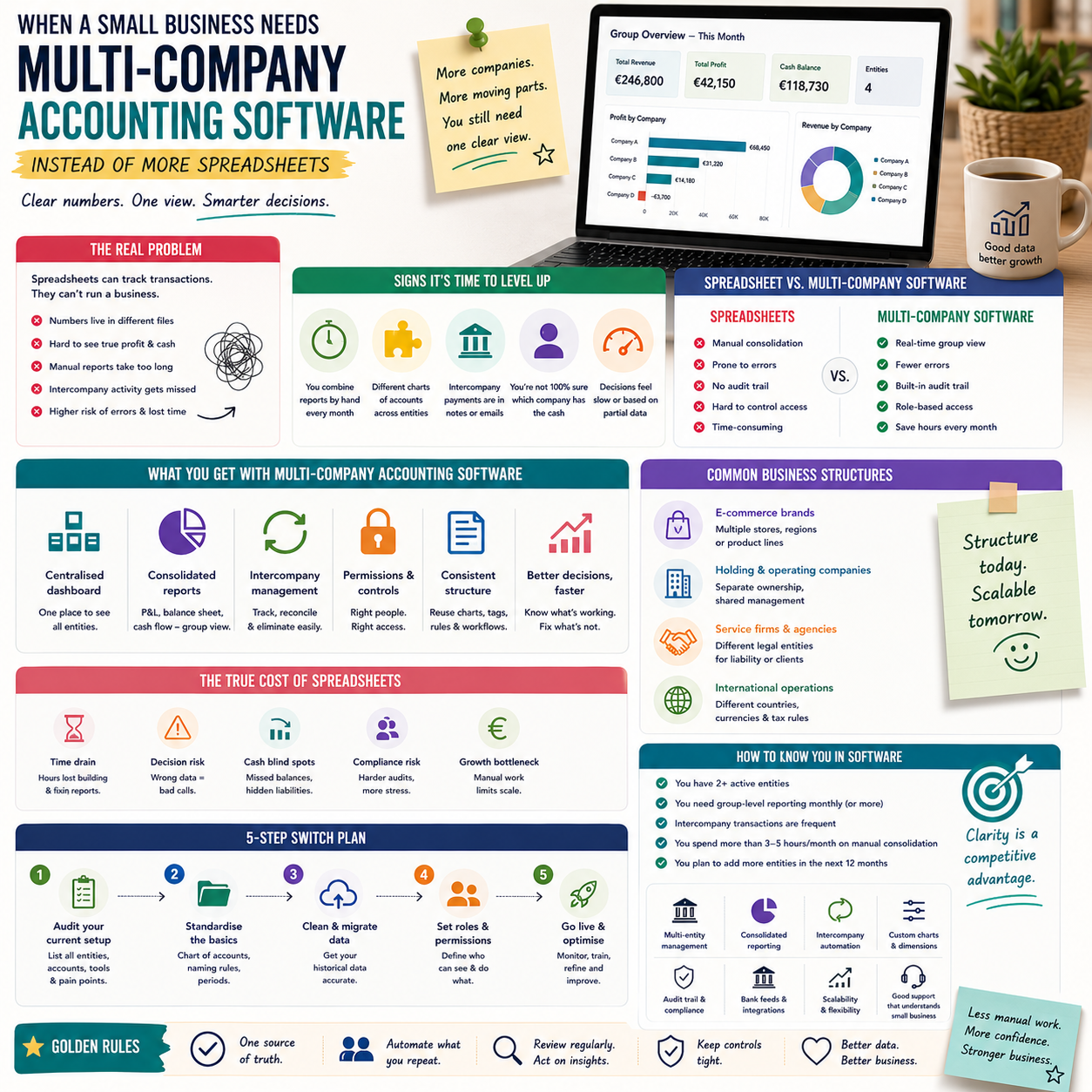
Running more than one business entity, store, brand or regional operation changes the finance problem. The issue is no longer whether accounting software can send invoices or reconcile a bank feed. The real question is whether the owner can see cash, liabilities, margins and intercompany activity without rebuilding the numbers by hand every month.
This guide is for small business owners, e-commerce operators, agency founders and digital operators who have outgrown single-company bookkeeping but are not ready for an enterprise finance stack. The decision is not about buying a bigger tool. It is about deciding when separate books become an operational risk.
The trigger is not company size, it is financial fragmentation
A small business can become financially complex before it becomes large. One founder may run a main operating company, a second entity for a marketplace brand, a holding company for intellectual property, and a separate company for a local market. An e-commerce seller may operate multiple Shopify stores, marketplace accounts and payment processors while keeping different legal entities for tax, liability or partner reasons.
That structure creates a management problem. If each company has its own accounting file, its own login, its own chart of accounts and its own reporting calendar, the owner may not know which part of the group is actually producing cash. Revenue can look healthy while cash is trapped in one entity, inventory is paid from another, and shared software subscriptions sit in the wrong cost centre.
The Small Business Trends guide to multi-company accounting software focuses on tools built to manage more than one company from a shared environment. That distinction matters. A normal accounting package may let an owner create another account, but that does not mean it handles consolidated reporting, shared controls, repeatable setup, user permissions or group-level visibility well.
The practical signal is this: if the owner or bookkeeper spends more time combining numbers than interpreting them, the system is now consuming management capacity.
Where single-company accounting starts to break
Single-company accounting software is usually designed around one set of books. That is fine when the business has one bank account structure, one chart of accounts, one main revenue model and one reporting view. It becomes awkward when the owner needs to answer questions across entities.
Common failure points include:
Different charts of accounts: One company tracks advertising as paid media, another splits it into marketplace ads, search ads and creative production. Consolidation then becomes a manual mapping exercise.
Separate user permissions: A finance assistant needs access to one entity but not another. The owner wants an external accountant to see all entities. The tool does not make this clean.
Manual group reporting: Profit and loss reports are exported from several files, copied into a spreadsheet, adjusted and then reviewed days later.
Duplicate supplier records: The same software vendor, logistics provider or freelancer appears differently in each company file, making spend analysis unreliable.
No clear intercompany process: One entity pays costs on behalf of another, but the internal recharge is tracked in notes, emails or memory.
None of these issues sounds dramatic at first. Together, they create slow reporting and weak control. For a founder, the danger is making pricing, hiring or inventory decisions from partial information.
The decision: add more accounting files or move to a multi-company setup
The owner has three realistic paths. The right answer depends on complexity, budget and how often the business needs group-level numbers.
Option one: keep separate files and standardise the process
This can work when the entities are simple and independent. For example, a consultant with one trading company and one property company may not need a multi-company system if each entity has few transactions and reporting is quarterly rather than weekly.
The requirement is discipline. The same chart of accounts structure should be used where possible. Month-end dates should match. Supplier naming rules should be consistent. Reports should be exported in a predictable format. This is low-cost, but it depends heavily on the owner, bookkeeper or accountant maintaining the system manually.
Option two: use a mainstream accounting platform with multiple subscriptions
Some small businesses create separate subscriptions for each entity. This is often the next step after spreadsheets. It gives each company a clean accounting file, bank feeds and standard reporting. It may be enough for owners who need legal separation but not true consolidated management reporting.
The cost implication is not only subscription fees. The hidden cost is repeated setup, repeated integrations, repeated permissions and repeated reporting work. If every new entity requires rebuilding the operating model from scratch, the finance system becomes harder to scale.
Option three: adopt multi-company accounting software
Multi-company accounting software is more relevant when the owner needs a shared view across entities. The useful features are not flashy. They are operational: company switching, consolidated reporting, reusable chart structures, permission control, shared vendor visibility, recurring transactions, reporting by entity and clean audit trails.
This option is worth considering when the business has multiple active entities, frequent cross-company transactions, shared staff or suppliers, and a need to review group performance monthly or more often. It is also relevant when a founder manages several brands or stores but wants one finance operating rhythm.
The cost is not just the software subscription
Small businesses often compare accounting systems by monthly fee. That is too narrow. A finance tool changes how work moves through the company. The real cost includes setup, migration, training, process design, integrations and cleanup.
Before switching, an owner should price the change across five buckets:
Licensing: Per company, per user, per feature tier or per consolidated group.
Bookkeeping time: Whether the new setup reduces month-end work or simply moves it into another interface.
Accountant involvement: Setup of chart of accounts, opening balances, entity structure and reporting rules.
Integration work: Bank feeds, payment processors, payroll, inventory, CRM, Shopify, WooCommerce, Amazon, Stripe, PayPal or other systems.
Management reporting design: Dashboards, entity-level reporting, margin reporting, cash views and approval workflows.
The mistake is treating the tool as the project. The tool is only the container. The project is building a finance operating system that can answer owner-level questions without manual reconstruction.
A practical scenario: two stores, one service business and shared costs
Consider an owner running two online stores and a small B2B service operation. The stores use different payment processors and sell into different markets. The service business pays for shared software, design support and part of the owner’s assistant. Each activity is held in a separate entity for commercial reasons.
At first, separate accounting files look tidy. Each business has its own reports. Then the questions become harder. Which operation is actually funding growth? Are software costs being allocated fairly? Is one store profitable only because another entity is carrying shared labour? Are marketplace fees rising faster than gross margin? Can the owner afford to hire, or is cash simply moving between accounts?
In this situation, better accounting software is not about prettier reports. It is about preventing bad operating decisions. If shared costs are not allocated, the owner may scale the wrong store. If intercompany balances are not visible, cash planning becomes guesswork. If reporting arrives too late, inventory buying decisions may be based on last month’s reality.
A multi-company setup would not remove the need for bookkeeping judgment. It would, however, make the workflow more controlled. The owner could standardise account codes, tag costs by entity, review group cash, track internal recharges and compare store-level performance on a consistent basis.
What most people miss
The biggest issue is not consolidation. It is comparability.
Owners often think they need multi-company accounting software because they want one combined profit and loss report. That may be useful, but the deeper value is making each entity report in a way that can be compared. If one store records fulfilment costs under cost of goods sold and another records them under operating expenses, the combined number may look accurate while the management insight is weak.
Comparability requires decisions before implementation. The owner needs to decide how revenue streams are coded, how marketplace fees are treated, where payment processing costs sit, how shared software is allocated, and whether owner compensation is shown consistently. Without these rules, a better tool can still produce messy management information.
This is especially important for e-commerce operators. Sales channels often create noisy accounting data: payouts net of fees, refunds, chargebacks, shipping income, marketplace advertising, fulfilment fees and sales tax or VAT handling depending on jurisdiction and setup. If those flows are not mapped consistently across entities, the owner may misread margin by channel or brand.
The finance workflow that should exist before migration
A software switch should not begin with importing data. It should begin with a written finance workflow. This does not need to be a long document. It needs to define how financial data should move from transaction to decision.
A workable workflow for a small multi-entity business should cover:
Entity structure: Which companies exist, what each one does, and which bank accounts, stores and payment processors belong to each.
Chart of accounts rules: Which account codes must be identical across companies and which can be entity-specific.
Shared cost allocation: How costs such as software, contractors, rent, management time or logistics support are split.
Intercompany process: How one company records payments made for another, how often balances are reviewed, and who approves recharges.
Month-end calendar: The closing date, reconciliation deadline, management report date and review meeting rhythm.
Exception handling: What happens when a payout does not match, a supplier is duplicated, a bank feed breaks or a transaction is coded to the wrong company.
This is where automation can help, but only after the rules are clear. Bank rules, recurring journals, invoice capture, approval flows and reporting dashboards are useful when they enforce an agreed process. If the process is unclear, automation spreads the confusion faster.
Automation boundaries: what to automate and what to keep human
Multi-company accounting creates tempting automation opportunities. Some are worth using early. Others should wait until the data model is stable.
Good early automation includes bank feed reconciliation rules for recurring suppliers, invoice capture for standard expenses, recurring journals for predictable allocations, automated report packs and alerts for unreconciled accounts. These save time without removing too much judgment.
Be careful with automated coding for ambiguous costs. A subscription may belong to one entity one month and be shared the next. A contractor invoice may include work for two brands. A payment processor payout may include refunds and fees that need proper mapping. If the system auto-codes these without review, the reports may look complete but be wrong.
The human boundary should be set around judgment-heavy areas: shared cost allocation, intercompany balances, unusual supplier invoices, revenue recognition policies, tax treatment and any transaction that affects margin analysis. The aim is not to remove the bookkeeper or accountant. It is to stop them spending time on repetitive cleanup so they can review the numbers that influence decisions.
Metrics to monitor after switching
A successful move to multi-company accounting should show up in management behaviour, not just software usage. The owner should track whether the finance process is faster, clearer and more useful.
Useful metrics include:
Days to close: How many days after month-end the owner receives usable management reports.
Unreconciled transaction count: The number of transactions still unresolved at reporting date.
Intercompany balance age: How long balances between entities remain uncleared or unexplained.
Shared cost allocation coverage: Whether material shared costs are allocated according to a defined rule.
Report adjustment volume: How many manual spreadsheet corrections are needed after reports are exported.
Entity-level cash visibility: Whether the owner can see cash by company and group without logging into several systems and rebuilding the view.
If these metrics do not improve, the business may have bought software without fixing the operating model.
Decision checklist before buying multi-company accounting software
Use this checklist before committing to a platform, migration or new accounting workflow.
You manage more than one legal entity, brand, store, region or operating unit.
You need monthly group-level visibility, not only annual accounts.
Shared costs are material enough to distort entity-level profit if they are not allocated.
Intercompany transactions happen often enough that email notes and spreadsheets are becoming risky.
Your chart of accounts can be standardised across companies without losing useful detail.
Your accountant or bookkeeper is willing to help design the setup before migration.
The system can support the integrations that matter to your operation, such as bank feeds, payment processors, inventory, payroll or e-commerce platforms.
User permissions can be managed by company and role, especially if external partners, assistants or managers need access.
You know which reports the owner will review each month and what decisions those reports should support.
You have budgeted for cleanup, migration and training, not only the monthly software fee.
If fewer than half of these apply, improving the current process may be enough for now. If most apply, the risk is no longer software cost. The risk is running several businesses while looking at fragmented finance data.