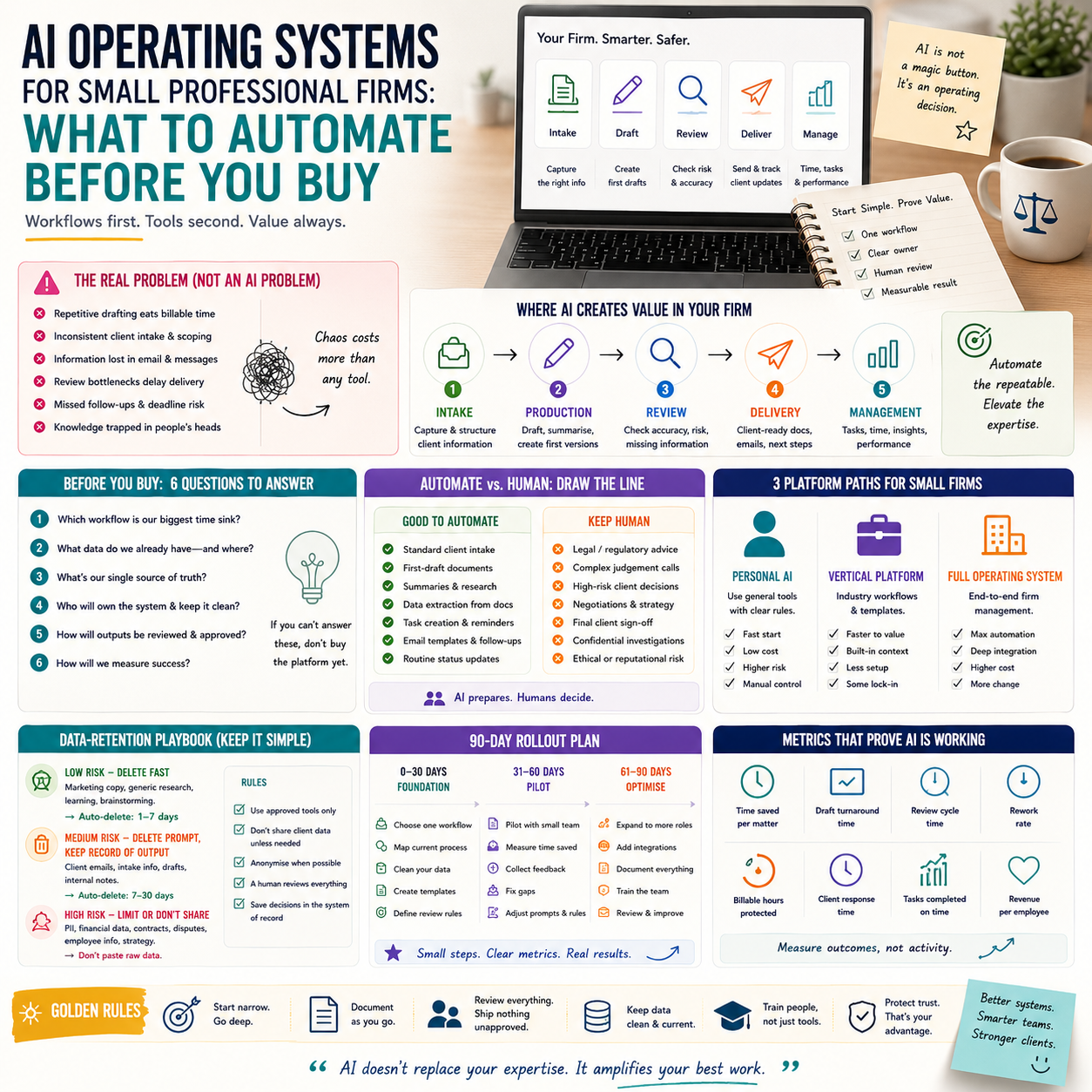
LawX raising €7.5 million to build an AI-powered operating system for law firms and notaries is not just a legaltech funding story. It points to a more practical question for small professional service firms: when does AI belong inside the core operating workflow, and when is it just another tool creating more places to check?
For small law offices, accounting practices, consultants, agencies and other document-heavy service businesses, the buying decision should not start with model quality or vendor demos. It should start with the parts of the business where work is repeated, reviewed, billed, delayed and exposed to client risk.
The real buying decision is workflow ownership, not AI access
Most small firms already have access to AI in some form. A partner, manager or operator may use ChatGPT, Microsoft Copilot, Google Gemini, Notion AI or a specialist drafting tool. That is useful, but it does not automatically change how the business runs.
An AI operating system is a different proposition. It tries to sit across the firm’s actual workflow: intake, document creation, review, client communication, task routing, deadline tracking, file storage and sometimes billing. That creates a sharper decision than simply subscribing to an AI assistant.
The operator question is: should AI remain a personal productivity layer, or should it become part of the firm’s production system?
That distinction matters because personal AI use can be cheap and flexible, but hard to control. A system-level platform can create consistency, but it also adds switching cost, process dependency and implementation work. A two-person firm should not buy the same way as a 40-person practice with dedicated operations staff.
The LawX announcement is useful as a signal because it focuses on an operating system for notaries and law firms, not a generic chatbot. Cosmico’s funding and acquisition activity in the future-of-work space points in the same direction from another angle: work platforms are moving closer to execution, not just talent matching or collaboration. Small operators should read that as a warning against buying isolated AI tools without deciding where the system of record should live.
Where AI earns money inside a small service firm
AI produces business value only when it reduces a constraint that already costs money. In professional services, the expensive constraints are usually review time, rework, missed follow-ups, inconsistent file handling and low-value drafting that blocks senior staff.
A small firm should map AI use against four workflow zones:
- Intake: turning emails, forms and call notes into structured matter or project records.
- Production: drafting first versions of documents, summaries, checklists, proposals or client updates.
- Review: flagging missing information, contradictions, unusual clauses, stale assumptions or internal policy mismatches.
- Delivery: preparing client-ready outputs, next-step emails, reminders and task handovers.
The mistake is to start with the most impressive demo. A document generator that produces polished text may not be the best first deployment if the real bottleneck is missing client information. In that case, AI-assisted intake and follow-up automation may save more staff time than drafting.
For a small professional firm, the first AI workflow should meet three conditions. It should happen frequently. It should have a clear human reviewer. It should have an existing cost, such as admin hours, senior review delays, client chasing or write-offs caused by poor scoping.
What most people miss
The hidden issue is not whether AI can draft a document. It is whether the firm can prove how the document was produced, reviewed and approved.
Small firms often run on informal trust. A senior person knows who prepared the file, which template was used and what still needs checking. Once AI enters the workflow, that informal memory becomes weaker. If a draft includes an old clause, a wrong client detail or an unsupported assumption, the firm needs to know where the error entered the process.
That is why audit trail and review design matter more than many feature lists. A serious AI workflow should record the source material used, the prompt or instruction pattern, the person responsible for review, the approval status and the final client-facing version. Without that, AI can speed up production while making accountability harder.
This is especially important for regulated or high-trust services. A marketing agency can recover from a weak first draft faster than a notary, lawyer, accountant or compliance consultant can recover from a flawed client document. The practical lesson for small firms is simple: do not automate anything that you cannot review consistently.
Personal AI tool, vertical platform or full operating system?
Small operators should separate three categories before comparing vendors.
Personal AI assistant
This is the lightest option. It works well for research notes, draft outlines, internal summaries, meeting preparation and rewriting internal material. The cost is usually predictable and the rollout is simple.
The risk is fragmentation. Each person may use different prompts, upload different information and save outputs in different places. If the firm has no policy on client data, source checking and file storage, the assistant can create operational mess even when the individual output looks good.
Vertical workflow platform
A vertical platform is built around a specific industry workflow, such as legal matters, client projects, creative production, insurance claims or recruitment. It may include templates, intake structures, document workflows and industry-specific review steps.
This is often the most realistic middle path for a small firm. It reduces setup work and gives the team a narrower system to learn. The tradeoff is vendor dependency. If the platform’s workflow does not match how the firm prices, reviews and delivers work, staff may end up duplicating tasks in spreadsheets, inboxes and the platform.
Full AI operating system
A full operating system aims to become the place where the firm runs client work. That can be powerful if the business has enough repeated processes and enough team members to justify the change.
But this is not a casual software purchase. It affects file structure, permissions, templates, client communication, internal review and reporting. The cost is not only subscription fees. It includes migration time, process redesign, staff training, quality control, data cleanup and the productivity dip while old habits are replaced.
The cost model should include review time, not just software price
Many AI tool evaluations fail because they compare subscription cost against a vague promise of saved time. A better small-firm model is built around review minutes and throughput.
Start with one repeated workflow, such as preparing a client onboarding pack, drafting a standard agreement, producing a monthly report or summarising a case file. Measure the current process in plain operational terms:
- How many times per month does this workflow happen?
- Who touches it before it reaches the client?
- How long does first preparation take?
- How long does senior review take?
- How often does work return because information is missing?
- Which parts are billable, non-billable or written off?
- What delays client delivery?
Then test the AI-assisted version. Do not only measure draft speed. Measure whether review time falls, whether fewer client follow-ups are needed, whether junior staff can prepare cleaner files and whether senior staff spend less time correcting structure.
If AI cuts drafting time but doubles review anxiety, it has not improved the operating model. If it creates a faster first draft but increases the chance of wrong assumptions reaching a client, the apparent saving is not real. For many professional firms, the best AI workflow is not the one that removes humans. It is the one that gives the right human a better file to review.
A practical scenario: the five-person advisory firm
Consider a five-person advisory firm handling recurring client reports and bespoke project documents. The team uses email for intake, shared drives for files, Word or Google Docs for drafts, a task board for project status and accounting software for invoices. The founder wants AI because senior staff are spending evenings turning rough notes into client-ready documents.
A weak implementation would let everyone use an AI assistant however they like. That may produce short-term relief but no consistent process. Files may not show which source notes were used. Prompts may vary by person. Client-specific assumptions may live in private chat histories rather than the project folder.
A stronger implementation starts with one workflow: monthly client report preparation. The firm creates a standard intake form for the information needed, connects call notes and source documents to the client folder, uses AI to prepare a structured first draft, and requires the account lead to review a fixed checklist before the report is sent.
The firm does not need to automate every report section at once. It can begin with the low-risk sections: activity summary, open items, meeting recap and next-step email. The higher-risk analysis remains human-led until the firm has a review pattern it trusts.
The useful metric is not “AI usage”. It is the number of reports delivered without late-night senior editing, the average review time per report, the number of client clarification emails required after delivery, and the amount of non-billable admin time per account.
Implementation risks that small firms underestimate
The first risk is data handling. Client files, contracts, financial information and personal data should not be casually pasted into tools without understanding retention, training use, access controls and regional compliance requirements. Small firms do not need a complex policy document to begin, but they do need clear rules on what can be uploaded, which tools are approved and where AI-generated work must be stored.
The second risk is template drift. AI can create small variations that look harmless but weaken consistency. In a document-heavy business, template control is operational control. If every employee asks for a slightly different version of a standard document, the firm may lose the consistency that made the workflow safe in the first place.
The third risk is unclear responsibility. “AI drafted it” is not an operating answer. Every AI-assisted output needs an owner. For client-facing work, the reviewer must be named in the workflow, not assumed after the fact.
The fourth risk is over-automation at the client boundary. Automated follow-ups, summaries and reminders can help, but a high-trust client relationship can be damaged by messages that are technically correct and commercially tone-deaf. The firm should decide which communications can be automated, which can be AI-drafted but human-sent, and which must remain fully human.
The metrics dashboard for an AI-enabled firm
A small firm does not need enterprise analytics to manage AI adoption. It needs a short dashboard tied to operational outcomes.
Useful metrics include:
- First-draft cycle time: time from complete intake to first internal draft.
- Review time: senior or specialist minutes spent before approval.
- Rework rate: how often drafts return because of missing information, wrong assumptions or format problems.
- Client clarification rate: how often clients ask for corrections or explanations after delivery.
- Non-billable admin time: hours spent formatting, chasing information, summarising notes or moving files.
- Template exception count: how often staff deviate from approved document structures.
- Approval trace completeness: percentage of client-facing outputs with a recorded reviewer and final approval status.
These metrics keep the AI discussion grounded. If the platform is expensive but review time falls sharply and delivery becomes more predictable, the investment may be justified. If usage is high but rework and clarification rates rise, the firm has automated noise.
Buying signals to check before signing a contract
Before buying an AI operating system or vertical workflow platform, a small firm should ask vendor questions in operational language rather than demo language.
- Can the system separate draft, reviewed and approved versions clearly?
- Can permissions be set by client, matter, project or role?
- Can the firm control templates and prevent uncontrolled variations?
- Can outputs show which source documents or notes were used?
- Does the workflow fit existing billing and review responsibilities?
- Can the firm export data if it leaves the platform?
- Can AI features be switched on by workflow rather than across the whole firm?
- Does the tool integrate with the firm’s existing document storage, calendar, email, CRM or practice management system?
The export question deserves special attention. A small firm should not trap its client history, document logic and internal knowledge in a system it cannot leave. AI operating systems are attractive because they promise one place for work, but that also makes switching harder later.
Rollout sequence for a small firm testing an AI operating layer
Use this sequence before committing the whole firm to a platform:
- Pick one repeated workflow: choose a process with enough volume to measure, but not the highest-risk client deliverable.
- Write the current process in six steps or fewer: intake, file creation, drafting, review, client delivery and follow-up are usually enough to expose the gaps.
- Set one target metric: review time, rework rate, delivery delay or non-billable admin hours.
- Create an AI-use boundary: define what the system may draft, what it may summarise and what must be approved by a human.
- Standardise the source folder: AI output is only as reliable as the material it is allowed to use.
- Run ten real jobs through the workflow: use actual work, not a polished demo file, and compare against the previous method.
- Review the error pattern: separate harmless formatting issues from risky content errors, missing context and approval failures.
- Decide whether to expand, pause or replace: expand only if the workflow improves the target metric without weakening accountability.
The useful lesson from the new wave of AI operating systems is not that every small firm needs a large platform immediately. It is that AI value moves from individual productivity to business performance only when the firm redesigns the workflow around review, responsibility, client risk and measurable throughput.


