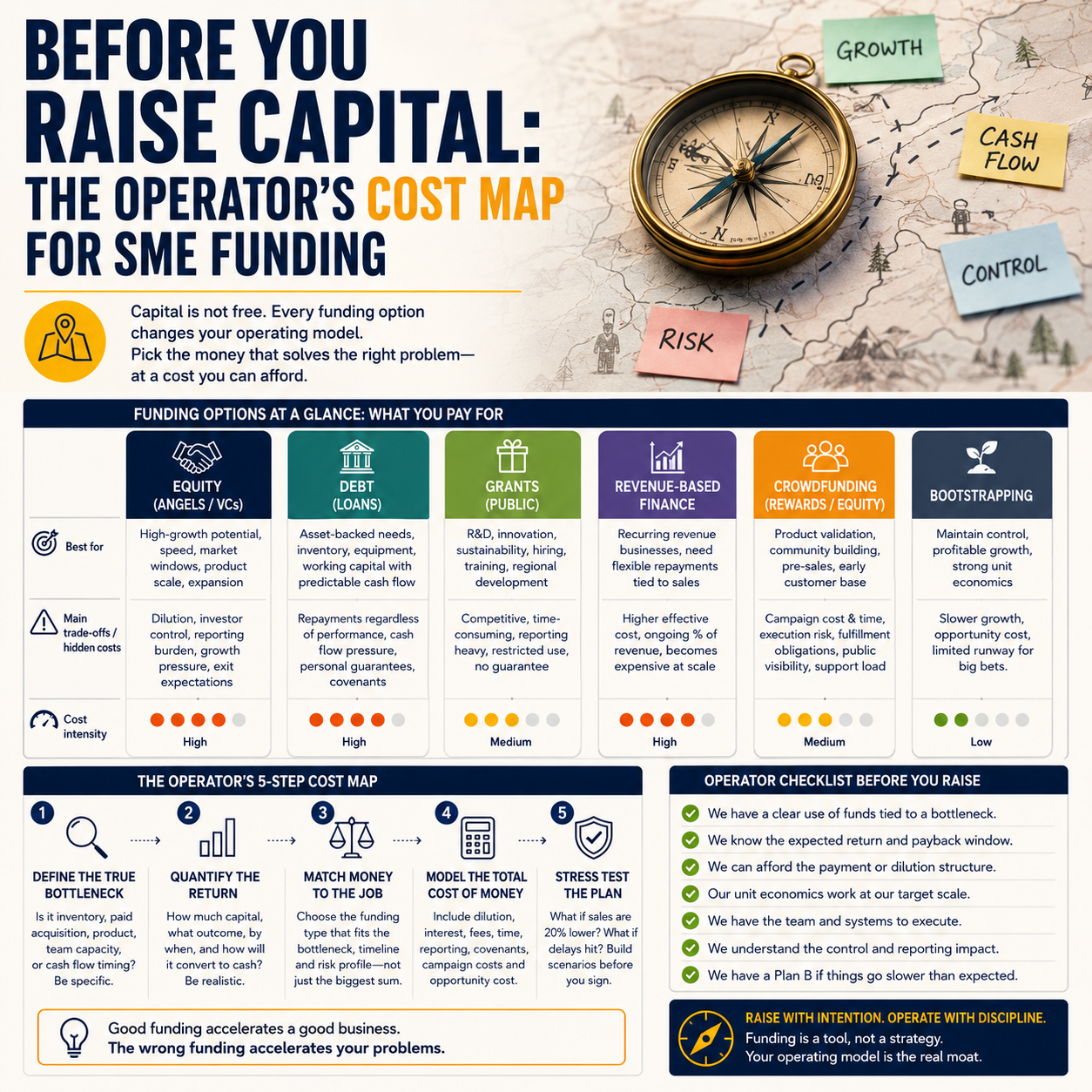
Most founders ask the wrong funding question first. They ask how much money they can raise, not what the money will do to their operating model after it lands.
That difference matters for small teams. A funding round can buy growth, but it can also add reporting load, cash pressure, dilution, distraction, governance friction and execution risk. The real decision is not simply capital versus no capital. It is which constraint you are willing to accept.
The funding decision starts with the bottleneck, not the cheque size
The EU-Startups piece on funding costs makes a useful point for European SMEs: capital is not one product. A bank loan, venture round, grant, revenue-based finance, crowdfunding campaign and angel cheque all change the business in different ways. Treating them as interchangeable cash sources is how small companies end up with money that solves one problem and creates three others.
For an operator, the first diagnostic should be brutally specific: what is actually blocking growth?
If the bottleneck is stock availability, the capital must be measured against inventory turns, supplier terms, warehouse handling and dead-stock risk. If the bottleneck is paid acquisition, the capital must be measured against payback period, contribution margin and creative testing capacity. If the bottleneck is product development, the capital must be measured against release cadence, hiring dependencies and the cost of delay. Different bottleneck. Different money.
This is where many small companies overreach. They raise for “growth” when the business has not proven which lever grows profitably. Money then becomes a fog machine. It hides weak pricing, messy fulfillment, poor retention or a sales process that depends too heavily on the founder.
Cash can mask waste.
Equity capital buys speed but sells part of the operating room
Equity funding is attractive because it does not usually create monthly repayments. For a small team with uncertain revenue timing, that can feel safer than debt. But the real cost is not only dilution. The cost is a change in how decisions are made.
Once outside investors own part of the company, the founder is no longer optimizing only for cash survival and customer value. The company must also support the expected return profile of the capital. That changes acceptable risk, growth targets, hiring pace and exit logic. A business that could have been a profitable specialist operator may be pushed toward a larger, riskier market position because the capital structure requires it.
That is not automatically bad. It is just not neutral.
Equity can make sense when the business has a time-sensitive market window, high upfront product investment, a defensible technology advantage or a distribution opportunity that competitors can copy if the company moves slowly. The paymove funding announcement is an example of capital being connected to infrastructure development and European expansion. That is a different funding logic from a local service business needing two more staff or an e-commerce seller needing seasonal inventory.
For a small business owner, the operator test is simple: would the company still be healthy if it grew more slowly but kept control? If yes, equity may be expensive money. If no, and the opportunity decays without speed, equity may be rational.
Debt looks cheaper until repayment timing hits the workflow
Debt is often described as less expensive because ownership is not diluted. That is only true if the repayment schedule fits the cash conversion cycle. A loan that funds inventory with a 90-day sell-through period but demands cash before the stock converts into profit can create a liquidity squeeze even when the gross margin looks good on paper.
Small operators should stop evaluating debt by interest rate alone. The more useful question is: when does the cash leave the bank compared with when the financed activity returns cash?
For an e-commerce seller, this means mapping supplier deposits, final supplier payments, shipping, duties, warehouse fees, ad spend, marketplace payout delays, returns, refunds and VAT timing. A loan repayment that looks comfortable in a monthly spreadsheet can become painful if marketplace payouts are delayed or a product batch sells slower than expected.
Debt also creates behavioral pressure. When repayments are fixed, founders often cut the wrong things first. They reduce testing, delay system upgrades, postpone stock reordering or push discounts to generate cash. Each move may help this month while weakening the next quarter.
Debt is not bad money. It is structured money. Use it when the funded activity has predictable conversion into cash, the margin buffer is real and the repayment dates do not force operational shortcuts.
Crowdfunding is not free capital; it is a campaign operation
Crowdfunding often gets framed as community-powered finance. For operators, that framing is too soft. A crowdfunding raise is a launch, a fulfillment promise, a customer support workload and a public reputation test at the same time.
The visible cost may be platform fees or reward costs. The hidden cost is operational preparation: pre-launch audience building, campaign creative, email sequences, landing pages, paid traffic tests, customer messaging, production planning, refund handling and post-campaign delivery. If the team is already stretched, crowdfunding can pull the founder away from the business at the exact moment precision is needed.
It can still be useful. Crowdfunding works best when the campaign itself validates demand, builds a first customer base or finances production that has already been costed carefully. It works poorly when it is treated as a shortcut around poor cash planning.
A small hardware brand, for example, should not ask only whether people will pledge. It should ask whether the pledged price covers manufacturing changes, packaging revisions, freight movement, quality control failures, support queries and late delivery communication. The campaign is only the front door. Fulfillment is the house.
The funding source must match the business system you already run
Before choosing capital, map the business system underneath it. Not the pitch deck version. The operating version.
Map the cash path
Start with the exact activity the capital will fund. If it funds inventory, write down supplier payment dates, expected receiving dates, launch dates, expected sales period, return windows and payout dates. If it funds hiring, write down recruitment time, onboarding time, productivity ramp, management time and the first measurable output expected from the role.
This turns funding from an abstract finance decision into a workflow decision. You can then see where cash is trapped, where assumptions are weak and where a delay creates a second-order problem.
Map the control path
Each funding source changes who gets a say. Equity can introduce investor reporting and strategic influence. Debt introduces lender covenants or repayment discipline. Grants can introduce eligibility rules and documentation. Crowdfunding introduces public accountability to backers. Revenue-based finance introduces a claim on future receipts.
Control cost is not emotional. It affects speed. If every meaningful decision now requires explanation, approval or reporting, the business needs admin capacity. Small teams forget this. Then the founder becomes the finance department, investor relations desk and operating manager at once.
What most people miss
The unpopular answer is that some businesses should stay manually funded for longer.
That does not mean staying small forever. It means using customer cash, supplier negotiation, pre-orders, deposits, slower hiring or narrower product lines until the operating model has fewer unknowns. Standard startup advice often treats external capital as proof of progress. For many small companies, it can be proof that the founder has avoided the harder work: tightening margins, simplifying the offer, removing unprofitable channels and building a cash dashboard that tells the truth.
Automation builders and digital operators should be especially careful here. If the internal workflow is chaotic, funding may only automate chaos faster. A company with messy CRM stages, unclear attribution, weak customer support tagging and inconsistent fulfillment metrics should not rush to finance scale. It should first make the system measurable.
Manual discipline can beat funded speed.
There is another missed point: raising money consumes the founder’s best attention. The opportunity cost is not abstract. During a raise, sales calls may slow, product decisions may wait, supplier negotiations may drift and team management may become reactive. If the business depends heavily on the founder, the fundraising process itself becomes an operating risk.
So the question is not only “Can we raise?” It is “Can the business keep improving while the founder is raising?” If the answer is no, the company may need to fix management bandwidth before seeking capital.
A practical scenario: the funded stock mistake
Consider a small EU e-commerce operator selling specialist home accessories through Shopify and two marketplaces. The owner wants capital to increase stock before the winter season. On the surface, debt looks sensible: buy more inventory, sell more units, repay from seasonal revenue.
The deeper operating check reveals a different picture. The best-selling SKUs have stable demand, but the newer range has a higher return rate. Marketplace payouts lag behind direct store payments. Paid acquisition works on branded search but is unproven on cold audiences. The warehouse charges extra for slow-moving bulky items. Customer support volume increases sharply when delivery promises slip.
In that situation, one large loan for broad stock expansion is blunt. A better structure may be smaller supplier deposits on proven SKUs, negotiated payment terms for the slower range, a capped advertising test budget and a cash reserve for returns. The funding decision becomes narrower, safer and easier to measure.
This is the operator mindset. Do not fund a category. Fund a tested cash path.
The metrics that decide whether capital is helping or hiding problems
After funding, most founders track bank balance and revenue. That is not enough. Funding can make both look healthy while the operating engine worsens underneath.
For a small business, the capital dashboard should include metrics that expose whether money is converting into durable operating strength:
- Cash conversion cycle: how many days pass between cash leaving the business and cash returning from the funded activity.
- Gross margin after direct operating costs: not just product margin, but payment fees, fulfillment, returns, support load and channel fees where relevant.
- Payback period by channel: especially for paid acquisition or sales hiring.
- Founder time allocation: hours spent on fundraising, reporting, lender communication or campaign management versus sales, product and operations.
- Forecast variance: the gap between expected and actual cash timing, not only expected and actual revenue.
- Decision latency: how long important operational decisions now take because of new approval, reporting or stakeholder processes.
If those metrics worsen after funding, the business has not bought growth. It has bought complexity.
Use this 30-day funding audit before accepting money
This is the operating check a founder should run before signing a term sheet, loan agreement, crowdfunding campaign plan or revenue finance contract. It is deliberately narrow. If the answers are vague, the business is not ready for that money yet.
- Day 1-3: Name the funded constraint. Write one sentence stating exactly what the money will unlock. If the sentence includes broad words like growth, expansion or marketing without a measurable workflow, rewrite it.
- Day 4-7: Build the cash path. List every cash-out and cash-in date connected to the funded activity. Include supplier payments, platform fees, tax timing, refunds, payroll, contractor invoices, ad spend, software, fulfillment and repayment dates.
- Day 8-10: Define the stop-loss rule. Decide in advance what metric will stop further spending. Examples: payback period exceeds the target window, return rate crosses an agreed threshold, sales hire pipeline fails to reach a defined stage volume, or inventory sell-through misses the reorder checkpoint.
- Day 11-14: Price the management load. Estimate the founder or manager hours required for investor updates, lender reporting, campaign management, compliance documents, financial tracking and stakeholder communication. Assign those hours to a real weekly calendar.
- Day 15-18: Choose the least distorting capital. Match the funding type to the constraint. Use debt for predictable cash conversion, equity for speed and uncertainty with large upside, crowdfunding for validated demand and community delivery, grants for eligible projects with admin capacity, and customer cash where deposits or pre-orders are credible.
- Day 19-23: Run the delay test. Model what happens if revenue arrives 30 days later than expected, hiring takes twice as long, inventory is delayed or campaign conversion underperforms. If one delay breaks the plan, the structure is too tight.
- Day 24-27: Set the post-funding dashboard. Create a weekly view covering cash conversion, gross margin after direct costs, payback period, forecast variance, operational backlog and founder time allocation.
- Day 28-30: Decide with a constraint statement. Accept the money only if you can say: this capital funds this constraint, returns through this cash path, is stopped by this metric, and does not overload this management system.


