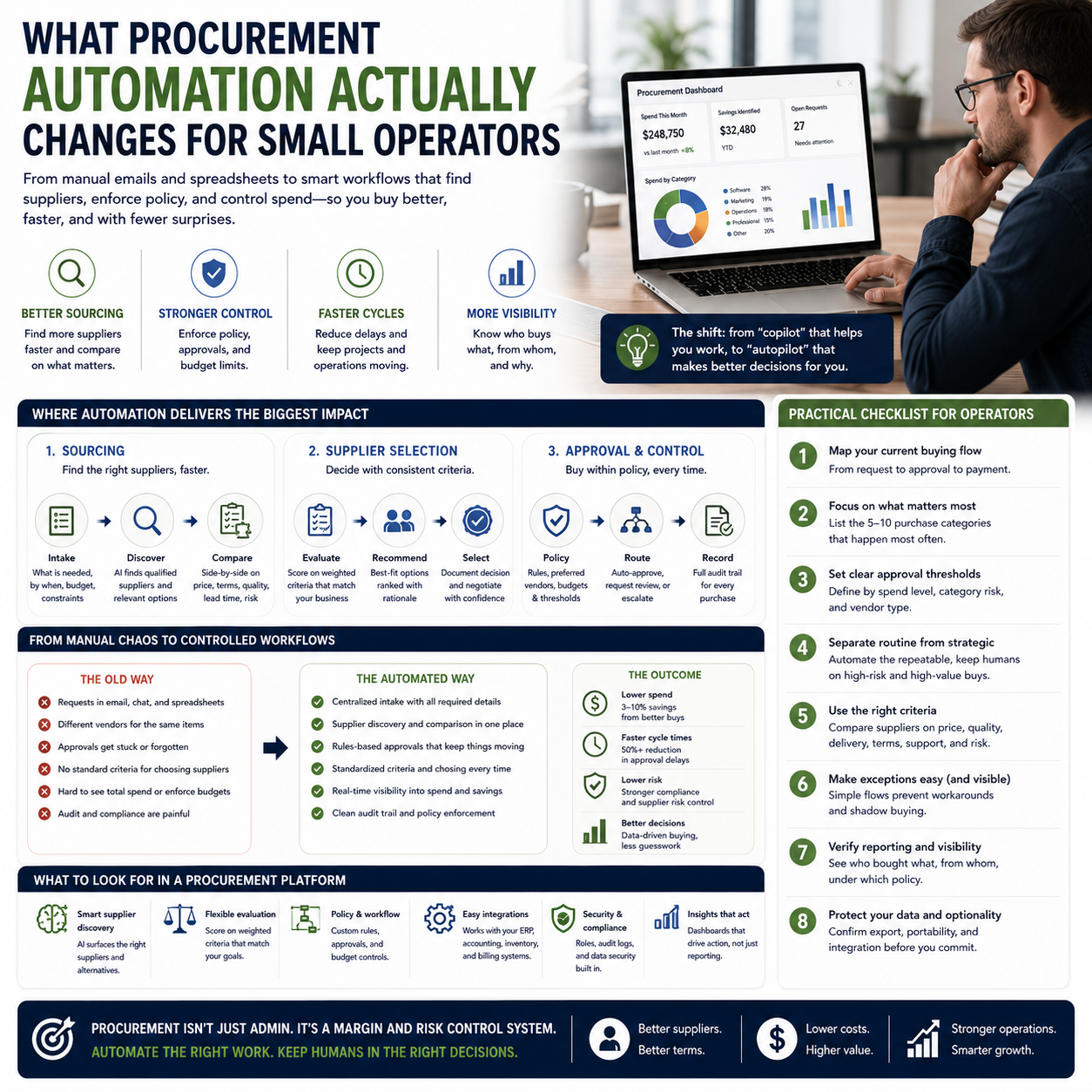
Procurement software is moving beyond dashboards and reminders. The more interesting change is that sourcing is being pushed from a manual, people-heavy workflow toward systems that can narrow options, surface suppliers, and standardize buying decisions.
That matters to founders and operators because procurement is one of the easiest places to lose margin quietly: duplicated vendor spend, inconsistent supplier criteria, approval delays, and poor visibility into who bought what and why. Recent funding for Soource, which positions procurement as moving from “copilot” to “autopilot,” is a useful signal that the market is shifting toward decision automation rather than just record-keeping.
What the Soource story signals
Soource’s raise is not just a funding headline. It points to a broader shift in how companies think about procurement: not as a back-office function that only processes purchase requests, but as a control layer for sourcing, supplier selection, and spend discipline. For smaller businesses, that distinction matters because procurement tools are becoming more opinionated. They are increasingly designed to recommend suppliers, compare options, and enforce workflows instead of simply storing documents.
That creates a practical decision for operators: are you buying software to speed up approvals, or to change the way purchasing decisions are made? If your team still relies on email threads, scattered spreadsheets, and one person’s memory of “the usual vendor,” then automation can remove friction. But if the underlying purchasing rules are unclear, software can simply automate confusion.
Where procurement automation helps most
For small and mid-sized companies, the biggest gains usually come in three areas.
First is sourcing. Instead of each department or manager finding suppliers independently, a system can create a repeatable intake flow: what is needed, by when, under what budget, and with which constraints. That makes it easier to compare suppliers on the same criteria.
Second is supplier selection. Procurement systems can structure decision-making around price, delivery terms, lead times, service quality, compliance requirements, and payment terms. This is especially useful when a business is growing and buying starts to happen faster than oversight.
Third is approval control. Automation can make it harder for non-standard purchases to slip through without review. That does not mean every purchase needs a committee. It means the company can define thresholds, preferred vendors, and exceptions once, then enforce them consistently.
For founders, the practical value is not abstract efficiency. It is visibility into what the business is buying, who approved it, and whether the purchase followed policy.
What most people miss
The biggest mistake with procurement automation is assuming that software will fix weak purchasing rules. It will not. If a company has no approved vendor list, no budget ownership, and no clear approval thresholds, an “autopilot” system can just produce faster bad decisions.
The smarter approach is to treat procurement automation as a design exercise. Before choosing tools, define the buying paths that should be standardized and the cases that should remain manual. For example, a business might automate routine office supplies, standard software renewals, and common service purchases, while keeping legal, strategic, or high-value buys under human review.
That separation is where the business case becomes real. Automation should reduce buyer friction without removing judgment from purchases that affect risk, margins, or supplier dependency.
The operational questions founders should ask
If you are evaluating procurement software, the right questions are operational, not promotional.
Can the system ingest requests from multiple teams without creating more admin work? Can it compare suppliers using criteria that matter to your business, not just generic ratings? Can it enforce spend controls across locations or departments? Can it route exceptions to the right person without approval bottlenecks? And can it produce a clean audit trail when a purchase is questioned later?
These questions matter because procurement is often tied to three hidden costs: extra approvals, duplicated supplier relationships, and low-visibility spending. A system that only speeds up intake but does nothing about those costs may not be worth the change management effort.
There is also a vendor concentration issue. If your business becomes dependent on one procurement platform to manage supplier discovery and approvals, switching later can be painful. So the decision should include portability: can you export data, preserve approval logic, and keep your vendor records usable outside the tool?
How to decide whether to automate now
Not every company needs procurement automation today. The best fit is usually a business that has grown beyond informal buying, but has not yet built a mature procurement function. That includes e-commerce operators with multiple categories of spend, distributed teams ordering independently, service businesses with repeat supplier purchases, and scaling startups that now need tighter controls.
If your procurement process is already centralized and disciplined, the ROI may be incremental rather than transformative. But if purchases are scattered across inboxes, cards, and spreadsheets, automation can create immediate operational clarity.
Think in terms of the decision you want to improve. Do you want faster purchase cycles, better supplier comparison, stronger controls, lower maverick spend, or cleaner reporting? The answer determines whether you need a lightweight workflow tool or a more ambitious procurement platform.
In that sense, the Soource signal is less about one startup and more about a category maturing. Procurement tools are being sold not just as helpers, but as systems that can shape buying behavior. For founders, that means the buying decision is becoming strategic: a procurement platform is no longer just admin software, it is part of operating discipline.
Practical checklist for operators evaluating procurement automation
- Map your current buying flow from request to approval to payment, and mark every manual handoff.
- List the 5–10 purchase categories that happen most often and identify which ones should be standardized first.
- Define approval thresholds by spend level, category risk, and vendor type.
- Separate routine purchases from strategic purchases so the tool does not automate every decision.
- Check whether the platform supports supplier comparison using criteria that matter to your business.
- Verify that exception handling is simple enough that employees will use it instead of bypassing the system.
- Test reporting: can you quickly see who bought what, from whom, and under which policy?
- Review data portability before committing so your purchasing records are not trapped in one system.


