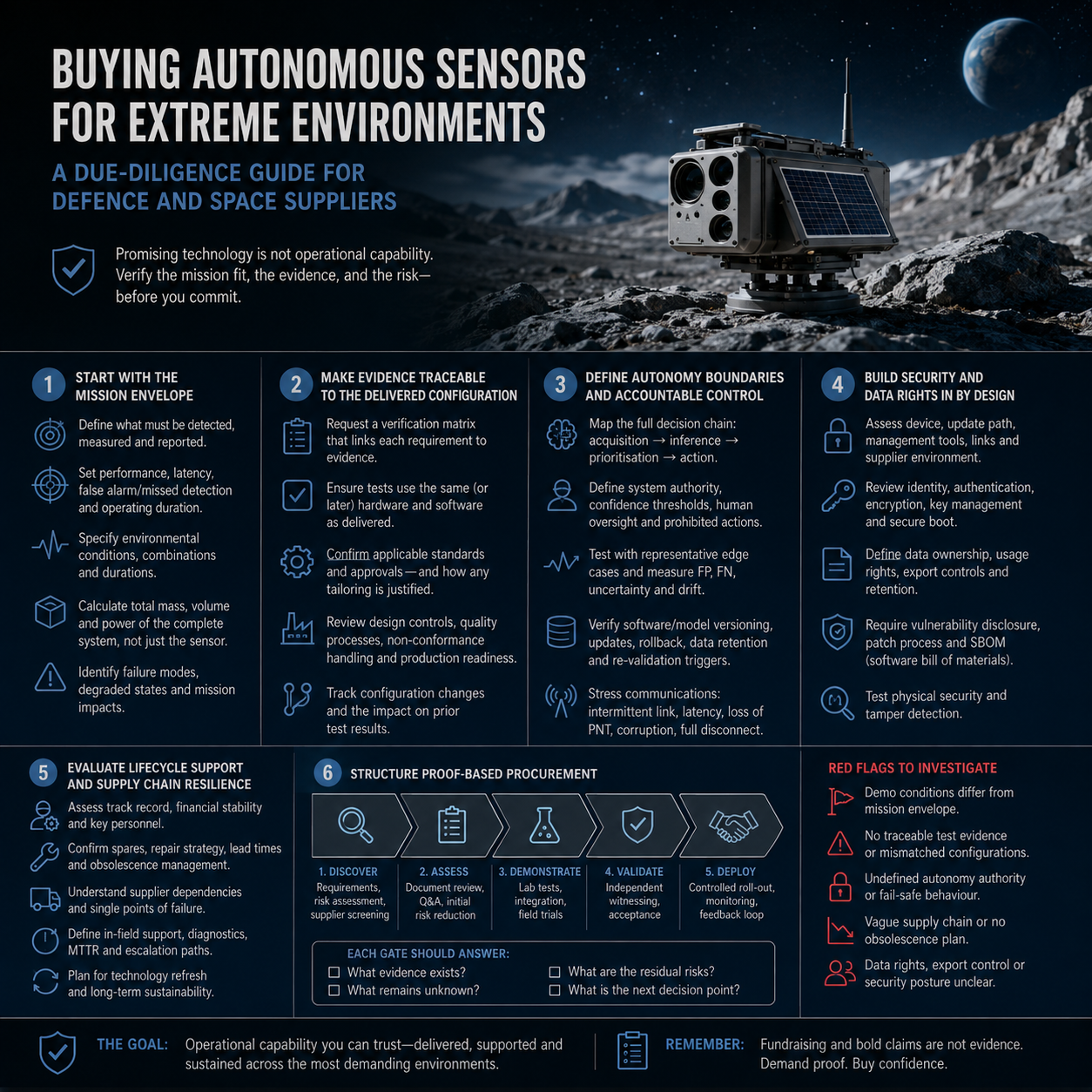
SpaceAM’s reported seed round provides a timely procurement lesson for aerospace, defence and dual-use operators. The UK company says it is developing ultra-lightweight, AI-powered autonomous sensing technology for difficult environments and intends to use the funding to scale. That proposition addresses an important mission need, but neither fundraising nor an attractive weight-and-autonomy concept establishes operational readiness.
Buyers in regulated, mission-critical markets must determine whether a promising sensor can survive its intended environment, integrate safely with existing systems and remain supportable for the life of the programme. The following staged framework separates those questions and shows how to move from an initial supplier review to evidence-based deployment without assuming technical performance, contracts or readiness levels not stated in the source.
Start with the mission envelope, not the product demonstration
A supplier demonstration is meaningful only when it represents the buyer’s operational conditions. Before requesting hardware, convert the mission into testable requirements: what must be detected or measured, at what distance and frequency, with what allowable error and latency? Define operating duration, duty cycle, deployment method and acceptable rates of missed detection and false alarm. Identify what happens if the sensor, communications link or autonomous function fails.
“Extreme environment” also needs a precise definition. A space payload may face launch vibration, vacuum, radiation, thermal cycling and limited opportunities for repair. A defence sensor may encounter shock, dust, salt fog, moisture, electromagnetic interference, concealment requirements, rough handling or deliberate disruption. Buyers should specify combinations and durations rather than accept evidence that a component survived isolated laboratory conditions.
Ultra-low mass can create real platform value, but weight should be assessed at system level. Record the mass and volume of the sensor, enclosure, mounting hardware, batteries, antennas, cables, thermal controls and processing equipment. Likewise, calculate average and peak power demand across sensing, inference, storage and transmission. A lightweight unit that needs substantial protection or power infrastructure may offer less mission advantage than its headline specification suggests.
Make qualification evidence traceable to the delivered configuration
Request a verification matrix linking every requirement to analysis, inspection, demonstration or test. Each result should identify the hardware and software version, test setup, calibration state, environmental profile, acceptance threshold and observed anomalies. Supplier-generated evidence can support early evaluation, but critical claims should eventually be witnessed by the customer or tested through an agreed independent facility.
Do not ask simply whether the product is “certified.” Applicable standards and approvals depend on the platform, jurisdiction, mission and procurement authority. Establish which environmental, electromagnetic, safety, quality and space- or defence-specific requirements apply, then classify evidence as complete, planned or not applicable. The supplier should explain any tailoring rather than presenting a collection of unrelated test certificates.
Configuration control is essential. Determine whether tested components match the proposed production design and whether changes to processors, sensor elements, batteries or enclosures would invalidate earlier results. For an emerging supplier, inspect design records, calibration procedures, non-conformance handling, software release controls and the route from prototype assembly to repeatable production. A successful prototype proves little about manufacturing yield or unit-to-unit consistency.
Define where autonomy ends and accountable control begins
Autonomous sensing can reduce bandwidth, operator workload or response time, but it introduces questions that a conventional sensor specification may not cover. Buyers should map the full decision chain: acquisition, preprocessing, classification, prioritisation, storage, transmission and any downstream action. Mark which stages are deterministic, model-driven, remotely configurable or dependent on external data.
Specify the authority granted to the system. Is it merely detecting and reporting, choosing what data to transmit, retasking itself or triggering another system? For every autonomous function, define confidence thresholds, human review requirements, prohibited actions, fail-safe behaviour and the conditions that force a degraded or manual mode. Mission safety should not depend on an unexplained output.
Evaluation must include representative edge cases, not only curated demonstrations. Agree how false positives, false negatives, uncertainty and performance drift will be measured. Ask how software and models are versioned, validated and rolled back; what operational data are retained; and whether an update requires renewed testing or approval. Evidence should distinguish laboratory accuracy from end-to-end mission performance.
Communications deserve separate scrutiny. Test intermittent and low-bandwidth links, latency, loss of positioning or timing inputs, corrupted messages and complete disconnection. Establish what the device stores locally, how it resumes operation and how operators identify stale or incomplete data. Interoperability should be demonstrated with the buyer’s actual interfaces, message formats, timing constraints and command architecture rather than inferred from a generic API.
Treat cybersecurity and data rights as design requirements
Security diligence should cover the device, its update path, management tools, communications links and supplier development environment. Buyers should examine identity and access controls, encryption, key provisioning, secure boot, signed updates, logging, vulnerability handling and recovery from compromise. Physical capture or unauthorised access may also be credible risks in contested environments.
Require a software and component inventory appropriate to the programme, including third-party dependencies. Contract terms should set responsibilities for vulnerability notification, patch development, validation and support. A patch that cannot be delivered securely—or that disrupts a certified configuration—is not an adequate remedy.
Data governance must identify who owns raw observations, derived outputs, operational logs and data used to improve models. Clarify where information is processed and stored, who can access it, and whether supplier personnel require specific clearances or controls. Export restrictions, security classifications, sovereign-data requirements and procurement rules should be reviewed early because they can affect technical architecture, staffing and support arrangements.
Investigate whether the supplier can sustain a programme
SpaceAM’s reported financing is relevant because scaling mission-critical hardware requires capital and organisational capacity. It should, however, trigger questions rather than serve as proof of continuity. Ask for a credible production plan covering facilities, tooling, test equipment, quality assurance, specialist staff, throughput assumptions and lead times. Review which processes are performed internally and which depend on subcontractors.
Build a component-level resilience view. Identify sole-source parts, long-lead items, controlled technologies and components vulnerable to obsolescence. Determine whether alternatives are qualified, how substitutions are approved and how much redesign a shortage could cause. Country-of-origin and export considerations should be checked throughout the bill of materials, not only against the supplier’s headquarters.
Support planning must cover calibration, inspection, battery replacement, fault diagnosis, software maintenance, spares and repair turnaround. For inaccessible space assets, buyers need redundancy and graceful degradation strategies. For deployed defence equipment, the questions include field servicing, technician training and operation without routine connectivity. Contractual provisions may also address technical-data access, source-code escrow or transition assistance, where proportionate and legally feasible.
Use gated demonstrations before an operational commitment
A staged agreement limits exposure while producing decision-grade evidence. The first gate should review mission requirements, architecture, regulatory constraints and claimed technical evidence. The second can fund a bench evaluation using representative power, interfaces and data. Acceptance criteria must be agreed before testing.
The third gate should expose the integrated configuration to relevant environmental and communications conditions, including failure modes. The fourth should be a limited field or platform demonstration with trained users, controlled scope and a documented safety case. Only after anomalies are resolved should the programme move toward production qualification and operational deployment.
Tie payments and options to measurable deliverables: approved designs, traceable test reports, interface compliance, security remediation, manufacturing readiness and support documentation. Record who pays for retesting, how design changes affect milestones and what happens if a critical dependency disappears.
Before committing, the buyer should be able to answer five questions with evidence: Does the complete system meet the mission’s mass, power and performance limits? Has the delivered configuration survived relevant environments? Are autonomy and failure boundaries understood? Can the system be integrated, secured and updated under operational constraints? Can the supplier manufacture and support it despite component, regulatory or financial disruption? If any answer remains speculative, the appropriate next step is another bounded milestone—not operational reliance.