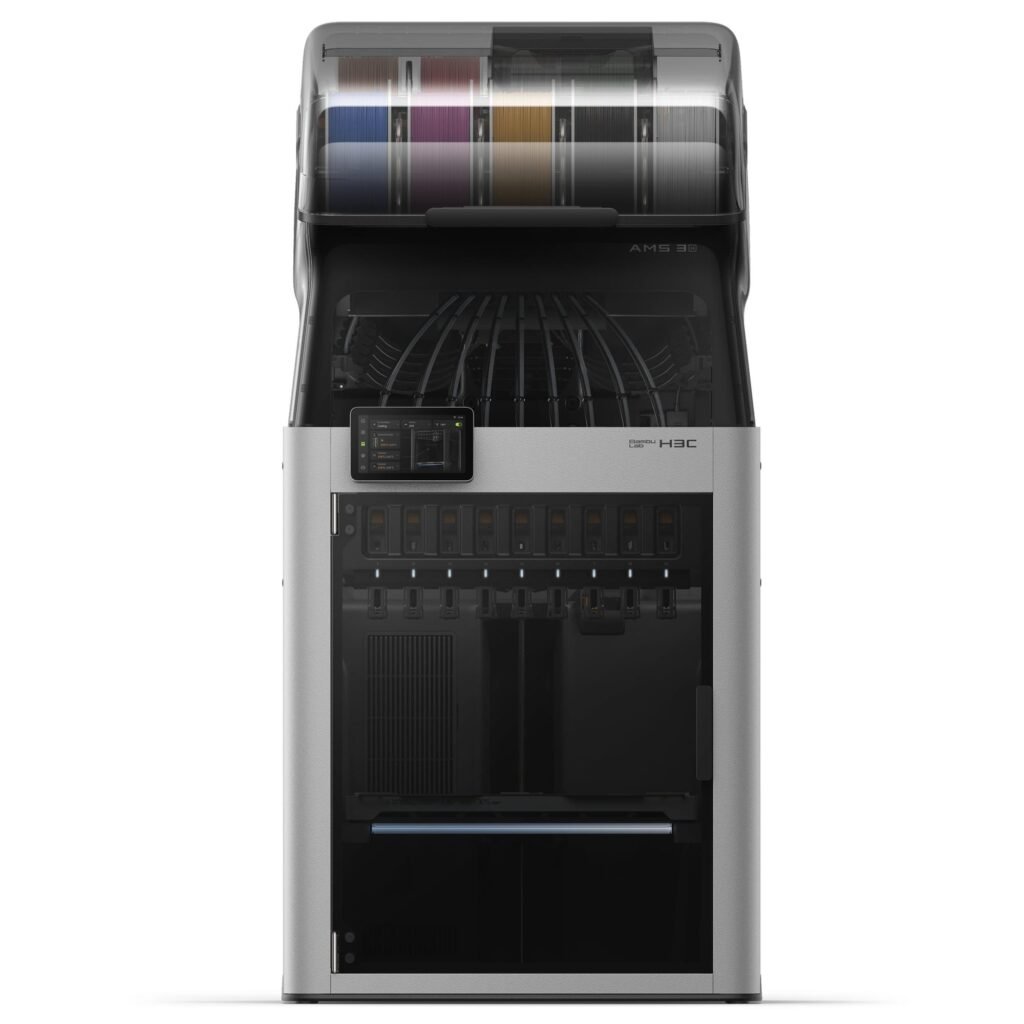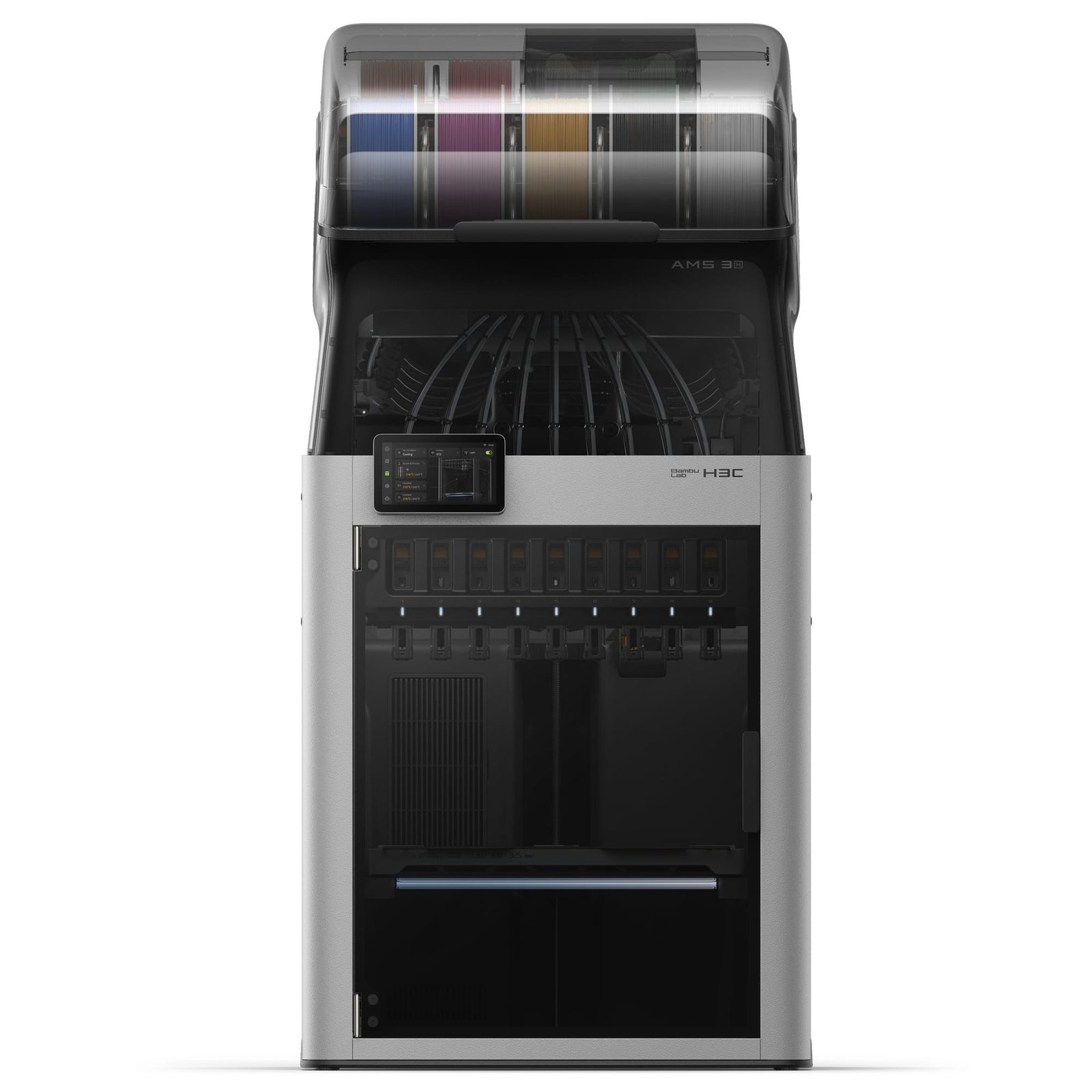
Bambu Lab H3C introduces nine dedicated print tools
Bambu Lab announced the H3C on November 3, 2026, describing it as its first third-generation FFF printer and the foundation for a new multi-material platform. Its defining feature is Swaptek, an architecture with nine independent print tools rather than a single nozzle that repeatedly unloads and reloads different filaments.
According to Bambu Lab’s technical explanation of Swaptek, every tool has its own filament path and heating system. The tools remain loaded and preheated, and the printer docks the active tool before collecting another. The company’s official announcement distributed through PR Newswire claims material changes take less than six seconds.
That timing is a manufacturer claim, not an independently verified benchmark. The cited material does not provide a test method, identify whether the result applies to every tool combination or quantify its effect on complete job times.
How the architecture could change multi-material work
A conventional single-nozzle multi-material workflow must remove one filament and feed another through a shared melt path. It may also need to purge residual material before printing can continue. Swaptek separates those paths by assigning each loaded filament to a dedicated tool.
This distinction creates a reason to investigate the H3C for prototypes containing multiple colors, support materials or polymers with different functions. It does not, by itself, prove lower waste or higher throughput. A tool may still need to prime after docking, and a print may require purge structures or other conditioning steps. Bambu Lab’s supplied documentation does not quantify those behaviors or compare waste by job type.
For low-volume production, tool-to-tool repeatability may matter more than the headline changeover time. Differences in nozzle position, extrusion behavior or temperature control could affect interfaces between materials. Buyers should request dimensional-tolerance data across all nine tool positions, including results after repeated docking and maintenance cycles.
Material and process details remain procurement gates
The announcement establishes nine independent tools, but the available evidence does not provide a complete compatibility matrix. A professional evaluation should establish which polymers can occupy adjacent tools in one job, supported nozzle materials and diameters, maximum tool temperatures, build-plate requirements and restrictions involving abrasive, flexible or high-temperature filament.
Compatibility involves more than whether each filament can be extruded separately. Procurement teams should ask how the system manages different chamber, bed and nozzle-temperature requirements within one build. They should also determine whether particular combinations have been validated for interlayer adhesion or soluble and breakaway supports.
Calibration is another open issue. Nine tools introduce multiple offsets and potentially multiple wear states. The cited sources do not establish how often tool offsets must be recalibrated, whether calibration is automatic, what happens after replacing one tool or nozzle, or how the machine detects a poor dock. Recovery procedures for failed pickup, filament runout, heater faults and interrupted multi-tool jobs also need documented answers.
Software, capacity and maintenance questions
The H3C’s value will depend partly on its slicer workflow. Buyers should verify which software versions can assign models or regions to nine tools, how prime and purge behavior is represented in time and material estimates, and whether production files use an open format or depend on Bambu Lab software and cloud services. Offline operation, account requirements, network controls, update policies and export options are relevant for organizations handling confidential designs.
The cited launch material does not state how much usable build volume is lost to docking, tool clearance or purge structures. Published external dimensions are also needed to plan workspace and ventilation. A nominal build-volume figure alone would not show whether all nine tools can reach the same printable area.
Maintenance planning should cover nine heaters, filament paths, docking interfaces and nozzles. Prospective operators need inspection and replacement intervals, cleaning procedures, spare-part lead times and the expected service life and price of each tool assembly. It is also important to establish whether one failed tool disables the printer or whether a job can be reassigned to another compatible position.
What buyers should obtain before adoption
- A validated material matrix: Including nozzle, temperature and multi-material restrictions.
- Measured job-level evidence: Tool-change time, priming or purge consumption, failed-change rate and total duration for representative parts.
- Calibration and recovery documentation: Covering offsets, tool replacement, docking errors and interrupted jobs.
- A complete capacity statement: Usable build volume with Swaptek operating and space required around the machine.
- Full configured cost: Printer, nine required tools, software or service dependencies, consumables, spares, shipping, taxes and maintenance.
- Commercial terms: Regional availability, warranty coverage, response times and parts support.
The H3C’s dedicated-path design is materially different from repeatedly feeding several filaments through one nozzle. However, Bambu Lab’s launch information supports the architecture and intended use, not a conclusion that it reduces waste, shortens complete production cycles or provides production-grade reliability. Adoption should therefore depend on a representative-part trial and written answers to the unresolved operating-cost and support questions.
Transparency: This assessment is based on Bambu Lab’s manufacturer documentation and announcement materials. MakeBusiness.eu has not performed first-hand testing of the H3C, and the performance claims discussed here have not been independently validated.