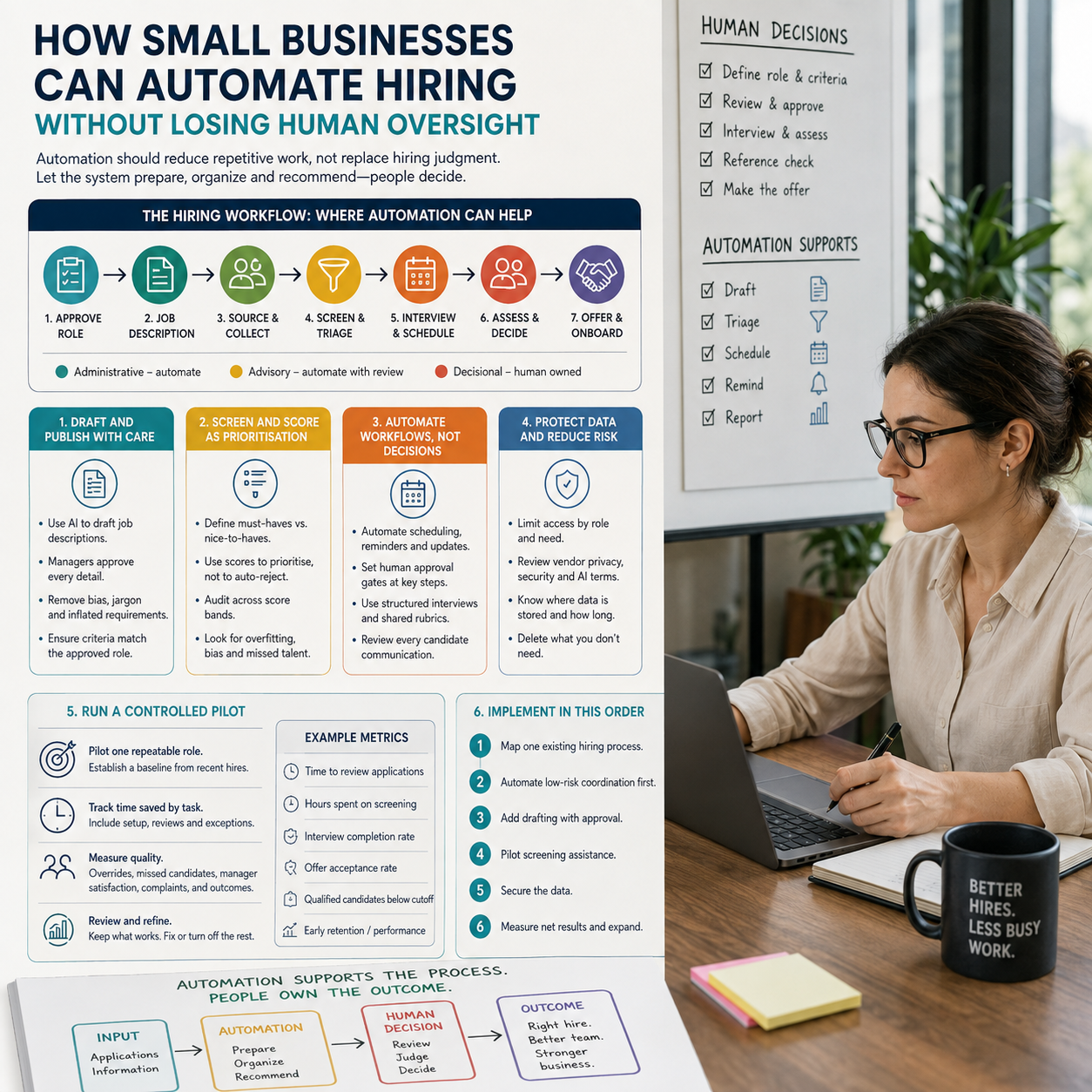
Hiring automation can help a small business process applications and coordinate interviews with less administrative effort. It can also amplify a vague job description, an unsuitable scoring rule, or an overlooked bias. The useful question is therefore not whether to automate recruitment, but where automation can reduce repetitive work without transferring consequential decisions to software.
Zoho Recruit provides a practical case study because its AI-assisted recruitment capabilities touch several stages of the process, including job-description creation, candidate matching or scoring, screening, and interview workflows. Reporting from Small Business Trends describes these capabilities as tools intended to streamline hiring. This guide uses that reported feature set as a reference point—not as evidence that every feature will suit every employer. The recommendations below are an operator framework for testing such tools responsibly.
Map the hiring workflow before configuring the software
Begin with the vacancy that your business fills most often. Write down every step from approval to hire, including who performs it, what information they use, how long it usually waits, and what decision ends the step. A typical flow might include role approval, job-description drafting, publication, application collection, eligibility checks, resume review, shortlist approval, interview scheduling, interviews, reference checks, and offer approval.
Label each step as administrative, advisory, or decisional. Administrative work—such as moving records, sending reminders, and scheduling—usually presents the clearest automation opportunity. Advisory work, including draft generation and candidate scoring, can be automated only if a person reviews the output. Decisional work, such as rejecting a borderline applicant, assessing interview evidence, or approving an offer, should retain named human ownership.
This classification prevents a common implementation error: enabling available features before defining who remains accountable. Software may rank, draft, or route information, but the business still needs an owner for the criteria and the outcome.
Automate drafts and triage, not hiring judgment
Job-description drafting
An AI-generated job description can provide a useful first draft, especially when a manager starts with an empty page. Supply concrete inputs: essential duties, reporting line, working arrangement, required credentials, expected outcomes, and genuinely necessary skills. Then require approval from the hiring manager before publication.
The reviewer should remove inflated qualification lists, ambiguous responsibilities, internal jargon, and language that could discourage qualified applicants. They should also verify that every screening criterion appears in the approved description. If the system later scores candidates against requirements that were never reviewed or disclosed, automation has made the process less defensible rather than more efficient.
Screening and resume scoring
Candidate scoring is best treated as prioritisation support. Define which criteria are minimum conditions, which are preferred, and which require contextual judgment. An objectively required licence may be appropriate for a structured check. Career gaps, employer prestige, writing style, or unconventional job titles should not silently become negative proxies.
Do not let a score become an automatic rejection merely because the platform makes that possible. During the pilot, have a person review candidates across the score range, including a sample below the proposed cutoff. Compare the system’s ordering with job-related evidence and record why disagreements occur. A low score may reveal a weak application, but it may also expose poor keyword matching, unusual resume formatting, or an overly narrow role specification.
Design interview automation around explicit checkpoints
Interview workflows contain high-volume tasks that are good candidates for automation: availability requests, calendar invitations, reminders, status changes, interviewer notifications, and standard candidate communications. These tasks are repetitive and governed by clear triggers. Automating them can shorten avoidable waiting without asking software to determine who deserves the job.
Place approval gates at the points where consequences increase. A practical workflow could require human approval before a candidate is rejected after screening, before an interview invitation is issued, after interview feedback is consolidated, and before an offer is generated. Assign each gate to a role rather than leaving it to “the team.”
Keep interviews structured. Use the same core job-related questions and a shared evaluation rubric for candidates applying to the same role. Automation can distribute forms and chase incomplete feedback, but interviewers must enter independent observations before viewing colleagues’ ratings. This reduces the risk that the first opinion anchors the rest of the panel.
Candidate messages also need supervision. Review templates for tone, accuracy, accessibility, and the correct sender identity. Escalate accommodation requests, complaints, and unusual circumstances to a person instead of routing them through standard sequences.
Test bias and protect candidate information
Bias control starts with the inputs. Review job requirements and scoring rules for criteria that are not demonstrably connected to performance. Test whether alternative terms, non-linear careers, overseas qualifications, or different resume structures produce unexpected results. Where legally and operationally appropriate, compare progression patterns across relevant groups, but avoid collecting sensitive information without a defined purpose and lawful basis.
Document what each automated feature does, what data it accesses, who can see the output, and how long records are retained. Candidate information may include contact details, employment history, salary expectations, interview notes, and other sensitive material. Limit permissions by role, remove access when staff responsibilities change, and avoid uploading information that is unnecessary for the hiring decision.
Before implementation, review the vendor’s current privacy, security, retention, deletion, and AI-processing terms rather than assuming that feature availability answers those questions. Determine where information is stored, whether subprocessors are involved, how deletion requests are handled, and whether customer data is used to improve models. Obtain legal or privacy advice where your jurisdiction or hiring practices require it.
Run a controlled pilot and measure both speed and quality
Pilot one repeatable role rather than switching every vacancy at once. Establish a baseline from recent comparable hiring: staff time spent drafting and screening, elapsed time between application and review, scheduling effort, interview completion, offer acceptance, and early retention or performance indicators already used by the business. Avoid inventing a universal target; improvement should be judged against your own process.
During the pilot, track minutes saved by task, not merely the number of automated actions. Include setup, exception handling, corrections, and human review time. A feature that generates a description instantly but creates extensive rewriting has not produced the apparent saving.
Quality measures should include the proportion of recommended candidates that humans advance, qualified applicants found below a score threshold, reasons for overriding rankings, interview-to-offer progression, candidate complaints, and hiring-manager satisfaction. Post-hire indicators can add context, but they should not be attributed to automation alone because onboarding, management, and labour-market conditions also influence outcomes.
At the end of the pilot, keep automation only where it removes work without weakening review. Expand scheduling and reminders if they are reliable. Continue AI drafting if managers improve and approve every output. Use scoring as advisory if audits show useful prioritisation. Disable automatic rejection or opaque ranking when the team cannot explain or validate the result.
A practical order of implementation
- Map one existing hiring process: identify delays, repeated data entry, and decision owners.
- Automate low-risk coordination first: reminders, scheduling, status routing, and standard acknowledgements.
- Add drafting with approval: require a hiring manager to verify every job description and message.
- Pilot screening assistance: define job-related criteria, audit candidates across score bands, and prohibit unattended rejection.
- Secure the data: review permissions, retention, deletion, integrations, and vendor terms.
- Measure net results: compare total staff time, waiting time, overrides, missed candidates, complaints, and hiring outcomes with the baseline.
The safest division of labour is straightforward: let the system prepare, organise, remind, and recommend; require people to define criteria, inspect exceptions, communicate sensitively, and make accountable decisions. That boundary allows a small business to gain administrative capacity without pretending that hiring judgment has become a software function.