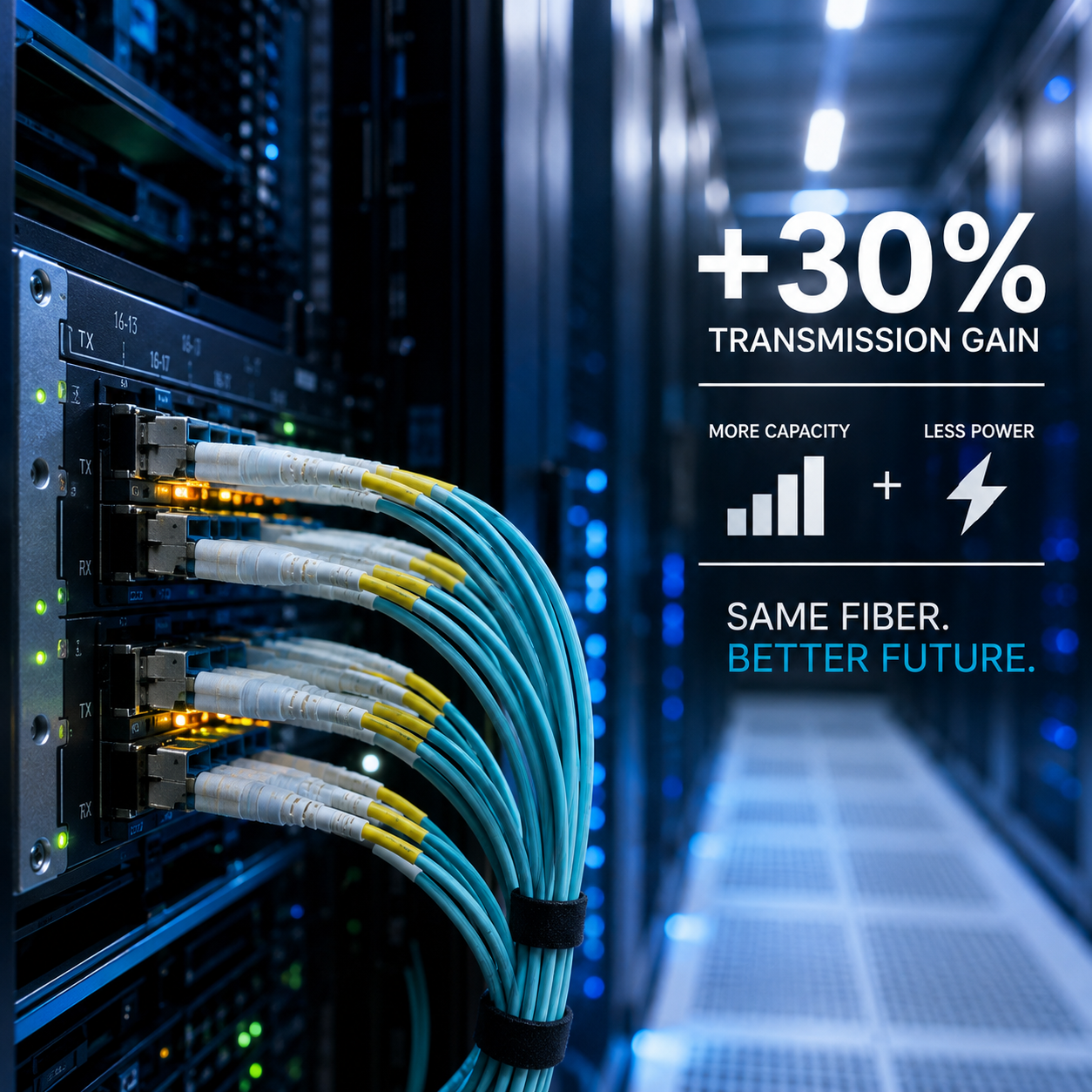
Relativity Networks says its hollow-core fiber can transmit data 30% faster than conventional optical fiber, according to TechCrunch. That is potentially meaningful for data centers, but it is not the same as making an application, AI cluster, or facility network 30% faster. Buyers must determine how much end-to-end delay comes from the fiber itself, whether the improvement persists in deployable cable, and whether it outweighs the cost and risk of introducing a new physical medium.
The company’s reported $22 million funding round indicates an effort to commercialize the technology. It does not resolve procurement questions about interoperability, installation, reliability, supply, or return on investment. For infrastructure teams, the sensible starting point is therefore a bounded test: identify links where propagation delay materially affects outcomes, measure the current latency budget, and evaluate hollow-core fiber against a conventional-fiber baseline under identical operating conditions.
What the 30% claim does—and does not—mean
Conventional optical fiber guides light through glass. Hollow-core fiber is designed so that light travels primarily through an air-filled core, where it can propagate faster than it does through glass. The reported 30% transmission advantage concerns this physical propagation component.
A production connection, however, includes more than time in the fiber. Its latency can also reflect transceivers, switches, network-interface cards, protocol processing, buffering, congestion, serialization, error correction, and application behavior. If those elements dominate a short link, reducing propagation delay may produce only a modest end-to-end improvement. Longer routes generally give propagation speed more room to influence the total, although route design and intermediate equipment still matter.
Procurement teams should consequently ask for results in units relevant to the intended deployment: one-way and round-trip latency over a stated distance, cable configuration, connector count, transceiver type, data rate, traffic pattern, and environmental conditions. A percentage without those parameters cannot establish operational value.
Where lower transmission delay may be valuable
Large, distributed AI clusters
AI training systems repeatedly exchange parameters, gradients, or other data among accelerators. Jobs can become sensitive to communication delay when computation must wait for collective operations or synchronization. Faster propagation could be useful where clusters span large halls, multiple buildings, or separated campuses and where measured network waiting time constrains accelerator utilization.
The strongest candidate is not simply an organization buying GPUs. It is an operator that can show, through workload traces, that physical-link latency forms a material part of communication stalls. Bandwidth, topology, congestion, switch delay, and software efficiency may remain larger constraints. Hollow-core fiber should therefore be compared with alternatives such as topology changes, better placement, fewer network hops, upgraded switching, or communication optimization.
Latency-sensitive facility and inter-building links
Links between data-center buildings may accumulate enough distance for propagation improvement to become measurable. Potential candidates include tightly coupled compute environments, replicated services with demanding response targets, and internal systems that make frequent sequential network exchanges. By contrast, ordinary storage, backup, management, or bulk-transfer traffic may care far more about throughput, availability, and cost than a reduction in propagation delay.
Operators should also distinguish a technically detectable gain from a commercially useful one. A lower median latency may have little value if the workload is governed by tail latency, while an improvement to the slowest critical transactions could matter disproportionately. Testing should include latency distributions under realistic load, not only an unloaded average.
The technical gates before a production trial
Benchmark comparability: Request a direct comparison with the incumbent single-mode fiber over equal route length and equivalent endpoints. Document whether the claim comes from a fiber specimen, finished cable, installed route, or complete network. Include bends, splices, connectors, patch panels, and expected operating temperatures.
Equipment compatibility: Confirm supported wavelengths, transceivers, connector interfaces, launch conditions, power budgets, and data rates. Determine whether deployment requires specialized coupling hardware, monitoring tools, or termination processes. A fiber that works with existing optics and switching has a different adoption profile from one requiring an additional equipment stack.
Optical and network performance: Evaluate attenuation, insertion loss, return loss, signal integrity, error rates, and stability across the intended distance. Test both latency and throughput. Faster propagation cannot compensate for a link that introduces unacceptable loss, errors, or operational variability.
Installation constraints: Ask about minimum bend radius, pulling tension, routing, field termination, splicing, testing, and repair. Data-center pathways are crowded and frequently reconfigured; performance must survive actual installation rather than ideal laboratory handling. Establish whether ordinary contractors can perform the work or whether certified specialists are required.
Reliability evidence: Seek accelerated-aging data and field evidence covering temperature cycling, vibration, moisture exposure where relevant, repeated handling, and connector durability. Buyers need defined failure modes, inspection procedures, repair times, warranties, and replacement commitments.
The commercial gates are equally important
A new cable type creates supply-chain and operating dependencies even if its physical performance is compelling. The funding reported by TechCrunch is evidence that Relativity Networks is pursuing commercialization, but buyers still need evidence of manufacturing repeatability and delivery capacity.
Due diligence should cover qualified production volume, lead times, manufacturing locations, quality-control processes, second-source prospects, and plans for demand spikes. Buyers should ask what happens if the supplier changes a design, misses delivery, or ceases supporting an early product generation. Contract terms may need inventory commitments, notification periods, acceptance criteria, and remedies for non-conforming batches.
Standards status also affects risk. Determine which cable, fire-safety, building, optical-interface, installation, and test standards apply; what certifications have been completed; and where proprietary methods remain. A product can be usable before broad standardization, but the buyer then assumes greater responsibility for validation, workforce training, and long-term support.
Total lifecycle cost must extend beyond cable price. Include design work, pathway changes, specialized optics or connectors, installation labor, certification, testing equipment, staff training, spare inventory, repair procedures, downtime exposure, and eventual replacement. Account for the opportunity cost of disrupting a live environment. The benefit side should use a workload-specific measure, such as reduced job completion time, improved accelerator utilization, lower application response time, or deferred construction—not an assumed 30% improvement in the whole system.
A procurement path that limits downside
Begin by instrumenting one candidate workload and decomposing its latency. If propagation is immaterial, stop: hollow-core fiber is unlikely to be the best first intervention. If it is material, define the minimum end-to-end improvement needed to justify change.
Next, run a laboratory comparison using production-intent cable and the equipment planned for deployment. Require raw measurements and test both steady-state and stressed conditions. Follow with a contained route that reflects real bends, patching, installation practices, monitoring, and repair procedures.
Before expanding, buyers should be able to answer:
- Was the 30% transmission claim reproduced over the relevant distance and finished-cable configuration?
- How much did the target workload improve end to end, including tail behavior?
- Can existing transceivers, switches, connectors, and test tools remain in service?
- Can regular installation and maintenance teams handle the medium safely and consistently?
- Do reliability evidence, warranty terms, and replacement times match the facility’s risk tolerance?
- Can supply scale to the planned rollout, with acceptable dependence on one vendor?
- Which standards and certifications apply, and which deployment elements remain proprietary?
- Does lifecycle value exceed both the conventional-fiber baseline and less disruptive alternatives?
The strongest early deployment case is likely to combine meaningful physical distance, a demonstrably latency-bound workload, measurable economic value per unit of delay, and a route that can be isolated if problems emerge. For other environments, conventional fiber’s maturity, broad ecosystem, and operational familiarity may outweigh the incremental speed. The procurement decision should rest not on whether light moves faster in hollow-core fiber, but on whether that advantage survives the entire installed system and changes a business-relevant result.