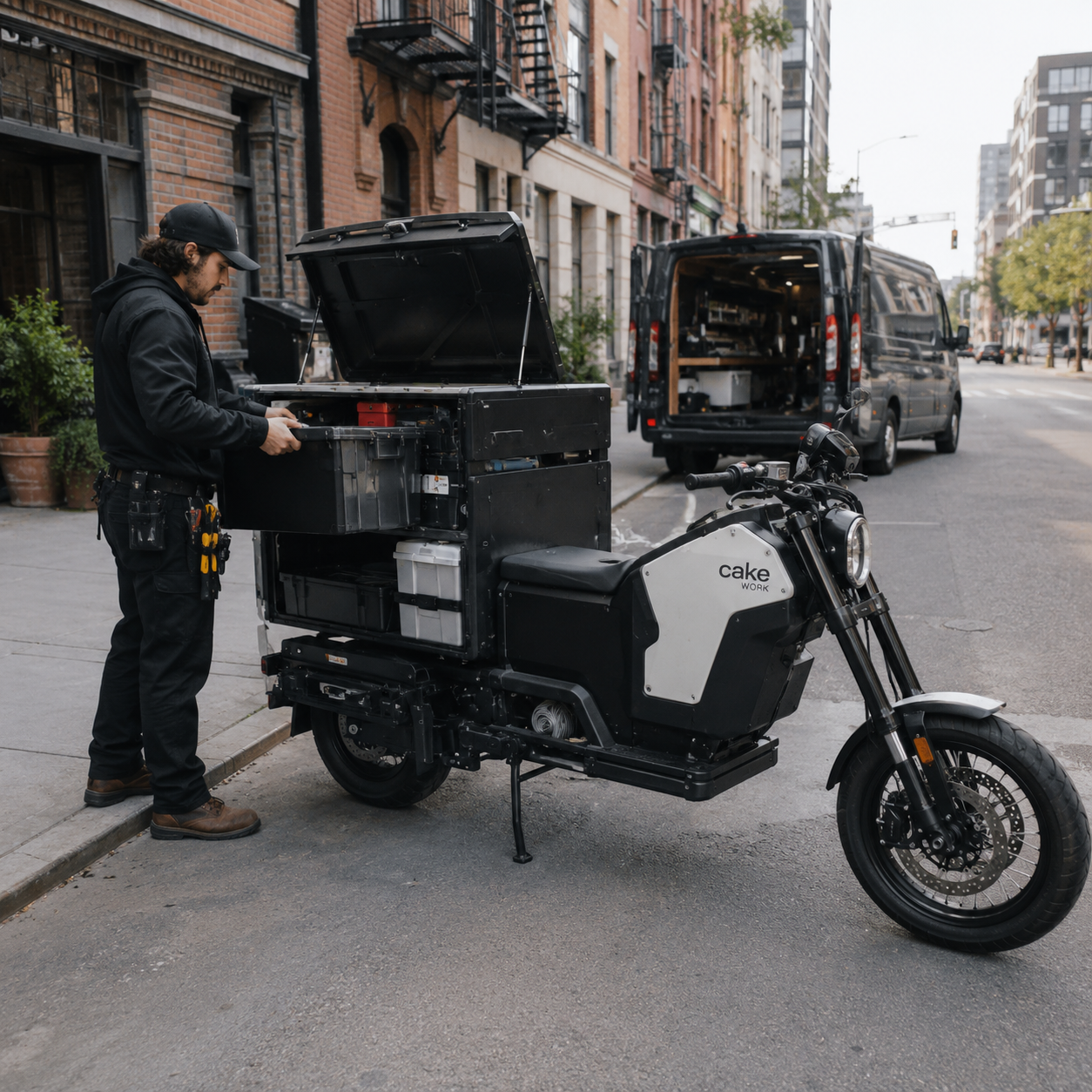
A van often remains the default choice for urban deliveries and mobile work—even when much of its capacity travels empty. Any’s LUV1 offers a different proposition: an electric motorcycle designed around modular cargo carrying. TechCrunch reports that the vehicle provides 120 litres of cargo space, making load utility rather than passenger transport central to its design.
For couriers, tradespeople, retailers and field-service firms, the relevant question is not whether a smaller vehicle can replace every van. It is whether a defined group of routes can be completed more efficiently with less vehicle. The answer depends on cargo dimensions, working range, weather, rider safety and downtime—not cargo volume alone.
What a 120-litre modular platform could—and could not—replace
The reported 120-litre capacity is a useful starting point, but litres do not reveal the full carrying capability. A compact box of replacement parts and a set of long tools may have similar volume yet require entirely different compartments. Operators need the internal dimensions, opening size, payload limit, weight distribution rules and available modules before judging fit.
A cargo-focused motorcycle may suit routes involving small parcels, prepared food, pharmacy items, documents, samples, consumables or compact service kits. Potential field-service users include technicians carrying diagnostic equipment and selected spare parts, locksmiths with secured tool sets, property inspectors, and maintenance staff responding to predictable jobs. Retailers could use it for local orders or stock transfers that consistently fit the platform.
It is less plausible as a van substitute when work requires ladders, bulky machinery, many uncertain spare parts, multiple workers, temperature-controlled space, substantial waste removal or protection for fragile oversized goods. Payload matters as much as volume: dense components can reach a vehicle’s weight limit while leaving space unused. A modular motorcycle should therefore be considered a route-specific van alternative, not a universal replacement.
Where the operating advantage may appear
Smaller powered two-wheelers may reduce time lost searching for suitable parking and make frequent urban stops easier. Those advantages are most relevant on dense routes with short distances between jobs, limited loading space and relatively small consignments. A technician completing several appointments in a congested district presents a stronger use case than one travelling between distant sites with unpredictable equipment needs.
Electrification may also change energy and routine-maintenance costs, but no saving should be assumed without operating data. Electricity tariffs, charging losses, battery treatment, service intervals, tyre consumption, insurance and financing all affect the result. Rider wages can dominate route economics, so minutes saved—or added—at each stop may matter more than energy expenditure.
A smaller vehicle can introduce new burdens. Rain, heat and cold affect rider comfort and may influence range or charging. Loading must remain secure and balanced. Staff may need motorcycle licences, protective equipment and additional training. Theft or vandalism can interrupt operations, while a specialist model may have fewer service options or slower parts availability than an established van.
Compare vehicles route by route, not fleet by fleet
The right benchmark is the smallest vehicle that can complete a route safely and reliably. Cargo bikes can be attractive for short, dense routes with lighter loads and suitable cycling infrastructure. They may face limitations involving distance, gradient, weather, payload or secure storage. Electric scooters offer agility but usually provide a different cargo configuration. Conventional motorcycles may serve longer routes, although they are not necessarily designed around business cargo modules.
Compact vans retain advantages when payloads are large or variable, operators need enclosed working space, two employees travel together, or equipment must be protected from weather. Their disadvantage is carrying that capability through every congested stop, even when it is unnecessary.
Segment work using actual dispatch records. Separate routes by maximum load, largest item, number of stops, distance, parking delay, road type and seasonal conditions. A modular electric motorcycle may replace a van on morning parcel rounds while remaining unsuitable for afternoon installation jobs. Mixed fleets can capture this distinction instead of forcing one vehicle category onto every assignment.
Run a pilot under real working conditions
Begin with routes where every historical load appears to fit, then physically test representative items. Do not rely on stated volume: load the tools, packaging and consumables staff really carry. Verify that compartments can be opened at the kerb, goods can be retrieved in stop order, and the vehicle remains stable with uneven or diminishing loads.
Measure range as an operational constraint
Published or expected range is not a substitute for field measurement. Record energy use with the normal payload, repeated stops, urban speeds, hills, cold or hot weather, and any powered accessories. Include travel to depots, charging locations and alternate assignments. Establish a reserve policy so riders are not expected to finish shifts near depletion.
Charging must fit the duty cycle. Confirm where the vehicle can be charged, who manages cables or removable batteries if applicable, how long charging occupies the asset, and whether overnight access is dependable. Test the response to a missed charge, power interruption or unexpectedly extended route.
Test the work system, not only the vehicle
Track total shift time, stop duration, unsuccessful jobs, parking or access delays, loading time and cargo damage. Gather rider feedback on visibility, balance, manoeuvring, weather exposure, fatigue and protective clothing. Assess safe parking at the depot and customer sites, including locks, immobilisation, tracking and cargo-compartment security.
Before carrying customer goods or professional equipment, obtain written guidance on insurance coverage, licensing, permitted use and local road or parking rules. Confirm maintenance intervals, nearby service capacity, parts lead times, roadside support and warranty terms. Ask what replacement vehicle is available when the motorcycle is damaged or awaiting a component.
Build a total-cost comparison around completed work
Compare cost per completed route or service visit rather than purchase price alone. Include acquisition or lease payments, financing, charging equipment, electricity, insurance, registration, rider training, protective clothing, maintenance, tyres, security systems and expected residual value. Add the operational cost of charging time, cleaning, weather disruption and downtime.
Apply the same discipline to alternatives. A van comparison should include fuel or electricity, parking costs, maintenance and time lost accessing customers. Cargo bikes and scooters need realistic allowances for capacity constraints and any extra trips. Avoid assigning a monetary saving until the pilot establishes actual route time, availability and completion rates.
The LUV1’s reported modular design and 120-litre cargo space make it a credible vehicle to evaluate where vans are routinely underfilled. A replacement decision should follow only if the pilot demonstrates cargo fit, dependable working range, safe rider conditions and resilient support. Start with one repeatable route, test it across representative weather and workload, and retain a fallback vehicle. Expand only to route types that reproduce the evidence—not simply because they operate in the same city.


