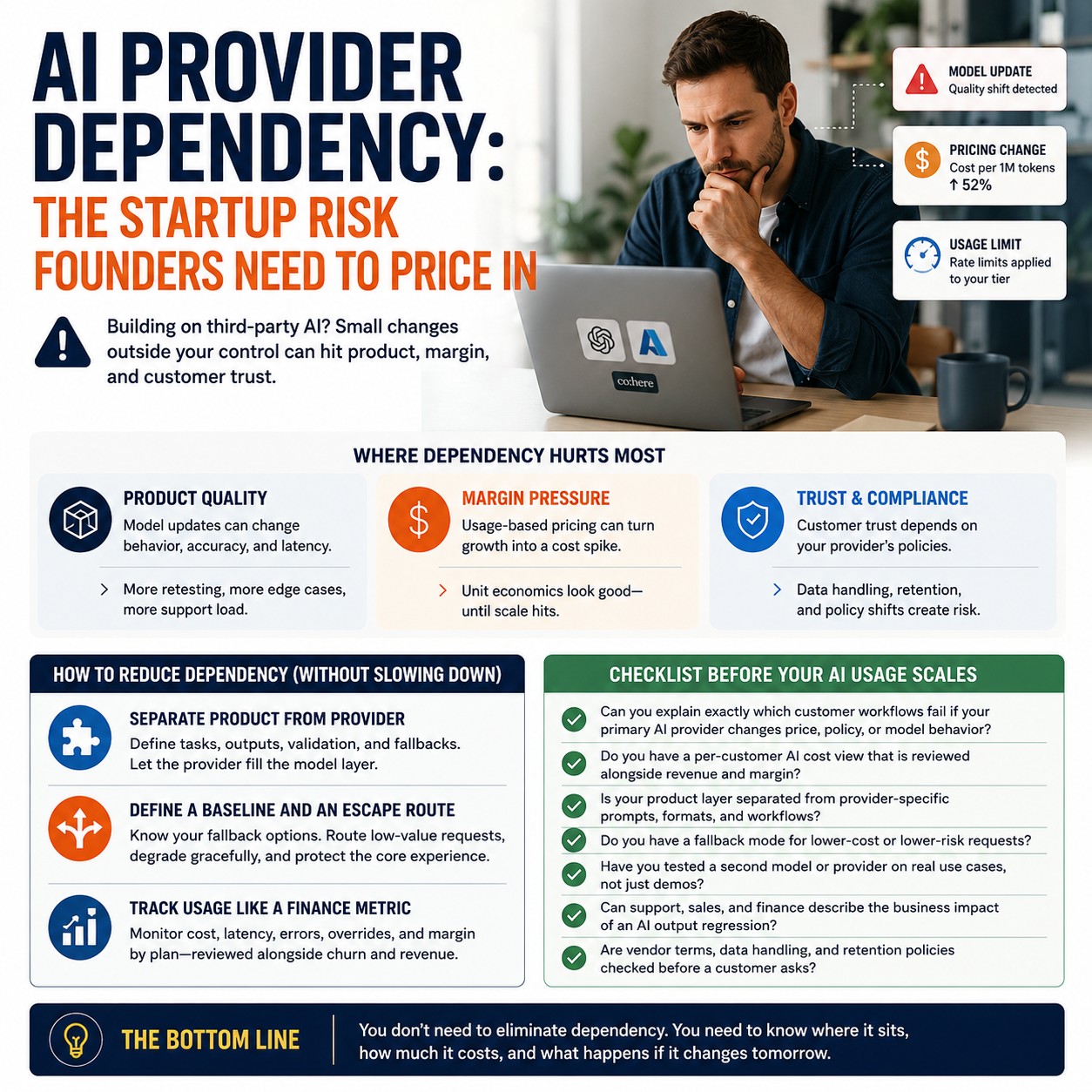
For many founders, AI infrastructure feels easy until one provider change starts rewriting the business model. Model quality shifts, pricing changes, usage limits appear, and a product that looked stable suddenly depends on decisions made outside the company. If you are building on top of third-party AI, this is not a technical footnote; it is an operating risk.
Why AI dependency is now a business issue, not just an engineering one
The immediate danger is not that a provider fails completely. It is that the provider changes something small enough to pass in a weekly release note but large enough to affect customer outcomes, gross margin, or support load. A model update can alter output quality, latency can affect conversion, and usage-based pricing can turn growth into a cost spike.
The bigger problem is concentration. When one provider controls your core capability, you inherit its roadmap, policy shifts, and commercial terms. That matters most for startups selling AI features as part of a subscription, because the feature cost can move faster than revenue.
What the latest startup signals are telling founders
The clearest signal comes from the increasing number of European startups building entire products around AI infrastructure, while investors and operators are starting to treat provider dependence as a risk category. That concern shows up in the warning that a single provider decision can shape an AI startup’s future, especially once the product is already live with customers.
The funding news around energy and flexibility platforms also points to a broader pattern: startups that depend on external systems need resilience in the stack, whether the dependency is on AI models, grid APIs, or hardware partners. The logic is the same. If your product requires someone else’s platform to stay available and economically viable, you need a contingency plan before scale exposes the weakness.
Where dependency hurts most: product, margin, and trust
There are three places AI provider dependency usually becomes visible.
First, product quality. If the model behaves differently after an update, your team has to spend time retesting prompts, workflows, and edge cases. That is not just an engineering task; it can change sales demos, onboarding flow, and support expectations.
Second, margin. AI-heavy products often start with generous unit economics at low volume, then lose control of cost as usage grows. If you cannot forecast per-customer AI cost with enough precision, pricing becomes guesswork. That is especially dangerous in flat-rate plans where power users can consume far more than expected.
Third, trust and compliance. Customers increasingly ask where data goes, how long it is retained, and whether vendor changes affect their risk profile. If your answer depends on one provider’s policy, your contract language and procurement process can become a bottleneck.
How to reduce dependency without slowing the product down
The answer is not to abandon AI providers. It is to stop treating them as interchangeable back office utilities. A good operating model makes the dependency visible and contains the blast radius.
Start by separating the business logic from the provider logic. The product should define the task, output format, validation rules, and fallback behavior. The provider should only fill in the model layer. That makes it easier to switch models or route some traffic elsewhere without rewriting the whole product.
Next, define a baseline and an escape route. If the primary model becomes too expensive or too inconsistent, what happens? Can you route low-value requests to a cheaper model? Can you degrade from full generation to assisted templates? Can you pause a feature without breaking the rest of the customer experience?
Finally, track usage like a finance metric, not just a technical metric. Per-account token consumption, error rates, response time, manual override rate, and margin by plan should all be visible in the same review cycle as churn and conversion. That is how founders catch a problem before it becomes a renewal issue.
What most people miss
The hidden risk is not just provider lock-in. It is product lock-in to a specific AI behavior. If your workflow, pricing, and sales promise all assume one model’s output style, changing providers can feel like changing the product itself. The sooner you standardize evaluation, fallback rules, and cost monitoring, the less painful that change becomes.
What founders should decide now
This is the right moment to ask whether AI is a feature, a core dependency, or the product itself. Those three cases require different levels of resilience.
If AI is a feature, you can usually tolerate more provider concentration, but you still need cost controls and fallback behavior. If AI is core to the workflow, you need a second-source strategy, evaluation harnesses, and contractual review. If AI is the product, dependency planning should sit alongside revenue forecasting and customer success as a board-level issue.
For smaller teams, the practical move is not heavy enterprise architecture. It is disciplined packaging: choose one primary provider, one backup option, and a standard way to test quality before every meaningful release. That gives you leverage without forcing premature complexity.
Use this checklist before your AI usage scales
- Can you explain exactly which customer workflows fail if your primary AI provider changes price, policy, or model behavior?
- Do you have a per-customer AI cost view that is reviewed alongside revenue and margin?
- Is your product layer separated from provider-specific prompts, formats, and workflows?
- Do you have a fallback mode for lower-cost or lower-risk requests?
- Have you tested a second model or provider on real use cases, not just demos?
- Can support, sales, and finance describe the business impact of an AI output regression?
- Are vendor terms, data handling, and retention policies checked before a customer asks?
Founders do not need to eliminate dependency. They need to know where it sits, how much it costs, and what happens if it changes tomorrow.