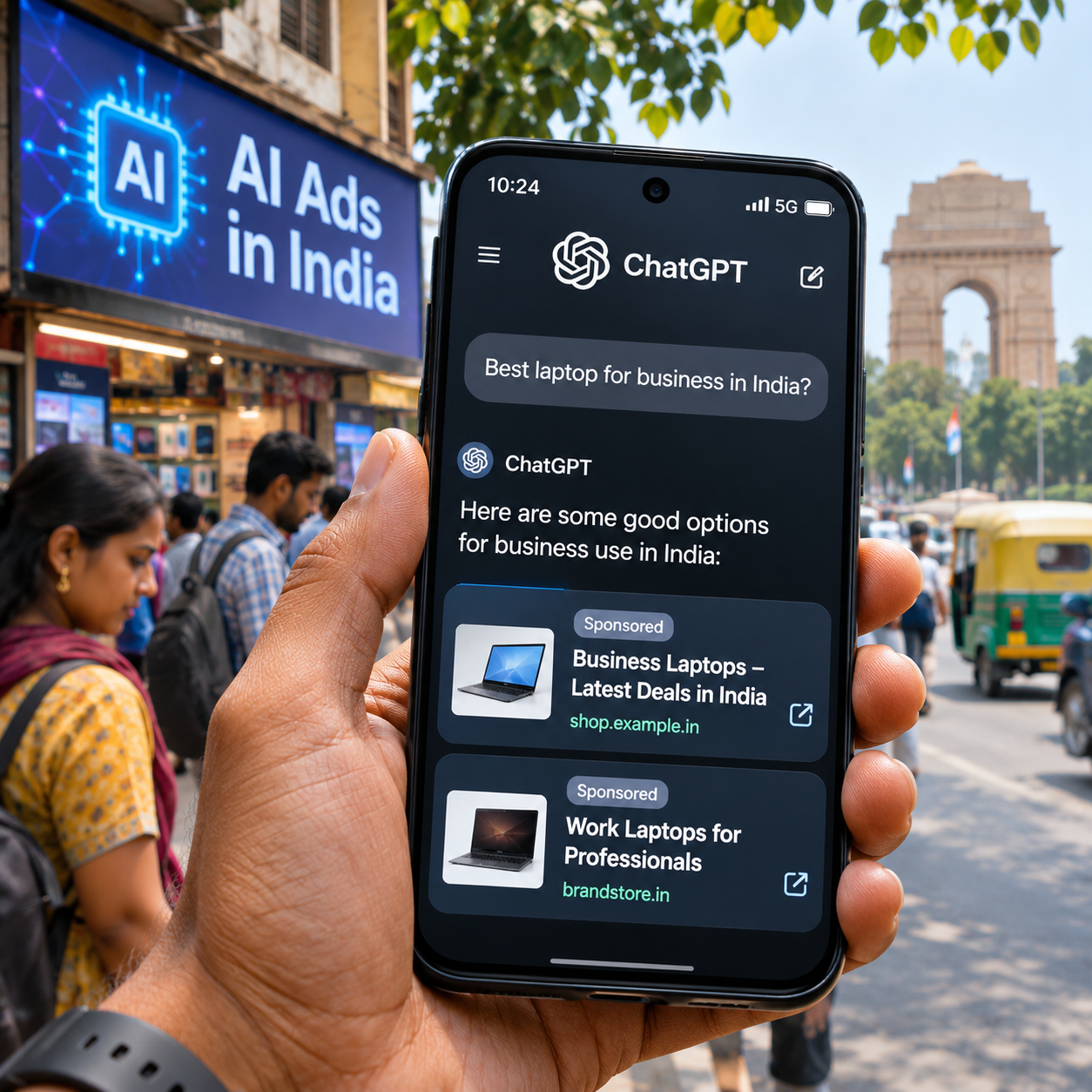
OpenAI’s introduction of advertising on ChatGPT’s free and Go tiers in India turns an AI assistant into a new kind of commercial environment. For advertisers, publishers, e-commerce operators and brands, the opportunity is not simply another source of impressions. Ads may appear while users are asking questions, comparing options or trying to solve problems—contexts that can reveal intent but also carry higher expectations of neutrality and trust.
TechCrunch reports that OpenAI is beginning to show ads to eligible ChatGPT users in India and separating those placements from generated answers. The audience scale described in the report makes India a meaningful test market. Yet businesses should resist treating this as established search, social or display inventory. The practical task is to determine what the channel can accomplish, what evidence it provides and what remains unknown before committing meaningful budget.
What changes when an AI conversation carries advertising
ChatGPT has primarily been experienced as a conversational product: users ask questions and receive generated responses. Advertising introduces a second layer—the paid placement—alongside that interaction. This changes the commercial context even if the generated answer itself remains independent.
The distinction matters. According to TechCrunch, OpenAI says ads are separate from answers and do not influence ChatGPT’s responses. Businesses should therefore distinguish two forms of visibility:
- Paid visibility: a clearly identified placement purchased through the advertising product.
- Organic inclusion: a brand, product, publisher or source appearing in a generated answer because of the model’s response process, not because the business bought an ad.
An advertising purchase should not be interpreted as a way to enter, improve or control the answer. Marketing teams should document this internally so executives do not assess the campaign by monitoring whether the brand begins appearing in generated recommendations.
The conversational setting also affects user expectations. A person may be researching a purchase, but they may instead be seeking education, troubleshooting or sensitive guidance. Relevance depends not only on the topic but on whether an advertisement is appropriate at that moment. That makes placement context and exclusions as important as audience reach.
Choose objectives that fit an experimental channel
Until businesses can examine stable delivery, reporting and attribution, ChatGPT advertising is best evaluated as a controlled test rather than a dependable performance channel. Appropriate initial objectives may include qualified site visits, product discovery, offer engagement or incremental reach among Indian users of the supported tiers.
Objectives requiring precise end-to-end attribution deserve more caution. A conversational journey may include an ad exposure, further questions, independent research and a later direct visit. Last-click measurement could understate influence, while broad attribution windows could overstate it. Teams should decide in advance which evidence would justify continued investment.
A useful test brief should define:
- one audience or customer need the campaign is intended to address;
- one primary outcome, such as qualified sessions or completed purchases;
- secondary indicators, including bounce rate, engaged-session quality or assisted conversions;
- a fixed budget and duration that limit downside;
- a comparison point from an existing channel serving a similar objective;
- minimum reporting requirements necessary to make a decision.
Not every advertiser will be equally suitable. Businesses with a clear proposition, informative landing pages and the ability to isolate traffic sources are better prepared than those relying on vague awareness claims or fragile attribution. Publishers should additionally consider whether paid distribution produces loyal readers or merely one-off visits. E-commerce operators should test whether conversational context leads users to category, product or comparison pages—and whether those pages answer the question implied by the click.
Interrogate placement, targeting and reporting before buying
The source establishes the launch and reports information about how ads are presented, but businesses should not infer unannounced formats, targeting controls or auction mechanics. A media plan should be based only on capabilities confirmed in the buying interface or directly by OpenAI.
Before participating, request precise answers to operational questions:
- Where can an ad appear relative to the conversation and generated response?
- How is it labelled, and is that label equally clear across devices?
- Which contextual, demographic or geographic controls are actually available?
- Can advertisers exclude topics, query classes or sensitive contexts?
- What constitutes an impression, engagement or billable click?
- Which campaign, placement and conversion reports can be exported?
- Are independent verification or third-party measurement integrations supported?
- What invalid-traffic and refund policies apply?
Targeting descriptions require particular scrutiny. If delivery uses conversation context, advertisers need to understand at a policy level how that context is processed, retained and converted into an ad decision. They should not assume access to users’ prompts or conversation histories. Privacy and legal teams should review the documented data flows rather than extrapolating from targeting labels.
Pricing is another unresolved decision variable. Without established benchmarks, a low click price does not prove efficiency, and a high one does not prove premium intent. Compare cost against qualified outcomes and incremental value, not novelty or raw traffic alone.
Brand safety and user trust need separate controls
Traditional brand-safety checks ask whether an ad appeared beside harmful or unsuitable content. A conversational interface adds further questions: What was the user trying to accomplish? Could the placement look like part of the assistant’s recommendation? Does the generated material immediately surrounding it contradict the advertiser’s claim?
Clear visual and textual separation between ads and answers is therefore commercially important, not merely a design detail. If users misunderstand paid placement as model endorsement, short-term response could create longer-term distrust. Brands should review screenshots or previews across supported surfaces and assess whether an ordinary user would immediately recognise the commercial message.
Advertisers should establish escalation rules for unsuitable adjacency, misleading rendering and complaints. Regulated sectors need stricter review because conversational questions may involve health, finance or other sensitive decisions. Even where a placement is technically permitted, the reputational risk may exceed the value of the impression.
Publishers and commerce brands should also monitor referral quality and sentiment. High traffic combined with confused visitors, customer-service complaints or poor conversion may indicate a context mismatch. User response should be assessed through behavioural data and feedback, not click-through rate alone.
Prepare now without assuming the model will scale unchanged
Businesses interested in the India test can become operationally ready without making a large commitment. First, separate the test budget from established search, social and affiliate allocations. This prevents an experimental channel from escaping scrutiny because it is blended into broader performance reporting.
Second, create dedicated tracking parameters and landing experiences. Conversational traffic may arrive with a more specific question than a generic campaign visitor. Landing pages should explain the proposition quickly, substantiate claims, show price or availability clearly where relevant, and provide an obvious next step. Do not imply that ChatGPT or OpenAI recommends the product unless an authorised arrangement explicitly permits that claim.
Third, define a measurement ladder: verified delivery, qualified engagement, conversion, assisted conversion and incremental business value. Record attribution assumptions before results arrive. Where volume permits, use holdouts or regional comparisons rather than relying solely on platform-reported conversions.
Finally, maintain a launch watchlist covering market expansion, eligibility, formats, controls, privacy documentation, pricing and third-party measurement. India’s rollout is commercially significant, but it does not establish that identical inventory will reach other markets or that policies will remain unchanged.
The immediate decision is not whether ChatGPT ads are universally effective. It is whether a business has a suitable objective, sufficient safeguards and a measurement design capable of learning from an unfamiliar interface. Treat paid placement as distinct from organic answers, cap the initial exposure and demand evidence on context and outcomes. That approach preserves the value of early learning without mistaking a prominent product launch for a proven media channel.