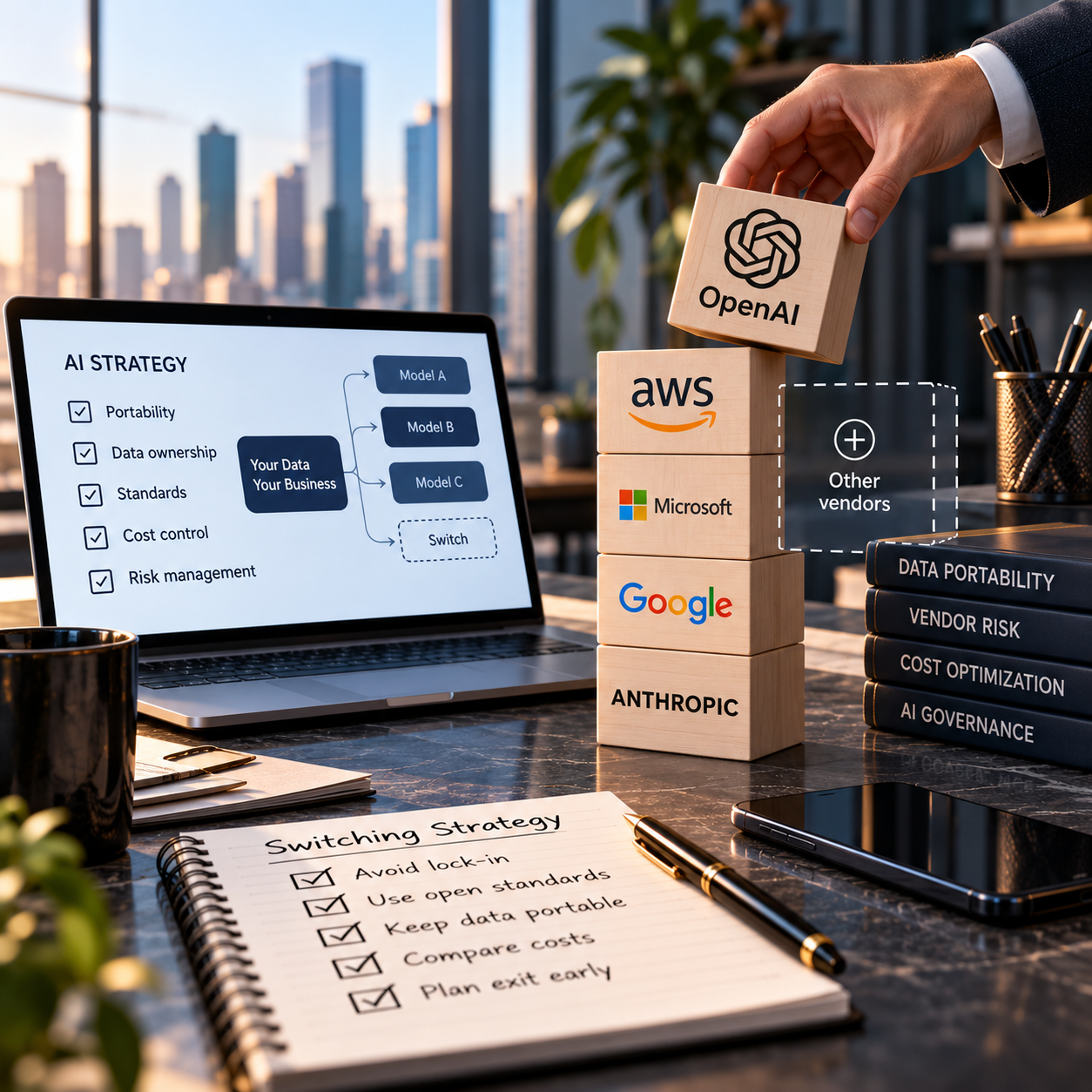
Enterprise buyers should treat leading AI models less like permanent platforms and more like fast-changing suppliers. TechCrunch reports new data indicating that business usage is shifting between OpenAI and Anthropic as their models improve. The important procurement signal is not a permanent winner or a market-share forecast. It is that model preference can change quickly when performance changes.
That weakens the case for tying a workflow unnecessarily to one provider. Yet supporting several vendors also carries costs: more integrations, security reviews, testing, monitoring, and operational complexity. The practical objective is therefore not “multi-model everywhere.” It is selective portability—preserving the ability to switch where model quality, continuity, or negotiating leverage materially affects the business.
Read changing usage as a procurement signal
The reported movement between OpenAI and Anthropic suggests that enterprise adoption may be less sticky than conventional software procurement. A CRM or accounting-system migration can require data conversion, process redesign, and extensive retraining. An AI model can sometimes be replaced behind an existing interface, although real-world switching is rarely as simple as changing an API endpoint.
Models differ in prompt interpretation, tool use, output structure, context handling, safety behavior, latency, and error patterns. Provider-specific features—such as assistants, file stores, retrieval services, agent frameworks, or proprietary tuning methods—can deepen dependence even when the underlying application appears portable.
Operators should consequently separate two decisions. The first is which model performs best for a workflow today. The second is how difficult it would be to adopt a better or more suitable model tomorrow. Procurement that answers only the first question risks turning temporary model leadership into structural lock-in.
Decide where portability earns its keep
Multi-model support is most valuable when the workflow is important, model-sensitive, and technically substitutable. Examples include customer-service drafting, document extraction, coding assistance, translation, classification, and internal research. In these applications, competing models can be tested against the same inputs and judged on observable outcomes.
Portability is particularly worthwhile when:
- output quality has a direct effect on revenue, compliance, or labor requirements;
- usage volume makes price changes financially meaningful;
- an outage would interrupt a customer-facing or time-critical process;
- different models excel at distinct tasks within the same workflow;
- data-residency or customer requirements may force a provider change;
- the organization needs negotiating leverage at renewal.
Added complexity may outweigh the benefit for a small internal experiment, a low-volume tool, or a workflow deeply dependent on one provider’s distinctive capabilities. The same applies when switching would require revalidating a regulated system or rebuilding a mature integration. In those cases, operators can document an exit path without maintaining two production-ready providers.
Choose portability by workflow rather than issuing one company-wide rule. A public marketing-copy assistant and a system handling confidential legal documents do not have equivalent continuity, security, or validation needs.
Benchmark workflows, not model reputations
Procurement teams should create an evaluation set from representative business tasks. Generic leaderboards may help identify candidates, but they cannot establish whether a model correctly classifies the company’s support tickets, follows its approval rules, or extracts fields from its document formats.
Each benchmark should include normal cases, difficult edge cases, and inputs likely to trigger harmful or unusable outputs. Define acceptance criteria before comparing providers. Relevant measures may include task success, factual accuracy, schema compliance, human correction time, latency, refusal behavior, and total cost per completed workflow—not merely the cost per token.
Run the same test set against the incumbent and credible alternatives after major model releases and before contract renewal. Preserve model versions, prompts, settings, tool definitions, and results so apparent improvements can be audited. Human reviewers should use consistent scoring guidance, especially for subjective tasks.
A challenger need not win every metric. It must meet the workflow’s minimum thresholds and improve the factors that matter enough to justify migration. A faster model that creates more correction work may be economically worse; a costlier model that resolves substantially more cases without escalation may be better.
Design an abstraction layer without hiding meaningful differences
A thin internal gateway can standardize authentication, request routing, logging, rate controls, and basic response handling across providers. Keep prompts, evaluation cases, schemas, and workflow logic in company-controlled repositories rather than embedding them exclusively in a vendor console. Use open or readily convertible formats for conversation histories, embeddings metadata, and audit records.
Do not force every capability into a lowest-common-denominator interface. Tool-calling formats, multimodal inputs, caching, batch processing, and structured outputs can differ substantially. A practical architecture has a common core plus provider-specific adapters. This preserves access to useful differentiation while containing the code that must change during migration.
Data controls belong in the portability design. For each provider, verify what data is transmitted, where it is processed, how long prompts and outputs are retained, whether data can be used for training, which subprocessors are involved, and how deletion is confirmed. Align encryption, access controls, audit logs, incident notification, and residency requirements with the sensitivity of each workflow.
Fallback routing must respect those same rules. Sending a failed request automatically to a provider that lacks the required data-processing terms can turn a reliability feature into a compliance incident.
Put switching rights and service resilience into the contract
Contract flexibility matters only when it can be exercised. Avoid commitments that exceed reasonably forecast usage unless the discount compensates for the loss of optionality. Examine minimum spends, exclusivity, renewal windows, price-change clauses, termination assistance, data-export rights, deletion procedures, and continued access to logs after termination.
Service-level terms should cover the operational failure modes that matter to the workflow, including availability, rate limits, support response, model deprecation, and notice of material changes. Ask whether a named model version will remain available long enough to test its successor. Sudden behavior changes can be as disruptive as downtime.
Maintain at least one assessed fallback for critical workloads, but define what “fallback” means. It may be a live secondary provider, a tested integration that can be activated quickly, or a manual process that sustains essential operations. Periodic failover exercises should confirm that credentials, quotas, routing, monitoring, and staff procedures work under realistic conditions.
Calculate migration cost before a switch becomes urgent
The visible integration effort is only one part of switching cost. Include prompt adaptation, output-parser changes, tool integration, security and legal review, benchmark reruns, regression testing, user training, documentation, monitoring changes, and temporary parallel operation. Add the risk of changed outputs reaching customers or downstream systems.
Create a migration register for every material AI workflow. Record the incumbent provider, provider-specific dependencies, data classification, benchmark owner, alternative providers, last test date, estimated engineering work, required approvals, and rollback procedure. This converts portability from an architectural aspiration into an operational capability.
Operators can then apply a simple decision rule: maintain active multi-model support where interruption or performance drift has a high business cost; maintain a tested exit route where switching is plausible but not urgent; accept deliberate dependence where proprietary functionality creates more value than portability. Review that classification whenever a workflow becomes more critical, a contract changes, or new model evidence emerges.
The reported shifts in business usage should not prompt indiscriminate vendor hopping. They should prompt disciplined optionality. Benchmark real work, control data and integration assets, negotiate usable exit rights, and test fallback paths before they are needed. In a market where model leadership can move, the durable enterprise advantage is not loyalty to a particular supplier—it is the ability to change suppliers without destabilizing the business.