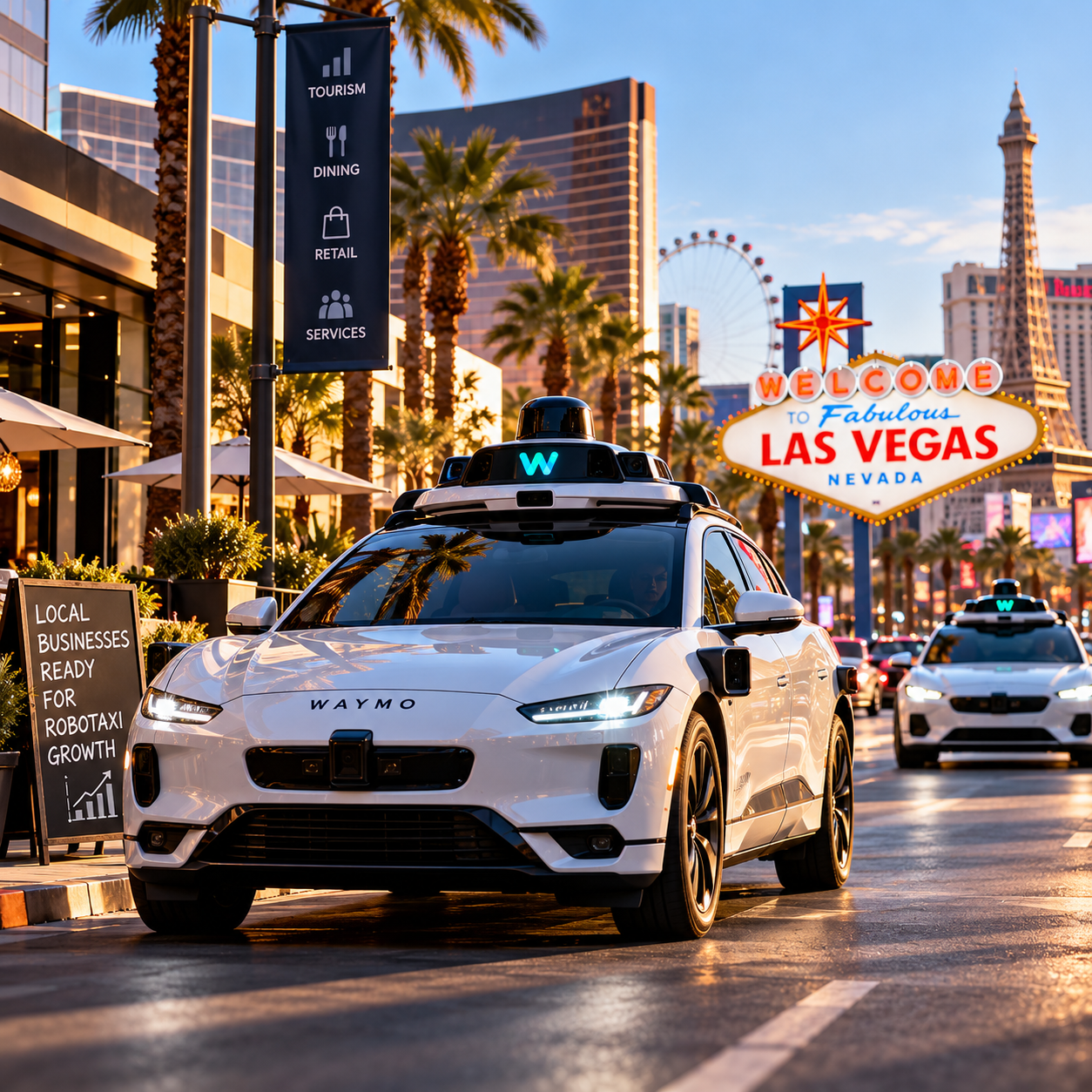
Nevada’s reported approvals for Tesla, Uber, and Waymo to operate thousands of robotaxis create an immediate planning issue for businesses—even if large fleets do not appear immediately. Hotels, casinos, venues, shopping centers, residential properties, fleet-service providers, and conventional passenger-transport operators may all face changes in how people arrive, wait, load luggage, and leave.
The key distinction is between regulatory capacity and street-level reality. TechCrunch reports that the companies have received permission to operate thousands of robotaxis in Nevada. That ceiling should not be treated as a deployment forecast, utilization estimate, or guarantee of customer adoption. Operators should prepare for multiple rollout speeds rather than redesigning facilities around the maximum authorized fleet.
Start with what the approvals do—and do not—prove
The approvals are consequential because they give three major mobility players room to deploy robotaxi services at substantial scale. For local businesses, however, an authorization answers only one question: whether operation is permitted within the relevant regulatory framework. It does not establish how many vehicles will launch in each market, which neighborhoods they will serve, when service will become broadly available, or what share of travelers will use it.
Businesses should therefore separate three concepts in internal discussions:
- Approved capacity: the maximum operation contemplated by the permits reported by TechCrunch.
- Actual deployment: the number of vehicles placed into service, their operating areas, hours, and service conditions.
- Adoption: the number and type of customers who choose robotaxis over rental cars, taxis, human-driven ride-hailing, shuttles, transit, or private vehicles.
That distinction prevents two expensive errors: making permanent infrastructure investments before demand is visible, or ignoring the change until vehicles begin disrupting entrances and curb space. A staged readiness plan is more defensible than either extreme.
Identify where operational effects will appear first
The earliest impact is likely to concentrate at properties with high passenger turnover and constrained loading areas. Hotels and casinos may see robotaxis competing with taxis, limousines, shuttles, buses, and ride-hailing vehicles. Arenas, convention venues, and entertainment sites face sharper peaks: many passengers may request vehicles simultaneously after an event. Shopping centers and mixed-use properties must account for vehicles waiting or recirculating when riders are not ready.
Apartment operators and employers should examine whether existing entrances give vehicles a safe, legally usable place to stop. Employee transport could become more flexible for late shifts or workers outside transit hours, but businesses should not assume robotaxis will reliably cover every shift, district, weather condition, or accessibility requirement.
Commercial effects will differ by sector. Parking operators could face lower demand in some locations while gaining opportunities to lease staging, charging, cleaning, or maintenance space. Fleet-service companies may find work in inspection, tire service, detailing, charging support, or incident recovery, subject to platform procurement rules. Taxi, limousine, shuttle, and rental-car operators should treat robotaxis as direct competitive pressure while identifying services that remain differentiated, such as group movement, assisted boarding, premium hospitality, scheduled capacity, and complex luggage handling.
Redesign the curb before redesigning the building
The first practical investment should usually be operating rules for pickup and drop-off, not permanent construction. Robotaxis need stopping locations that passengers can recognize and vehicles can approach without blocking traffic. A usable zone should have a precise digital address or map pin, visible signage, adequate lighting, pedestrian separation, and enough dwell space for realistic boarding behavior.
Property teams should observe existing curb activity by time of day. Record queue length, dwell time, illegal stops, pedestrian conflicts, luggage loading, wheelchair access, and demand after events or shift changes. The objective is to determine whether robotaxis can share a zone or require a separate lane, geofenced bay, or overflow plan.
Accessibility must be evaluated as a service requirement rather than a signage exercise. Ask whether the proposed route from vehicle to entrance is step-free, whether wheelchair-accessible vehicles will be available, and how a passenger receives assistance when no driver is present. Businesses should also decide who responds when a vehicle stops at the wrong entrance, a rider cannot locate it, or boarding takes longer than the platform anticipates.
A reversible pilot can use paint, cones, temporary signs, trained attendants, and updated guest instructions. Permanent curb changes should wait until observations show sustained volume and a stable vehicle-routing pattern.
Resolve liability and insurance before inviting vehicles onsite
Robotaxi incidents can cross several areas of responsibility: vehicle operation, software or remote support, property design, passenger behavior, security, and loading-zone management. A platform’s permission to operate does not settle who bears responsibility for an injury or property loss at a business entrance.
Before establishing a dedicated zone or commercial arrangement, businesses should ask their broker and counsel to review general liability, premises liability, cyber-related exposure, valet or garage coverage, contractual indemnities, and incident-reporting obligations. Nevada-specific legal advice is important because coverage and responsibility depend on the policy language, contract, operating model, and facts of an incident.
Contracts should define who controls the designated zone, provides signage, assists passengers, preserves vehicle or camera data, handles complaints, and responds to collisions or stranded riders. The business should know whether it is merely allowing public access or actively representing the platform as an approved transport partner. That distinction may affect customer expectations and risk.
Incident procedures should work across all platforms rather than relying on one company’s application. Staff need a method to identify the vehicle, record time and location, protect the passenger, contact emergency services when necessary, preserve property footage, and escalate the issue to the relevant operator.
Treat platform partnerships as controlled experiments
Hotels, venues, and property operators may be offered promotional placement, designated bays, app integration, customer discounts, or event-transport arrangements. Such partnerships can improve the arrival experience, but they also create concentration and reputation risks.
Exclusivity may prevent a property from accommodating platforms that customers actually prefer. Promotional pricing can generate demand that disappears when incentives end. Data-sharing terms may expose customer or trip information beyond what the business needs. A partner’s service interruption can become the property’s guest-service problem if the arrangement has been marketed as dependable.
Any pilot should specify geography, operating hours, service levels, accessibility commitments, support contacts, permitted data uses, termination rights, and responsibility for curb-management costs. Avoid promising guaranteed transport unless the provider contract genuinely supports that promise.
Measure outcomes that reflect operations: average dwell time, pickups completed at the correct zone, passenger complaints, accessibility failures, traffic conflicts, staff interventions, conversion from offered trips to completed trips, and effects on parking or shuttle demand. Compare ordinary days with event peaks rather than blending them into one average.
Use a phased Nevada readiness plan
Phase one: map exposure. Identify entrances, shift changes, event peaks, existing transport contracts, accessible routes, and revenue tied to parking or conventional transport. Assign one manager to monitor announced service areas and actual local availability.
Phase two: prepare without locking in capital. Create mapped pickup points, temporary signage, staff scripts, incident protocols, and a method for recording curb activity. Review insurance and contracts before presenting any platform as a preferred provider.
Phase three: run a limited pilot. Select one entrance, property, shift, or event series. Keep alternative transport available and cap the pilot tightly enough to diagnose failures. Gather feedback from customers, security personnel, facilities teams, and accessibility users.
Phase four: invest only after evidence. Expand curb space, charging access, staging areas, integrations, or commercial agreements when repeated observations demonstrate demand. Revisit the plan if deployment remains limited despite high approved capacity.
Nevada businesses do not need to predict which company will dominate. They need to preserve flexibility while making entrances safer, responsibilities clearer, and customer information more accurate. The permit ceiling is a signal to begin preparation—not proof that thousands of vehicles, dependable coverage, or mass adoption will arrive at once.