Zerops, a Prague-based platform-as-a-service startup, has raised €1.7 million to expand infrastructure and product development around a familiar operator problem: the gap between development and production cloud environments. For small SaaS teams, agencies running client apps, and e-commerce operators with custom tools, this is not an abstract engineering topic. It is a cost, reliability and hiring decision.
The useful question is not whether one platform is better than another. The question is when a small team should stop stitching together servers, deployment scripts, databases, queues and monitoring by hand, and when that control is still worth the maintenance burden.
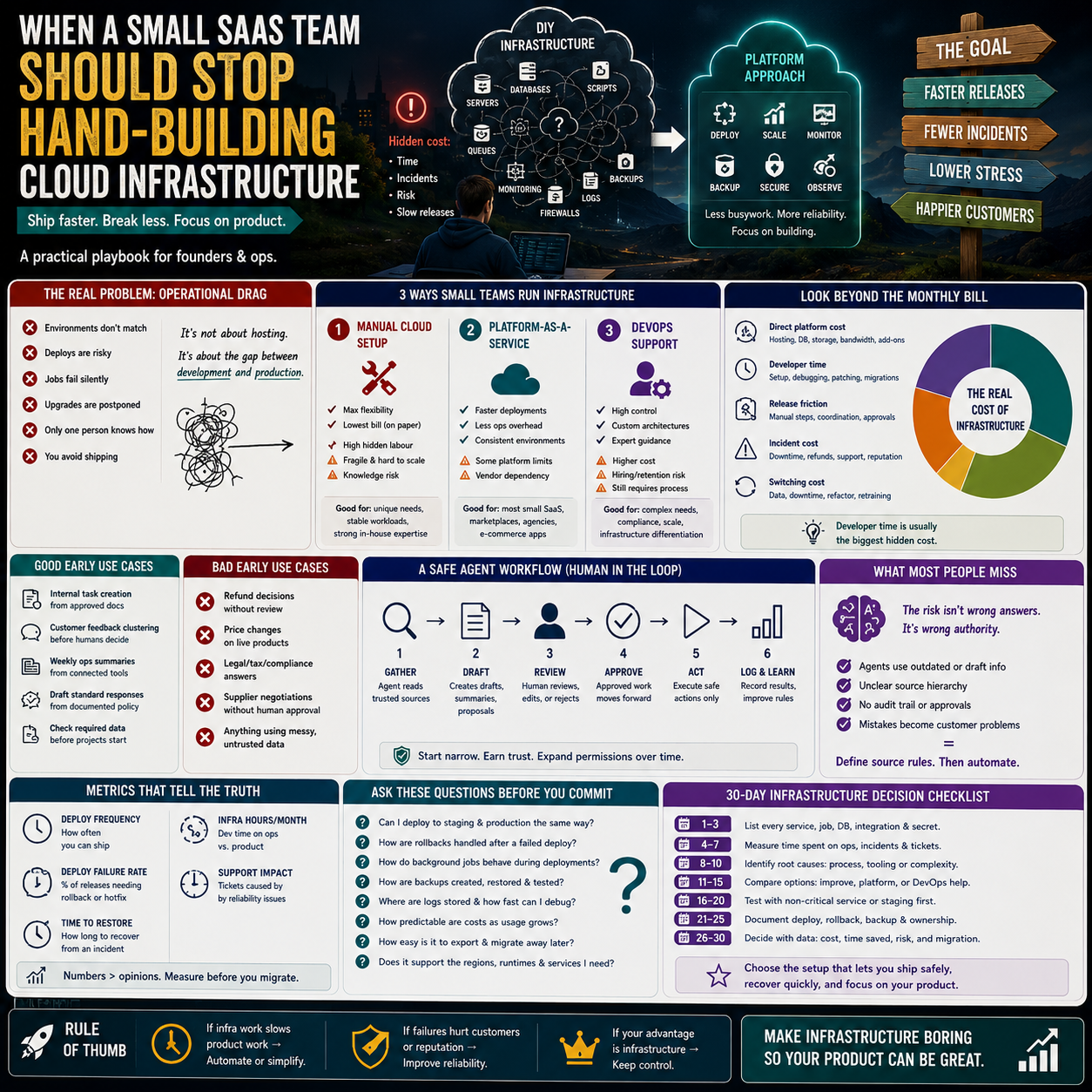
The real problem is not cloud hosting, it is operational drag
Small digital teams often start with a simple setup: a VPS, a managed database, a Git repository, perhaps a few scripts that deploy code when someone remembers the command. This works while the product is small, traffic is predictable, and only one person understands the stack.
The problem appears later, usually after the business has already built habits around the fragile setup. A developer pushes a feature that works locally but breaks in production. A background worker silently stops processing orders. A staging environment behaves differently from the live environment. A database upgrade is postponed for months because nobody wants to touch it. A founder avoids product changes because every release feels risky.
This is the development-to-production gap that newer platform services are trying to reduce. Zerops is one example of a company building in that direction, according to its funding announcement. The broader signal matters more than the specific vendor: small teams are being offered more opinionated infrastructure that reduces the amount of DevOps work required before a product can run reliably.
For Make Business readers, the decision is operational. If infrastructure work is slowing releases, creating support tickets, or forcing the founder to rely on one technical person, it has become a business constraint rather than an engineering preference.
Three infrastructure options for a small digital business
Most small SaaS or custom e-commerce operations are choosing between three practical models, even if they do not name them formally.
Option 1: Manual cloud setup
This is the do-it-yourself route: virtual machines, cloud services, scripts, manual configuration and developer-owned deployment processes. It can be cheap on paper and flexible in skilled hands. It is also where hidden labour accumulates.
The direct bill may look low, but the real cost includes setup time, debugging, patching, documentation, migration work and the risk that only one person knows how everything fits together. Manual infrastructure can be the right choice when the product has unusual technical needs, strong in-house engineering, or predictable workloads that do not change often.
It becomes expensive when each release requires coordination, when developers avoid touching parts of the system, or when small incidents consume hours because observability was never designed properly.
Option 2: Managed platform-as-a-service
A platform-as-a-service sits between raw cloud infrastructure and a fully managed software tool. It usually handles deployment, runtime configuration, scaling patterns, environment management and some operational defaults. The promise is not magic; it is reduced decision load.
For a small team, the attraction is straightforward. Fewer custom deployment scripts. Less time wiring up common services. Easier replication of staging and production environments. A clearer path for junior or outsourced developers to ship without having full control over the infrastructure.
The tradeoff is platform dependency. You may accept certain conventions around runtime, deployment, databases, networking or regions. That can be a good bargain for a business that needs reliable shipping more than deep infrastructure control.
Option 3: Hiring or contracting DevOps support
The third route is adding human infrastructure capability: a DevOps hire, a fractional engineer, an agency, or a senior contractor who cleans up the stack. This gives more control than a platform approach, but it changes the cost profile.
A contractor can fix urgent problems, but may not be around when a deployment fails on Friday evening. A full-time hire may be hard to justify if the product is not infrastructure-heavy. An agency can bring process, but may add communication delays.
This option makes sense when the business has a differentiated infrastructure need, regulatory constraints, high availability requirements, or enough revenue at risk that bespoke operational control is justified.
The cost model founders usually get wrong
Founders often compare infrastructure options by monthly hosting bills. That is too narrow. A €40 server can be more expensive than a managed platform if it consumes developer time, delays releases, or creates avoidable downtime. A more expensive platform can be a poor choice if it locks the team into constraints that later force a painful migration.
A useful cost model should include five buckets:
Direct platform cost: hosting, database, storage, bandwidth, build minutes, logs, backups and add-ons.
Developer time: setup, deployment fixes, environment debugging, migrations, security patches and documentation.
Release friction: time lost when shipping requires manual steps, approvals or troubleshooting.
Incident cost: support tickets, refunds, lost orders, missed demos, staff time and reputational damage.
Switching cost: how hard it will be to move away from the chosen setup later.
For a small SaaS team, developer time is often the largest hidden cost. If the same person writing product features is also maintaining deployment scripts, configuring servers and investigating production errors, the business is trading product velocity for infrastructure ownership.
For an e-commerce operator with custom middleware, the cost appears differently. A failed sync between inventory, storefront and fulfilment may not look like a cloud problem, but the root cause can be poor deployment design, missing logs, fragile background jobs or inconsistent environments. In that case, infrastructure quality directly affects operations.
When a managed platform is the cleaner business decision
A managed platform is not automatically better. It is a cleaner decision when the business gains more from speed and reliability than from custom infrastructure control.
Look for these signals:
Your developers spend more time fixing deployments than improving the product.
Staging and production are different enough that testing is unreliable.
Only one person can safely deploy or restart services.
Background jobs, queues or scheduled tasks fail without clear alerts.
New developers need days to understand how the app actually runs.
You avoid small improvements because deployment risk feels too high.
If several of these are true, the issue is not just technical debt. It is operating debt. The team has built a system that makes normal business changes slower than they need to be.
A platform approach can work especially well for small B2B SaaS products, internal tools sold to clients, marketplaces in early growth, subscription products, and e-commerce businesses running custom integrations. These businesses usually need dependable releases, logs, backups, staging, predictable costs and simple rollback more than they need infrastructure uniqueness.
When you should keep control instead of moving to PaaS
The opposite mistake is moving everything to a managed platform because infrastructure feels annoying. Annoying does not always mean wrong.
Keep more control when your product depends on unusual networking, strict data residency needs, heavy compute workloads, specialist databases, custom security architecture, or performance tuning that a general platform may not expose. Also be cautious if margins are thin and variable usage charges could become difficult to predict.
There is also a product strategy question. If infrastructure capability is part of what customers buy from you, outsourcing too much of the operational layer may weaken your differentiation. For example, a developer tool, data platform or high-compliance B2B product may need internal infrastructure expertise even at an early stage.
The right decision is not ideological. It is about matching infrastructure ownership to the business model. A small CRM product for local service businesses does not need the same infrastructure strategy as a real-time analytics platform. A Shopify-connected app processing order updates does not need the same setup as an AI video processing product.
What most people miss
The biggest overlooked factor is not hosting cost or scalability. It is the boundary between human judgement and automated operations.
Small teams should not automate every infrastructure decision. They should automate the repeatable parts that create mistakes when humans do them under pressure. Deployments, environment variables, build processes, health checks, backups, alerts and rollback paths should not depend on someone remembering the correct sequence at 11 p.m.
Human judgement should remain where tradeoffs matter: choosing regions, deciding database architecture, setting incident priorities, reviewing security posture, planning migrations and deciding how much platform dependency the business can tolerate.
This boundary matters because many small companies either under-automate or over-delegate. Under-automation creates fragile operations. Over-delegation creates dependency on tools the team does not understand. The practical middle ground is to make routine operations boring while keeping enough internal knowledge to diagnose problems and negotiate with vendors.
A practical scenario: the founder with one senior developer
Consider a small subscription software business with one founder, one senior developer and a part-time support person. The product has paying customers, a staging environment, a production database, a few background jobs, and several third-party integrations. Releases happen weekly, but occasionally a feature behaves differently in production than it did in testing.
The founder is considering three choices: stay on the current VPS setup, move to a managed platform, or hire a DevOps contractor.
The current setup has the lowest visible bill, but the senior developer spends several hours each month on deployment issues and environment fixes. The founder does not feel safe hiring a junior developer because the setup is poorly documented. Support tickets increase whenever background jobs fail quietly.
A managed platform would raise the direct monthly cost, but could standardise environments and reduce deployment work. A contractor could clean up the existing stack, but the business would still rely on periodic external help unless the internal team learns the new process.
The business decision should not be based on which option feels more professional. It should be based on bottleneck removal. If the main constraint is the senior developer being pulled away from product work, a managed platform or a contractor-led simplification project may pay back through faster releases and fewer incidents. If the setup is stable and the developer already has good deployment discipline, moving platforms may only create migration risk.
The migration risk small teams underestimate
Moving infrastructure is not just a technical project. It touches customer support, billing continuity, internal confidence and release planning. A poorly managed migration can create more operational risk than the old system.
Before moving to any platform, small teams should map the actual running system rather than the system they think they have. That means listing web apps, workers, databases, cron jobs, file storage, DNS records, environment variables, third-party API keys, email services, payment webhooks, logging, monitoring and backup routines.
The dangerous items are often the small ones: a scheduled job that updates marketplace inventory, a webhook endpoint used by a payment provider, a script that exports data for accounting, or a legacy admin route used by support. These details rarely appear in a clean architecture diagram, but they are exactly what breaks during migration.
The safest migration pattern for a small team is usually staged rather than dramatic. Move a non-critical service first. Replicate staging. Test deployment and rollback. Move background workers with monitoring. Only then move the main application. If the platform cannot support this kind of controlled migration, that is a decision signal in itself.
Metrics that should decide the infrastructure conversation
A founder does not need a complex engineering dashboard to make this decision. But the team should track enough operational evidence to avoid choosing based on mood.
Useful metrics include:
Deployment frequency: how often the team can release without special coordination.
Deployment failure rate: how often releases require hotfixes, rollback or manual repair.
Time to restore: how long it takes to recover from a production issue.
Environment mismatch incidents: how often something worked in staging but failed live.
Infrastructure hours per month: developer time spent on hosting, deployment, configuration, logs and patching.
Support tickets linked to system reliability: failed jobs, missing emails, delayed syncs, unavailable pages or broken integrations.
These metrics make the decision commercial. If infrastructure work is consuming product time and producing customer-facing errors, the business has evidence for changing the setup. If the numbers are stable, a migration may be lower priority than customer acquisition, product packaging or pricing work.
Vendor questions before you commit
Before choosing a platform provider, ask questions that reveal operating fit rather than sales polish.
Can staging and production be configured from the same template or process?
How are rollbacks handled after a failed deploy?
What happens to background workers and scheduled jobs during deployment?
How are database backups created, restored and tested?
Where are logs stored, and how quickly can a small team find the cause of a failed request?
How predictable are costs when traffic, storage or build activity increases?
What parts of the stack are easy to export if the business later migrates away?
Does the platform support the regions, runtimes and services your customers require?
These questions are more useful than asking whether the platform scales. Most early-stage teams do not fail because their platform cannot handle theoretical future scale. They struggle because deployment is unclear, monitoring is weak, costs are surprising, or recovery depends on one tired developer.
A 30-day infrastructure decision checklist
Use this sequence before changing platforms or hiring for DevOps work:
Days 1-3: list every service that runs the product, including workers, scheduled tasks, storage, APIs, payment webhooks, email services and admin tools.
Days 4-7: calculate the last 60 days of infrastructure-related developer time, incidents and support tickets.
Days 8-10: identify which problems come from missing process, which come from poor tooling, and which come from genuine architectural complexity.
Days 11-15: compare three options: improve the current setup, move to a managed platform, or bring in specialist DevOps help for a defined cleanup project.
Days 16-20: test the preferred option with a non-critical service or staging replica. Do not start with the production database.
Days 21-25: document deployment, rollback, backup restore, alert response and ownership. If nobody can explain the process simply, the setup is not ready.
Days 26-30: make the decision using evidence: monthly cost, developer hours saved, incident reduction potential, migration risk and vendor dependency.
The practical benchmark is simple: the chosen setup should let a small team ship routine changes without drama, recover from common failures without guesswork, and understand its monthly operating cost before the bill arrives.


