Satispay is planning a new capital raise to expand from payments into a broader financial platform, while CardNexus has raised pre-seed funding for a mobile-first trading card marketplace. These are different companies, but they point to the same operating pressure: more sales, payments and customer relationships are moving into specialized apps.
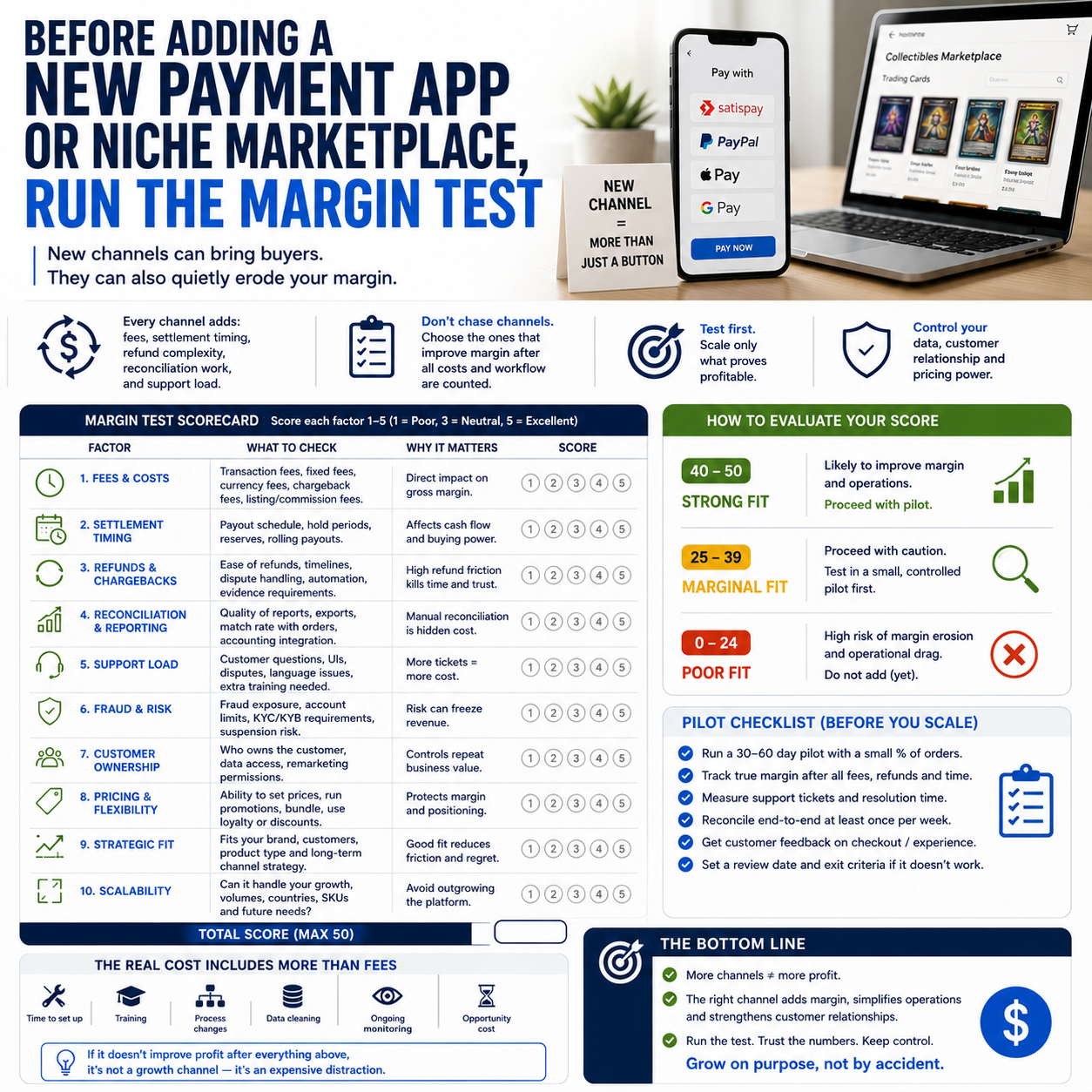
For a small merchant, the question is not whether these platforms are interesting. The question is whether adding one more payment method, niche marketplace or app-based sales channel improves margin after fees, workflow drag, refunds, reconciliation and support load. That is where many operators get it wrong.
The real decision is not adoption, it is operational fit
Small businesses are often pushed to treat new payment apps and niche marketplaces as growth channels by default. A new checkout option may reduce friction. A vertical marketplace may bring buyers who are already interested. A financial super app may later bundle payments, credit, savings, loyalty or buy-now-pay-later-style products into one customer interface.
That sounds useful until the operator has to run it every day.
A Shopify seller, WooCommerce store, service business or marketplace merchant does not just add a button. They add another settlement cycle, another export format, another refund path, another customer support script, another set of fees, another fraud surface and another dashboard to check. If the business is already stretched, the hidden cost is not the headline transaction fee. It is the loss of clean control.
The funding news around Satispay matters because payment apps are trying to become broader operating layers. The CardNexus news matters because niche marketplaces keep forming around communities where trust, collection management and mobile-native buying behavior are part of the product. Both signals affect small operators in the same way: customers may increasingly expect to transact inside systems that the merchant does not fully control.
That creates a practical decision. Should you integrate, list, wait, or ignore?
Where payment apps actually change the numbers
Payment methods are not equal. A card payment, bank transfer, wallet, local payment app and platform balance may all produce revenue, but they create different operating patterns behind the scenes.
The first difference is settlement timing. If one channel pays out daily and another pays out weekly or after a reserve period, cash planning changes. For a product business that buys inventory upfront, delayed settlement can create pressure even when sales are healthy. For a service business with payroll or subcontractors, timing can matter more than the fee percentage.
The second difference is refund handling. Some channels make refunds simple but expensive. Others make them cheap but operationally messy. If your support team has to manually match a refund request to a payment reference, order ID and accounting entry, you have not saved money. You have moved the cost into staff time.
The third difference is reconciliation. This is where small operators quietly lose control. A payment app may export data in a structure that does not match your accounting system, order platform or VAT reporting workflow. That means someone has to clean it. Maybe weekly. Maybe at month end. Maybe at the worst possible moment.
Do not evaluate the payment method only inside the checkout page. Evaluate it inside the finance workflow.
The niche marketplace trap: demand without clean ownership
CardNexus is focused on trading card game collectors, a market where condition, authenticity, catalog data and community trust matter. That is exactly why vertical marketplaces can work. They do not compete only on traffic. They compete on context.
For small sellers in collectibles, hobby products, specialist apparel, spare parts, craft goods or used equipment, this is attractive. A niche marketplace may bring better qualified buyers than a broad platform. It may also handle discovery better because the product attributes are specific to the category.
But there is a tradeoff. A marketplace can own the buyer relationship, search ranking, messaging flow, dispute process and pricing norms. The seller may gain demand while losing leverage. If the channel becomes meaningful, the operator becomes dependent on marketplace rules that can change faster than the business can adapt.
This does not mean avoid niche platforms. It means treat them as a channel with its own operating model, not as free upside.
What most people miss
The standard advice is to meet customers where they are. That is incomplete and sometimes expensive.
If a customer segment buys through a niche marketplace or payment app, the merchant may feel forced to be present there. But presence can dilute margin if the channel creates small fragmented orders, higher support complexity, slower settlement or pricing pressure. A lower-friction sale is not automatically a better sale.
The unpopular point is this: sometimes the right move is to keep a channel manual before automating or fully integrating it.
For example, a small seller testing a specialist marketplace may not need full inventory sync, automatic order import and accounting integration on day one. Manual listing and weekly reconciliation may be slower, but it gives the operator a cleaner view of real order quality. Are buyers asking more questions? Are returns higher? Are discounts required? Are customers repeatable outside the marketplace? Is the average order value worth the handling time?
Automation too early can hide bad economics. It makes a weak channel look smoother than it is.
A practical scenario: the specialist seller with three sales paths
Consider a small e-commerce operator selling specialist hobby products. The store already sells through its own website and one broad marketplace. A new vertical marketplace appears with a better fit for collectors. At the same time, more customers are asking for a local payment app at checkout.
The owner has three possible changes: add the payment method to the website, list part of the catalog on the vertical marketplace, or do both. The wrong way to decide is to ask, “Will this increase sales?” The better question is, “Which workflow can absorb this channel without damaging margin control?”
The owner should separate the two decisions.
The payment app affects checkout conversion, settlement, refunds and accounting. The vertical marketplace affects product data, pricing, inventory allocation, buyer messages, disputes and brand ownership. These are not the same problem. They should not be approved in one vague growth discussion.
A sensible test would place only a defined slice of catalog into the new marketplace: products with stable supply, clear condition rules, manageable return risk and enough margin to absorb platform fees. The payment app test should run on the owned store first, but only if the accounting export can be mapped before transactions begin. If the finance workflow is not ready, the checkout experiment will create cleanup work that shows up later.
Small operators do not fail because one extra channel exists. They fail because five small exceptions become the normal operating system.
The cost stack to check before saying yes
The visible cost is usually the platform fee or payment fee. That is only the first layer. The real cost stack has at least six parts.
Direct commercial costs
These include transaction fees, marketplace commissions, payout fees, currency conversion, chargeback or dispute costs, promotional placement fees and any paid tools required to manage the channel. If the platform later offers financial services, credit products or promotional financing, the operator should separate customer convenience from merchant economics.
A payment method that improves conversion but adds messy reconciliation may still be worthwhile. A marketplace that takes a high fee but delivers high-intent buyers may also work. The point is not to reject fees. The point is to compare fees against contribution margin after handling work.
Operational drag
This is the part many dashboards miss. Who checks the channel? Who answers messages? Who updates listings? Who resolves payment mismatches? Who closes the month-end accounting gap?
If the answer is “the founder,” the cost is not zero. It is founder attention, which is often the scarcest resource in a small company. If the answer is “support,” then the channel needs scripts, refund rules and escalation paths. If the answer is “finance,” then exports, IDs and settlement timing need to be clean enough to process repeatedly.
Messy work compounds.
The workflow test: what must connect before scaling
Before integrating a payment app or marketplace deeply, map the minimum workflow. Not the ideal system. The minimum system that prevents confusion.
Start with order identity. Every transaction needs a consistent reference that can be traced from checkout or marketplace order to payment record, shipment, refund and accounting entry. If the platform does not expose usable IDs, the channel becomes harder to control.
Next, check inventory behavior. For physical products, the danger is overselling. A niche marketplace may move a product that is also listed on the owned store. If inventory sync is unreliable, keep the test catalog narrow or allocate separate stock. Do not test a new channel with products that create customer anger when unavailable.
Then check refund logic. A refund is not only money leaving the account. It is inventory status, customer communication, payment record, fee treatment and accounting entry. If the team cannot describe the refund process in plain language, the channel is not ready to scale.
Finally, check reporting cadence. The owner should know which numbers will be reviewed weekly: gross sales, net payout, contribution margin, support tickets, refund rate, settlement delay, time spent on reconciliation and repeat buyer behavior where measurable.
Metrics that expose whether the channel is worth keeping
Revenue alone is a poor signal. A new marketplace can produce sales while weakening the business. A payment app can increase checkout options while adding administrative weight. Use metrics that show operating quality.
- Net payout per order: the amount received after transaction or marketplace fees, before internal handling cost.
- Contribution margin by channel: product margin after platform-specific fees, shipping differences, payment costs and typical discounting.
- Reconciliation time per payout: how long it takes to match platform payouts to orders and accounting records.
- Support contacts per 100 orders: a practical way to compare channel complexity without pretending all revenue is equal.
- Refund and dispute pattern: not just the rate, but the reason codes and staff time required to resolve them.
- Settlement delay: the number of days between order and usable cash in the business account.
- Repeat buyer visibility: whether the business can identify, retain or remarket to the customer outside the platform rules.
These metrics make the decision less emotional. A channel that looks small may be worth keeping if it has clean margin, low support load and fast cash. A channel that looks exciting may deserve a cap if it creates operational noise.
When automation should wait
Automation builders and digital operators like clean integrations. That instinct is useful, but it can become expensive when applied too early.
Do not automate a new payment or marketplace channel until the business has seen enough real orders to understand exception patterns. The first orders reveal the ugly parts: missing references, customer confusion, unusual refund requests, product data problems, shipping edge cases, payout mismatches and support questions that were not obvious during setup.
A staged approach works better. Start with manual or semi-manual processing for a defined test period. Document every exception. Then automate only the stable steps. For example, importing paid orders may be safe early, while automatic refund processing may wait until the team understands the platform’s refund behavior. Inventory sync may be useful, but only for products with simple variants and reliable stock control.
The human boundary matters. Let software move clean data. Keep humans near judgment-heavy decisions such as disputes, condition-sensitive products, high-value orders, fraud flags and customer complaints that could damage the brand.
Channel approval checklist for the next 30 days
Use this before adding a payment app, financial platform feature or niche marketplace to a small business operation. The goal is not to block experiments. The goal is to prevent experiments from becoming permanent messes.
- Define the channel role: write one sentence stating whether the channel is for checkout conversion, new customer acquisition, liquidation, repeat purchasing, geographic coverage or category-specific demand. If the role is vague, do not integrate yet.
- Select a protected test scope: choose a limited product set, service line or customer segment. Avoid fragile inventory, custom orders, low-margin products and items with complex return handling during the first test.
- Map the money path: document fee type, payout timing, refund treatment, dispute process, currency issues and where the payout appears in accounting. If the bookkeeper cannot follow it, the setup is not ready.
- Map the order path: confirm how order ID, payment ID, shipment ID, customer message and refund record connect. If these identifiers cannot be matched, keep the process manual and capped.
- Set a weekly review limit: track net payout per order, contribution margin, support contacts, refund reasons, reconciliation time and settlement delay. Revenue is not enough.
- Decide the automation gate: only automate a step after it has repeated cleanly. Importing orders, syncing inventory, issuing refunds and posting accounting entries should each have separate approval.
- Create a stop rule: pause expansion if reconciliation time grows faster than order volume, if support questions cluster around the same unresolved issue, or if net payout does not justify handling work.
- Protect owned customer data: where platform rules allow, encourage account creation, email capture, warranty registration or post-purchase service on owned systems. Do not assume the marketplace buyer is your customer in an operational sense.