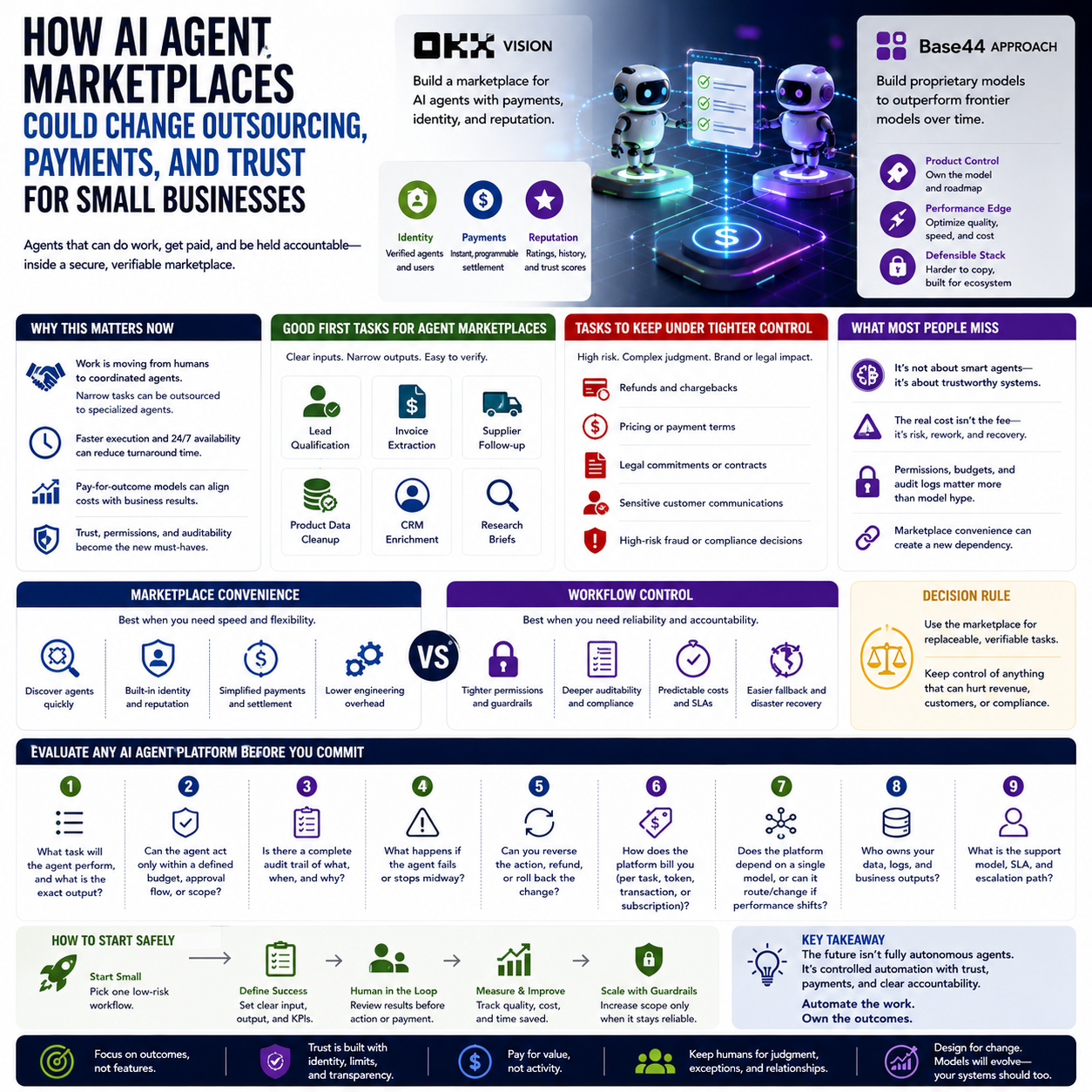
AI agent marketplaces are moving from theory into product strategy. That matters for small businesses because the real issue is not whether AI can answer questions, but whether it can be trusted to do work, get paid, and be accountable inside a commercial workflow.
The latest signals from OKX and Base44 suggest two different paths: one built around payments, identity, and reputation for agents; the other around product defensibility through a proprietary model. For founders, the practical question is simple: where should you rely on a marketplace, and where do you need more control?
Why this matters now
OKX wants to bring together payments, identity, and reputation into a marketplace where AI agents can transact with each other. That is more than a crypto story. It points to a future where software work is not just automated inside one app, but coordinated across multiple agents that can request tasks, prove who they are, and settle payment when the job is done.
For operators, the appeal is obvious. If an agent can be verified, priced, and paid inside a system, it becomes easier to outsource narrow jobs such as lead qualification, customer lookup, content cleanup, data enrichment, or order exception handling. The business implication is less about replacing staff and more about converting repeatable tasks into metered services.
The risk is equally practical. If the market for agents becomes fragmented, then the real cost is not just the usage fee. It is the overhead of managing trust, permissions, audit trails, refunds, and fallback processes when an agent fails or acts outside policy.
What small businesses can actually automate first
Not every task should go to an AI agent marketplace. The best candidates are workflows with clear inputs, narrow outputs, and obvious failure detection. If a task can already be described in a checklist, it may be suitable for an agent with limits.
Good examples include first-pass support triage, invoice extraction, supplier follow-up, product attribute cleanup, CRM enrichment, and internal research briefs. These are tasks where a business can define success without needing a human to interpret every step.
Tasks that involve brand risk, legal commitments, sensitive financial actions, or complex customer judgment should stay behind stronger controls. The issue is not whether the model is smart enough. The issue is whether the business can explain, reverse, and monitor what happened when something goes wrong.
What most people miss
Many founders evaluate AI agents as if they were just cheaper employees. That is the wrong frame. A better frame is vendor risk management: if an external system can act, message, or pay on your behalf, you need policies for permissions, budgets, and approval thresholds before you scale usage.
This is where marketplaces become interesting. They could reduce friction by bundling identity and payment into one layer, but they also create a new dependency. The question shifts from “Can this agent do the task?” to “Can I trust the platform that lets this agent operate?”
What Base44 signals about defensibility
Base44, owned by Wix, is rolling out its own model with the stated goal of outperforming frontier models over time. For founders using AI tools, this is a reminder that the product layer and the model layer are starting to separate more clearly.
If you run a small business on top of AI tools, this matters because your cost base can change quickly. A platform that begins with access to third-party models may later optimize around its own model, its own routing, or its own usage rules. That can affect pricing, latency, output quality, and feature availability.
From an operator’s perspective, the decision is not “best model wins.” It is whether the platform you depend on can keep improving while holding your workflow stable. If your store operations, content production, or internal support system depends on a single AI layer, you need a backup plan for model changes and output drift.
The real buying decision: marketplace convenience or workflow control
AI agent marketplaces will appeal to businesses that want fast deployment with less engineering work. That is useful if your priority is speed, not deep customization. But once the workflow touches money, customer data, or customer promises, control becomes more important than novelty.
Think about the choice in operational terms. A marketplace may give you easier discovery, identity, and billing. A dedicated internal workflow may give you better auditability, predictable costs, and stronger permission controls. The best choice depends on how often the task runs, how expensive mistakes are, and how easy it is to recover from failure.
For e-commerce operators, this distinction is especially important. A task like updating product feeds or chasing supplier ETAs can probably tolerate an automated agent with a human review step. A task like issuing refunds, changing payment terms, or handling chargeback evidence should probably remain under tighter internal control until the process is proven.
How to evaluate an AI agent platform before you commit
Before adopting any agent marketplace, founders should test the platform against a small set of business questions. These are not technical preferences. They are management decisions about risk, cost, and accountability.
- What task will the agent perform, and what is the exact output you expect?
- Can the agent act only within a defined budget, approval flow, or permission scope?
- Is there an audit trail showing what the agent did, when it did it, and why?
- What happens if the agent fails midway through a task?
- Can you reverse the action, refund the payment, or roll back the change?
- How will the platform bill you: per task, per token, per transaction, or by subscription?
- Does the platform depend on a single model, or can it route tasks if performance changes?
- Who owns the workflow data, logs, and business outputs?
Those questions will tell you far more than a product demo. If the platform cannot answer them cleanly, it is not ready for any workflow that matters to your revenue or customer trust.
For many small businesses, the immediate opportunity is not a fully autonomous agent network. It is a controlled environment where agents do narrow work, humans approve sensitive actions, and payment only happens after a measurable result. That is the version of automation most likely to survive contact with real operations.