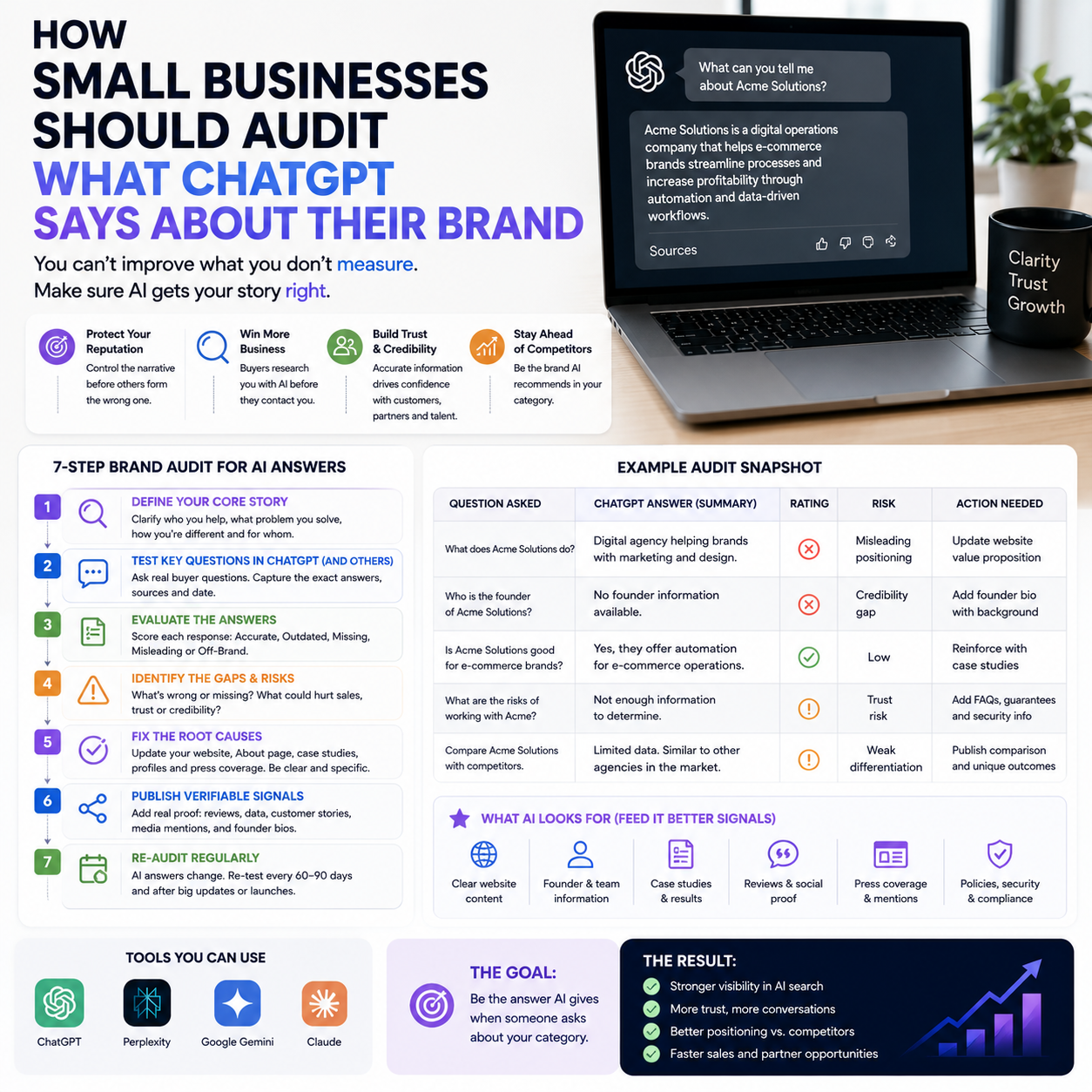
Search visibility is no longer only about where your website ranks. A growing number of buyers, partners, journalists and potential hires now ask AI tools to explain a company before they ever visit its site. For a small business, the risk is practical: if ChatGPT or another AI assistant gives an outdated, vague or incorrect version of your business, that can affect sales calls, investor conversations, hiring and supplier trust.
The useful question is not whether AI will replace your brand strategy. It is whether your public information is structured enough for AI systems to describe your business accurately when someone asks.
The new reputation problem is not visibility, it is interpretation
EU-Startups recently published an opinion piece arguing that a brand is increasingly shaped by what ChatGPT says it is, not only by what the company says on its own channels. That is especially relevant for founders and small operators because most small businesses do not have deep media coverage, analyst reports, Wikipedia pages or large volumes of third-party references. AI systems often have to work with a thin public footprint.
That creates a different kind of operational risk. Traditional search asks: can people find you? AI-assisted discovery asks: can a machine correctly explain you?
For a small service firm, SaaS tool, e-commerce brand, agency, marketplace seller or B2B supplier, the issue is not abstract brand theory. It shows up in everyday business situations:
- A potential customer asks ChatGPT to compare your company with two alternatives.
- A journalist asks an AI assistant for background before deciding whether to contact you.
- A buyer asks for the best suppliers in a niche and your business is described with the wrong positioning.
- A job candidate asks whether your company is credible and gets a shallow or outdated answer.
- A founder prepares for a partnership meeting and discovers that AI tools cannot explain the business model clearly.
The operational fix is not to chase every AI platform. The fix is to build a simple AI reputation audit into your normal marketing, sales and communications workflow.
Who should care first: businesses with complex positioning
This matters most when your business cannot be understood from one keyword. A local bakery may not need a full AI reputation process unless it relies heavily on online discovery. But many small digital businesses have positioning that AI tools can easily flatten or confuse.
The highest-risk groups are:
- B2B service businesses where trust is built before the first call, such as consultancies, agencies, software implementers and finance operations providers.
- E-commerce brands with specific sourcing, sustainability, product quality or manufacturing claims that must be explained accurately.
- SaaS and tool builders whose product category is crowded or poorly understood.
- Founder-led companies where the personal reputation of the founder affects sales, partnerships and hiring.
- Cross-border businesses where customers may ask AI tools to explain whether the company is legitimate, established or relevant in a specific market.
If your sales depend on trust before contact, you should treat AI-generated descriptions as part of your conversion path. It sits between search, PR, content, reviews, social proof and sales enablement.
Run the audit like a sales risk check, not a branding exercise
The first mistake is to ask one flattering prompt and feel reassured. A buyer does not usually ask, “Tell me about our company in the way our marketing team would prefer.” They ask practical, comparative and sometimes skeptical questions.
Create a spreadsheet with four columns: prompt, answer, business risk, corrective action. Then test the same set of prompts across the AI tools your customers are likely to use. For many small teams, that may include ChatGPT, Perplexity, Gemini, Claude or AI search features inside browsers and productivity tools.
Prompts that reveal commercial risk
Use prompts that simulate real buyer behavior:
- “What does [company name] do?”
- “Is [company name] a good option for [specific use case]?”
- “Compare [company name] with [competitor 1] and [competitor 2].”
- “What are the risks of buying from [company name]?”
- “Who is the founder of [company name] and what is their background?”
- “What evidence is there that [company name] is credible?”
- “What alternatives are there to [company name] in Europe?”
- “Summarise [company name] for a procurement manager.”
The point is not to control every answer. The point is to identify where the machine has too little reliable information, pulls from weak sources, misunderstands your offer or fails to connect your business to the use cases you actually sell.
What most people miss
The problem is often not that AI tools dislike your brand. It is that your public material does not give them enough clean, repeated and verifiable signals.
Many small businesses publish content for humans but leave machines guessing. The homepage says “we help ambitious teams grow.” The About page tells a founder story but does not clearly state the business model. Product pages use creative names instead of plain category language. Case studies hide the actual use case behind soft storytelling. Press mentions describe the company differently from the website. LinkedIn profiles use one positioning, marketplace listings another, and review platforms another.
An AI system may then produce an answer that is not exactly false, but commercially weak. It may call you a marketing agency when your core revenue comes from automation implementation. It may describe your e-commerce product as a lifestyle accessory when your real differentiation is supply chain transparency. It may miss that you serve EU customers, support Shopify, or specialise in small operators rather than enterprise clients.
That kind of error can reduce qualified demand because the buyer never reaches your website. The sales leak happens before analytics can easily show it.
Turn AI errors into a source-fixing list
When an AI answer is wrong, avoid treating the answer itself as the only problem. Ask what public source allowed that answer to happen.
For each bad or weak response, classify the issue:
- Missing category clarity: The AI tool cannot name what your business actually is.
- Outdated information: It references old services, old markets, old leadership or old products.
- Weak proof: It cannot find credible evidence for claims you make in sales materials.
- Competitor confusion: It places you in the wrong peer group.
- Geographic ambiguity: It cannot tell where you operate or which markets you serve.
- Founder or company mismatch: It confuses people, subsidiaries, brands or product names.
Then fix the source layer. For a small business, that usually means updating a practical set of assets rather than launching a large brand project.
Start with your website. Your homepage should contain one plain-language sentence that says what the company does, who it serves and what outcome it provides. Your About page should include current facts: legal business name if relevant, operating markets, leadership, founding background, service categories and contact routes. Your product or service pages should name the category clearly, not only the branded offer.
Next, update external profiles where AI systems may find supporting context. That can include LinkedIn company pages, founder profiles, marketplace profiles, app store listings, review sites, podcast bios, speaker bios, GitHub organisation pages, Crunchbase-style databases if relevant, partner directories and media mentions.
The important principle is consistency. If your website says “AI automation studio for Shopify merchants” and your LinkedIn says “digital transformation consultancy,” an AI tool may choose a vague middle description. If your agency stopped offering social media management two years ago but old directory listings still say that, do not be surprised when an AI answer revives the old positioning.
The cost is mostly time, but the hidden cost is ownership
This is not usually a software-heavy project. A small team can run a first audit with a spreadsheet, a few AI tools and access to website and profile updates. The cost appears small, but the ownership problem is real.
AI reputation touches marketing, PR, SEO, founder visibility, customer proof, partnerships and sales enablement. If nobody owns it, it becomes a one-time curiosity. If too many people own it, every correction turns into a brand debate.
A practical ownership model for a small company looks like this:
- The founder or commercial lead approves positioning and risk priorities.
- The marketing or content owner updates public pages and profiles.
- The sales owner reports confusing buyer questions that may come from AI-assisted research.
- The operations owner maintains a simple audit schedule and change log.
You do not need a new department. You need one named owner who checks whether public information matches how the business actually sells.
The cost becomes higher when the public footprint is messy. A founder who has launched several products under similar names may need to clean up old bios and company descriptions. An e-commerce brand that has changed supplier claims may need to update marketplaces, FAQs and third-party profiles. A SaaS founder who pivoted from one use case to another may need to replace outdated explainers that still rank or get cited.
A practical scenario: the Shopify automation consultant with the wrong AI profile
Consider a small consultancy that now implements Shopify automation for merchants: order routing, inventory alerts, customer support workflows, returns handling and reporting dashboards. Three years ago, the same founder ran a broader “digital marketing” agency. The old website pages are gone, but LinkedIn, podcast bios and several directory listings still describe the business as a marketing agency.
A merchant asks an AI tool: “Who can help automate Shopify operations for a small EU store?” The business does not appear. When the merchant asks directly about the company, the AI answer says it is a digital marketing agency that helps with campaigns and content. That is not a total hallucination. It is a stale interpretation based on public signals.
The correction is operational:
- Rewrite the homepage headline and service pages around Shopify operations automation, not broad digital services.
- Add clear pages for the specific workflows sold: inventory alerts, returns workflows, customer support triage, order tagging and dashboard setup.
- Update founder bios to say “Shopify operations automation” consistently.
- Replace old directory descriptions where possible.
- Publish two or three practical workflow articles showing the operating problems solved, without inventing results or claims.
- Add a short “Who we are not for” section to reduce wrong categorisation.
After changes are live, the team repeats the same prompts monthly. The goal is not instant perfection. The goal is to see whether AI answers begin to describe the business in the correct category and use case.
Metrics that make this more than a vanity exercise
AI reputation work can easily become subjective. To keep it useful, track a few simple measures.
Category accuracy: Does the AI tool describe your business in the correct category? For example, “returns automation for Shopify stores” is stronger than “e-commerce services company.”
Use-case match: Does the answer connect your business to the buying problems you actually solve?
Proof quality: Does the answer cite or refer to credible public evidence such as your website, media coverage, partner pages, app listings, reviews or founder profiles?
Outdated claim count: How many old services, old markets, old team details or discontinued offers appear?
Competitor set: Are you compared with businesses your buyers would realistically consider, or with companies in the wrong category?
Contact path clarity: If someone asks how to evaluate or contact you, does the answer point toward a useful next step?
You can score each prompt from 0 to 2: 0 means wrong or missing, 1 means partly useful, 2 means accurate enough for a buyer to continue. This gives a small team a simple dashboard without pretending to measure everything.
Where automation helps, and where a human must stay involved
This workflow can be partly automated, but not fully delegated. You can schedule prompt tests, collect answers, store screenshots, compare changes and flag words that indicate outdated positioning. A lightweight setup can use a spreadsheet, a task manager and AI API calls if your team has the technical ability.
Automation is useful for repetition. It can run the same prompts every month, capture answer changes and alert the owner when your company is described with risky terms such as an old service category, wrong country, discontinued product or competitor name.
Human review is still needed for judgment. An automated system may flag an answer as different, but a founder or commercial lead must decide whether the difference matters. Some variation is harmless. Some phrasing can damage conversion because it changes the category, the buyer, the price expectation or the trust level.
This is the boundary: automate detection, not positioning decisions.
AI reputation audit checklist for the next 30 days
Use this as a short rollout sequence rather than a brand project.
- Day 1: Choose 10 prompts that reflect how buyers, partners, journalists or hires would research your company.
- Day 2: Test those prompts across two or three AI tools and save the answers in a spreadsheet.
- Day 3: Mark each answer for category accuracy, use-case match, proof quality and outdated claims.
- Week 1: Rewrite the homepage, About page and core service or product pages where the positioning is vague or inconsistent.
- Week 2: Update founder bios, LinkedIn pages, marketplace profiles, app listings, partner directories and review profiles that still show old descriptions.
- Week 3: Add one or two practical pages that explain your core workflows, buyer use cases or product categories in plain language.
- Week 4: Rerun the same prompts, compare the answers and record which errors remain.
- Monthly: Repeat the audit after major product, pricing, market, leadership or positioning changes.
The operating standard is simple: if a buyer asks an AI tool what your business does, the answer should be accurate enough to move them closer to a useful conversation, not send them into the wrong category before you get a chance to explain.