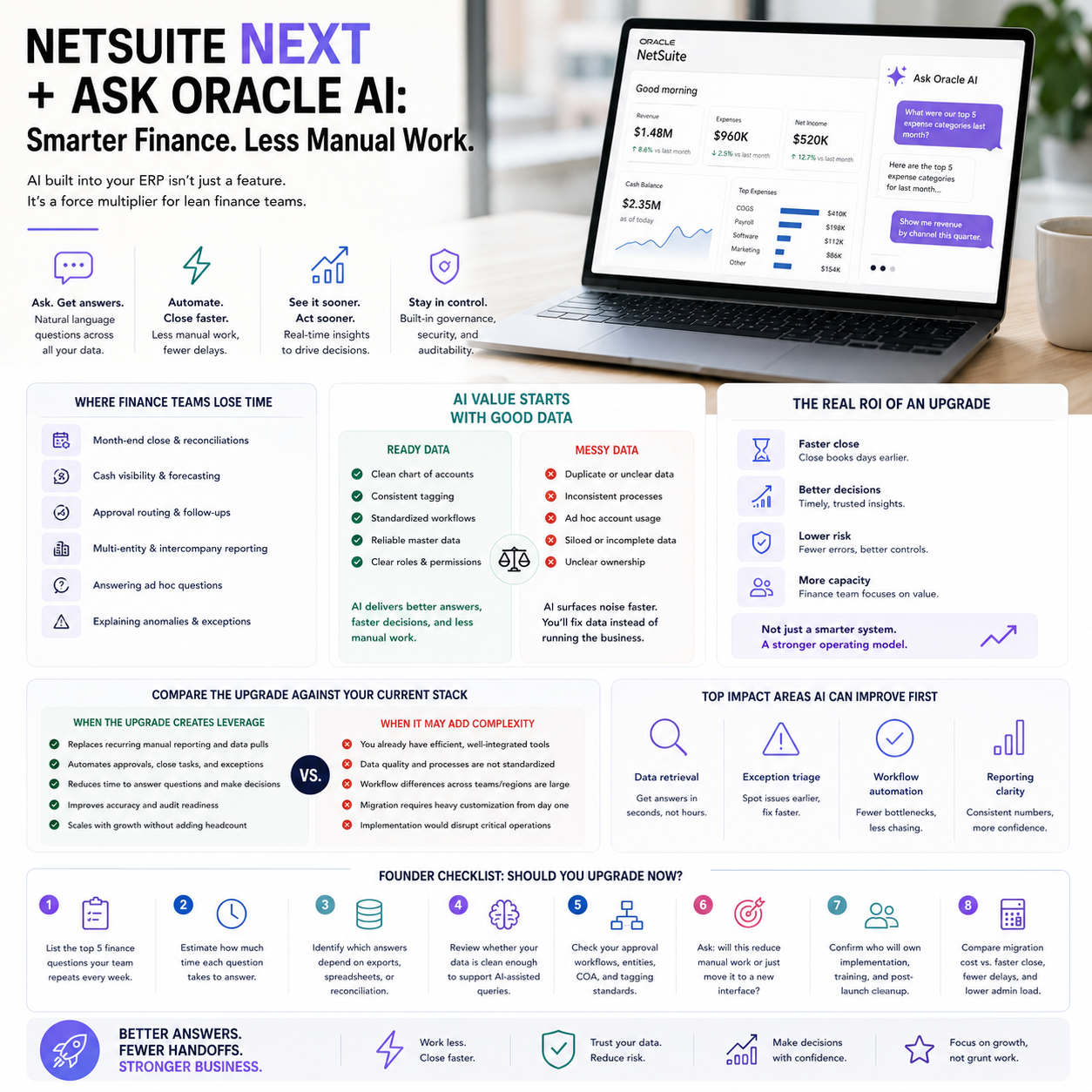
NetSuite Next is arriving in North America with Ask Oracle AI and more finance automation built into the platform. For small businesses, this is not mainly a feature story; it is a systems decision about whether your current finance stack is already creating friction in close, reporting, approvals, and exception handling.
The real question is whether an AI-enabled ERP upgrade reduces manual work enough to justify the migration cost, training time, and process change. If your team is spending too much time answering routine finance questions, chasing data across systems, or managing exceptions in spreadsheets, this release deserves a closer look.
What NetSuite Next is really signaling
The announcement suggests Oracle is pushing ERP from a record-keeping system toward a guided operating layer for finance teams. That matters because many smaller operators do not need a larger ERP for its own sake; they need fewer handoffs, faster answers, and a more reliable monthly close.
Ask Oracle AI appears to be aimed at making data access more conversational and less dependent on digging through reports. If that works well in practice, the value is not just convenience. It could reduce the amount of time a founder, controller, or operations lead spends asking the same questions in slightly different ways.
For businesses already using NetSuite, this is a moment to test whether the upgrade improves the workflows you actually run every week. For companies not on NetSuite, the announcement is a reminder to evaluate how much of your finance process is still powered by manual queries and spreadsheet workarounds.
The operational question: where does your finance team lose time?
Before looking at features, map the parts of finance operations that consume the most attention. In most small businesses, the pain usually shows up in a few places: month-end close, cash visibility, approval routing, intercompany or multi-entity reporting, and explaining anomalies in numbers that do not reconcile cleanly.
If those tasks require repeated export, cleanup, and re-entry across multiple systems, a more automated ERP can create value. If your current setup already gives you clean reporting with very little intervention, the upgrade may be more about convenience than operational leverage.
A useful way to evaluate NetSuite Next is to ask a simple question: does the platform reduce the number of times someone has to manually interpret the data before action can be taken? If the answer is yes, that can free up finance capacity without adding headcount.
What most people miss
The headline is not the AI layer itself. The bigger issue is data readiness. AI assistants only become genuinely useful when your chart of accounts, entity structure, approval rules, and transaction tagging are already disciplined enough to produce trustworthy outputs.
That means an AI-enabled ERP can expose weak processes as much as it can improve them. If your master data is messy or your workflows differ by team and region, the tool may surface answers faster but not necessarily better answers. The upgrade then shifts the burden from manual work to cleanup work.
Small businesses should therefore treat Ask Oracle AI as a force multiplier, not a rescue plan. If you are considering the rollout, evaluate the quality of your underlying finance data before you evaluate the interface.
How to compare upgrade value against current tools
Most founders do not need a broad software opinion; they need a decision framework. Compare the new platform against what you already use across accounting, BI, workflow approval, and support requests.
Start by identifying the workflows that could realistically be absorbed into one system. For example, if managers ask finance for the same recurring numbers every week, a conversational layer may reduce ad hoc reporting. If approval chains are fragmented across email and chat, better automation could remove bottlenecks.
But if your current stack is already modular and efficient, migrating may introduce operational drag. ERP changes usually affect not just reporting, but roles, permissions, training, and the way teams trust the numbers. That is where hidden cost often lives.
The best upgrade case is not “AI sounds useful.” It is “we can replace at least one recurring manual process with a controlled workflow that reduces delays or errors.”
What most people miss
The upgrade decision should also include the cost of interruption. Any ERP rollout forces the business to absorb implementation work, user retraining, and temporary ambiguity while processes settle. A platform that looks more efficient on paper can still slow down a team if the migration is rushed or the scope is too broad.
That is why the practical question is not whether the software is smarter. It is whether your team can adopt it without disrupting billing, cash control, or month-end reporting.
Where AI in finance can help small businesses first
The earliest wins for small businesses are usually in retrieval and triage, not in fully autonomous decision-making. A conversational layer is most useful when staff need quick answers about balances, transactions, or status updates without opening multiple reports.
Another likely use case is exception handling. If the system can help surface unusual entries, missing approvals, or mismatched records earlier, finance teams can spend less time chasing issues after the fact. That is especially relevant for lean teams that cannot afford a dedicated analyst for every problem.
AI also matters if your business is growing faster than your internal reporting discipline. Once transaction volume rises, the manual habit of “someone knows where that number lives” stops scaling. At that point, systems that make structured access easier can protect the business from bottlenecks.
A practical upgrade checklist for founders and operators
- List the top five finance questions your team repeats every week.
- Estimate how much time each question currently takes to answer.
- Identify which answers depend on exports, spreadsheet cleanup, or cross-system reconciliation.
- Review whether your current ERP data is clean enough to support AI-assisted queries.
- Check whether your approval workflows, entity structure, and chart of accounts are standardized.
- Ask whether an upgrade would reduce recurring manual work or simply move it into a new interface.
- Confirm who will own implementation, user training, and post-launch process cleanup.
- Compare migration cost against the value of faster close, fewer reporting delays, and reduced admin load.