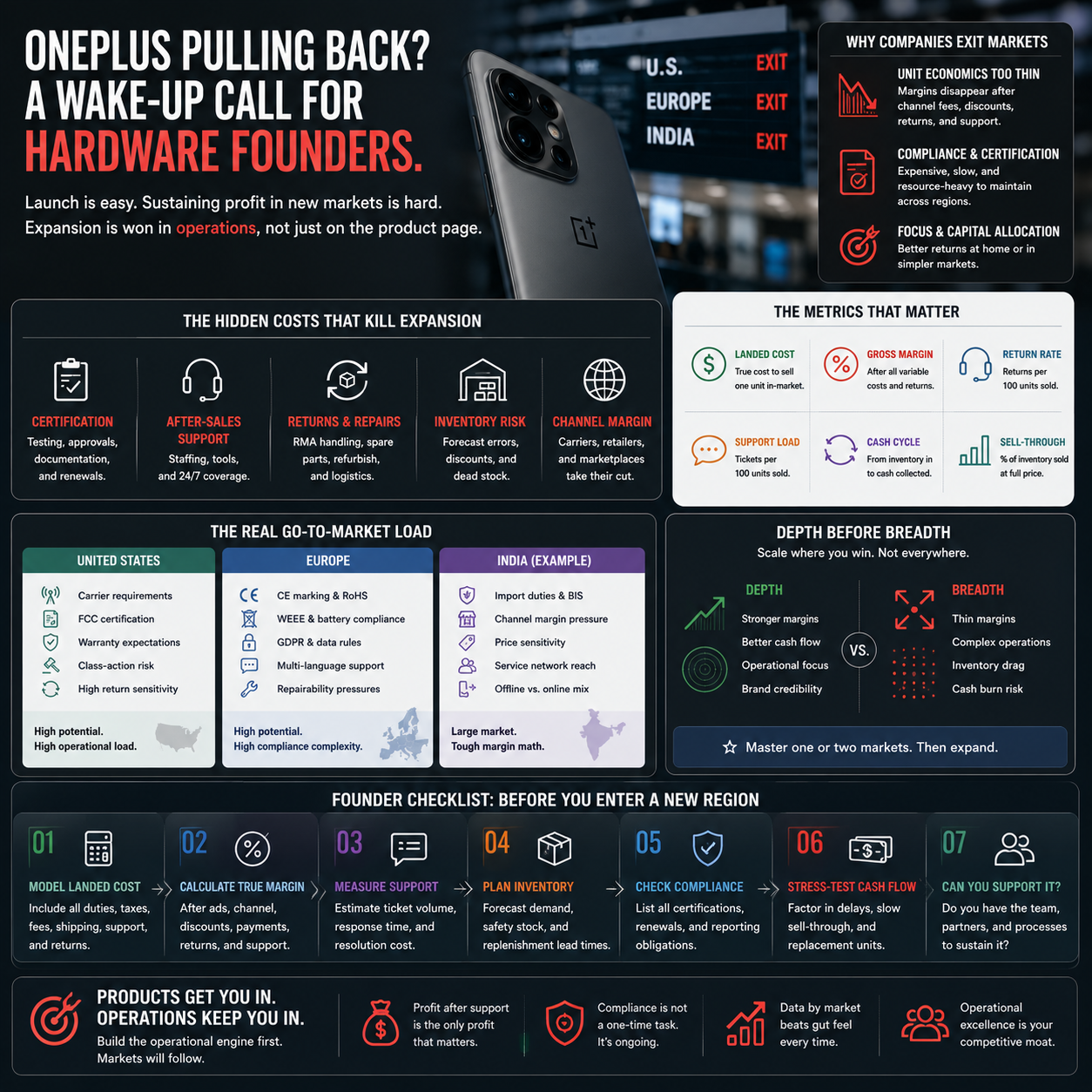
OnePlus reportedly won’t release new phones in the U.S. and Europe, with a possible wind-down in India later. For founders and operators, that is not just a consumer-tech headline. It is a reminder that hardware expansion is often decided less by product quality than by the ability to support, certify, distribute, and defend margins across regions.
For any company selling physical products, the real question is not “Can we enter this market?” but “Can we sustain the operational load after launch?” The answer depends on channel economics, compliance costs, after-sales service, inventory planning, and whether the brand can still make money after discounts, returns, and support.
What a market exit usually signals in hardware
When a phone maker reduces its presence in major regions, it often points to one of three pressures. First, the unit economics may be too thin once carrier deals, retail expectations, and local support are included. Second, compliance and certification work can slow launches and raise overhead. Third, the company may prefer to concentrate capital where demand is stronger or where distribution is simpler.
That is why this story matters to founders outside smartphones too. If you sell anything physical, the product launch is only the beginning. The business model is tested after the first shipment, when replacement rates, logistics, and support tickets start to appear.
The hidden costs that decide whether expansion works
Hardware founders often underestimate the full cost of entering the US and Europe. The obvious costs are manufacturing, freight, and marketing. The less visible costs are usually the ones that break the plan: product certification, returns processing, local repair handling, warranty reserves, and the staffing needed to answer support requests in local time zones.
There is also the channel problem. If you sell through retailers or carriers, margin gets split quickly. If you sell direct, you inherit more customer support and fulfillment complexity. Either way, the real margin is not the sticker price minus the factory cost. It is what remains after the full operating stack is paid for.
What founders should measure before entering a new region
Expansion decisions should be based on a small set of operational metrics, not on brand ambition alone. A hardware business needs to know whether the new market can absorb the company’s support burden and still leave enough gross margin to reinvest in inventory and product development.
What most people miss
The biggest mistake is treating international launch as a marketing project. It is actually an operations project. If a founder cannot model returns, service costs, and compliance delays before launch, the expansion is usually being financed by optimism rather than by cash flow.
That matters even more in categories where products age quickly. If the launch cycle is short, every region you add creates more pressure on inventory planning. A slow-moving stock position in one market can distort production for the next one. For smaller teams, that means a bad regional bet can become a company-wide cash problem.
How to use this signal in your own business
If you are running a hardware brand, DTC product line, or even a consumer electronics resale operation, OnePlus’s retreat should push you to rethink your region-by-region economics. Ask whether each market is truly profitable after support, not just after sales. Ask whether the team can handle warranties, replacement parts, and customer communication at the same service level across countries.
It also raises a broader strategy question: should you scale breadth or depth first? For many smaller operators, focusing on one or two markets with stronger unit economics is better than chasing global reach too early. That can mean fewer SKUs, fewer fulfillment nodes, and tighter inventory control.
- Model landed cost, not just manufacturing cost, for each target region.
- Include certification, customs, taxes, returns, warranty support, and local service in your margin calculation.
- Track gross margin by country or channel, not just company-wide.
- Measure return rate and support ticket volume per 100 units sold before expanding.
- Confirm whether you need local repair partners, spare parts inventory, or regional fulfillment.
- Stress-test cash flow for delayed launches, unsold inventory, and replacement units.
- Expand only where after-sales operations can be supported without distracting the core team.