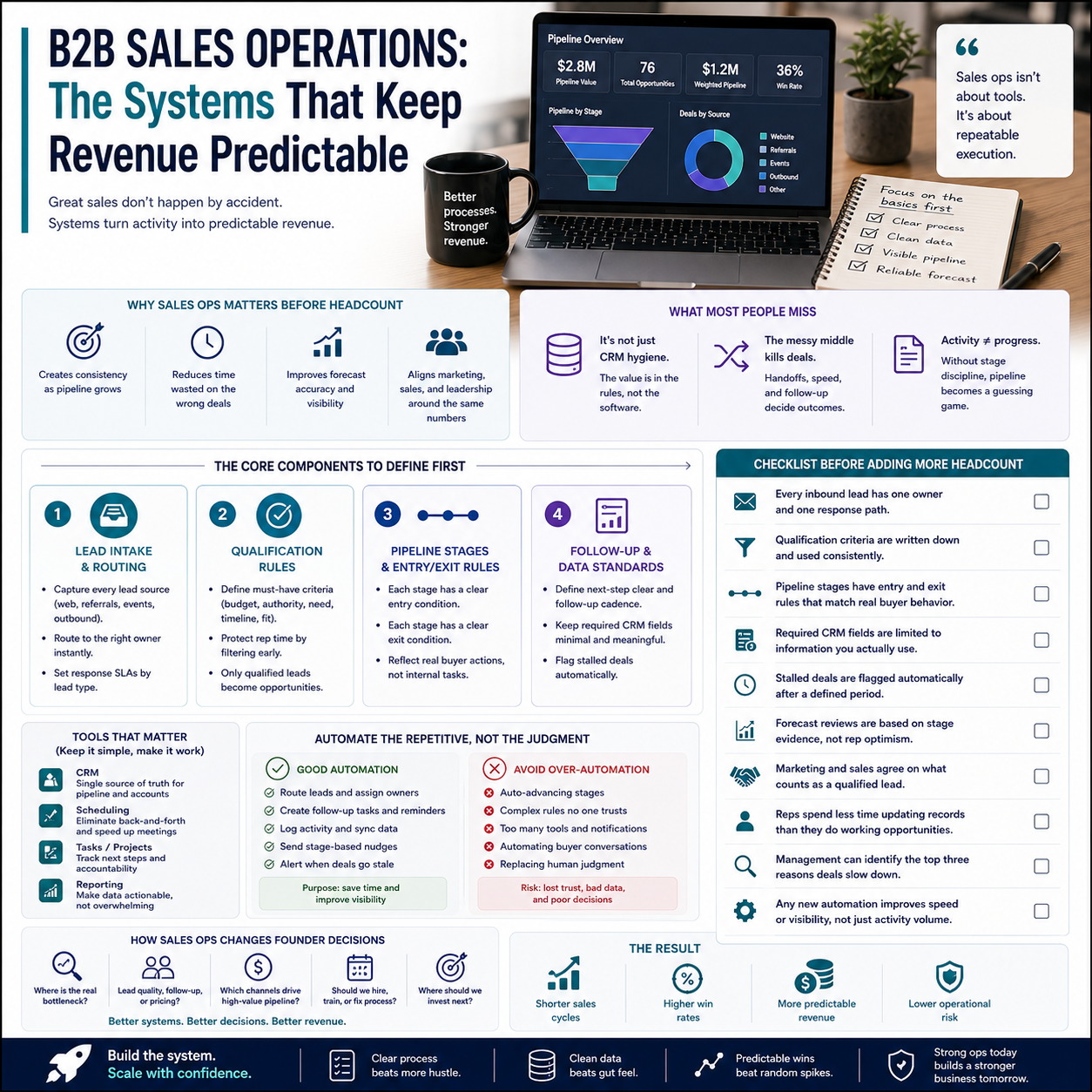
Most small B2B teams do not have a sales problem first; they have an operations problem. Leads arrive, follow-ups slip, forecasts drift, and no one can explain where deals slow down. Sales operations is the layer that turns activity into a repeatable process instead of a collection of heroic efforts.
If you are running a founder-led or small sales team, the real question is not whether you need a sales ops function on paper. It is which parts of the sales process must be standardized now so revenue stops depending on memory, spreadsheets, and guesswork.
Why sales operations matters before headcount does
When a B2B business is small, the sales process often lives inside one or two inboxes, a CRM that is only partly filled in, and a handful of recurring meetings. That can work for a while, but only until pipeline size, deal complexity, or sales cycle length starts to rise. At that point, the team needs a system for moving opportunities through stages, not just more outreach.
Sales operations covers the mechanics behind revenue: lead routing, stage definitions, CRM hygiene, reporting logic, handoffs between marketing and sales, and forecasting discipline. In practical terms, it answers questions like: Which leads get response priority? When is a deal allowed to move stages? What counts as qualified? What happens when a rep is out? Which data fields are required before management reviews the forecast?
For small businesses, this matters because every weak process creates hidden cost. Reps spend time on duplicate work. Founders make decisions from incomplete pipeline data. Marketing may send leads that sales cannot convert, while sales blames lead quality without evidence. A basic sales operations structure gives you a shared language and a way to measure friction.
What most people miss
The biggest mistake is treating sales ops as CRM administration. A clean database is helpful, but the real value is in the rules around how the database is used. If the team cannot agree on what a stage means, which actions trigger a task, or when a deal should be marked stalled, the CRM becomes a mirror of confusion rather than a system of record.
Another overlooked issue is handoff design. Many small teams focus on lead generation and closing, but the messy middle is where deals quietly die. If a demo request, inbound inquiry, or referral is not routed to the right person fast enough, the team loses trust with prospects before a salesperson even speaks to them. Sales operations is what turns those handoffs into a process with ownership and timing.
The core components a small team should define first
Start with the parts of the sales motion that create the most inconsistency. For most small B2B businesses, that means four things: lead intake, qualification, pipeline stages, and follow-up standards.
1. Lead intake and routing
Every new lead should land somewhere predictable. Decide which form submissions, referrals, event contacts, and outbound replies go to which rep or queue. If different lead types deserve different service levels, document them. A simple routing rule can reduce response delays and prevent high-value leads from sitting in the wrong inbox.
2. Qualification rules
Qualification is not just a conversation; it is an operational gate. Define what must be true before a lead becomes an opportunity. That could include company size, use case, budget fit, timing, or a confirmed decision-maker. Without this, the pipeline fills with deals that are unlikely to close, and forecast accuracy drops.
Qualification rules also help protect rep time. If sales keeps chasing unfit leads because the process rewards volume over quality, the team can look busy while revenue stays flat. A better setup makes it obvious which prospects deserve deeper effort.
CRM fields, stages, and reporting must match reality
A CRM is only useful if the fields and stages reflect how deals actually move. Too many small businesses copy a generic pipeline and then wonder why reporting feels useless. If a stage does not correspond to a real buyer action, it is just decoration.
Each stage should have a clear entry condition, exit condition, and owner. For example, a deal should not move from discovery to proposal until the discovery meeting has happened and the next step has been agreed. That sounds simple, but it is the difference between a forecast based on intent and a forecast based on evidence.
Reporting should also be built around decisions, not vanity. A founder usually needs to know where deals are stalling, which source produces the highest conversion, how long deals sit in each stage, and whether rep activity is producing qualified meetings. If the dashboard does not answer those questions, it is probably measuring too much or too little.
Tools that matter, and what to avoid
Small teams do not need a sprawling stack to improve sales operations. They need a stack that reduces manual work and keeps data clean. At minimum, that usually means a CRM, a scheduling tool, a shared task system, and a reporting layer that the team actually checks.
Automation should be used for repetitive coordination, not judgment. Good uses include routing leads, creating follow-up tasks, logging activity, sending stage-based reminders, and alerting managers when deals go stale. Poor uses include auto-moving deals based on weak signals or using too many workflow rules that reps stop trusting the system.
The tool risk is not just cost. It is process leakage. If the stack is too fragmented, salespeople maintain their own spreadsheets, managers keep separate notes, and no one knows which number is current. The best setup is usually the simplest one that forces shared visibility.
How sales ops changes the founder’s decisions
Once sales operations is defined properly, the founder gets better answers to practical questions. Should you hire another rep or fix conversion first? Is the real problem lead quality, qualification, or rep follow-up? Are you short on top-of-funnel volume or losing deals mid-cycle? Which channels create the highest-value pipeline, not just the most activity?
That changes hiring, spend, and management. Instead of scaling on hope, you can identify the bottleneck. If response times are slow, fixing routing may produce more impact than buying more leads. If opportunities are aging in proposal stage, the issue may be pricing clarity or decision-process mapping, not prospecting volume.
For small business owners, this is where sales ops stops being an internal function and becomes a decision system. It tells you where revenue is fragile and which operational fix will move the number fastest.
Use this checklist before adding more sales headcount
- Every inbound lead has one owner and one response path.
- Qualification criteria are written down and used consistently.
- Pipeline stages have entry and exit rules that match real buyer behavior.
- Required CRM fields are limited to information you actually use.
- Stalled deals are flagged automatically after a defined period.
- Forecast reviews are based on stage evidence, not rep optimism.
- Marketing and sales agree on what counts as a qualified lead.
- Reps spend less time updating records than they do working opportunities.
- Management can identify the top three reasons deals slow down.
- Any new automation improves speed or visibility, not just activity volume.
If those items are not in place, adding headcount usually adds noise before it adds revenue. The better move is to tighten the operating rules first, then scale the team around a process that can actually hold up under load.