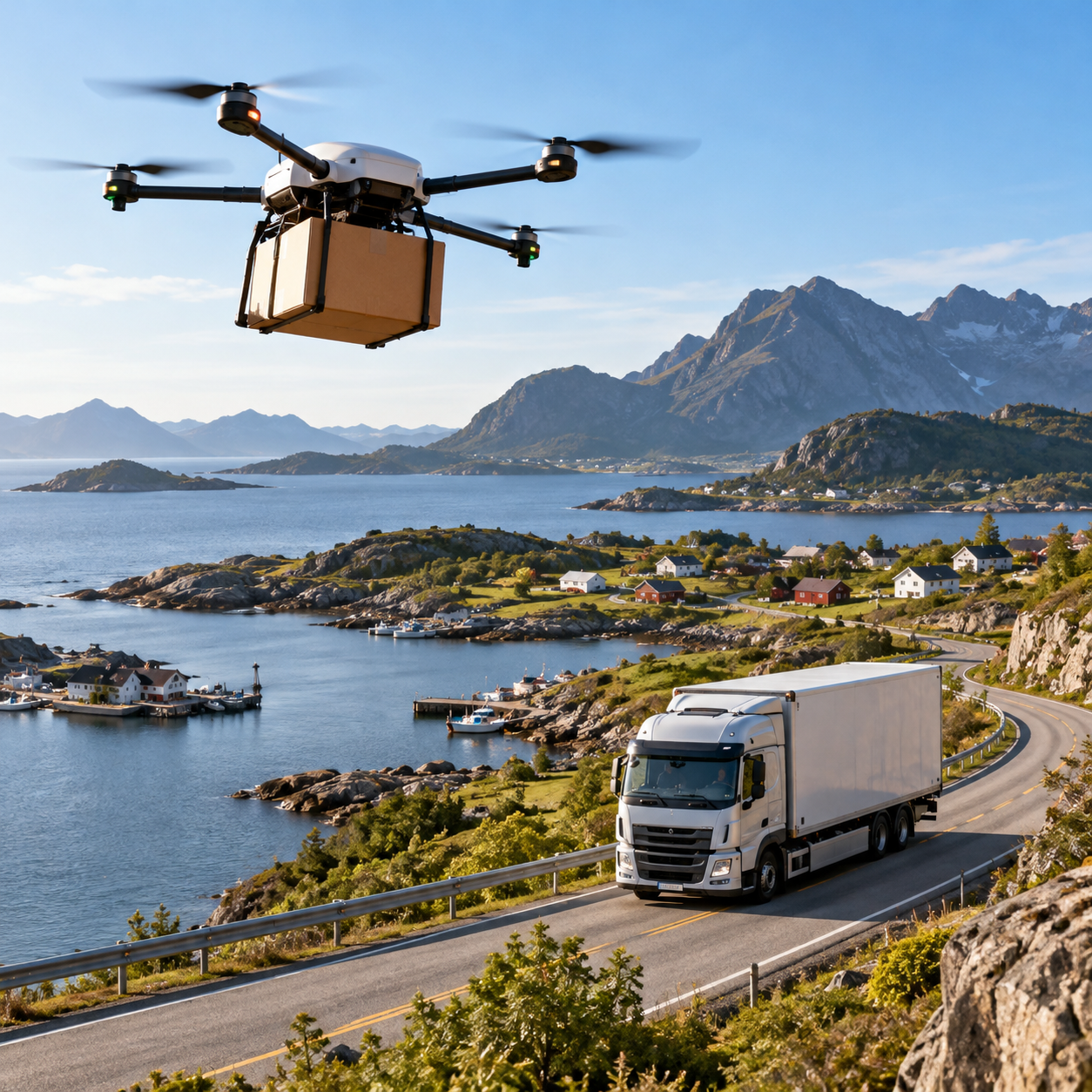
Delivery drones are often presented as competitors to trucks, but that framing can lead operators toward the wrong pilots. A drone does not need to replace an entire vehicle route to create value. It may only need to outperform the road-based alternative on a narrowly defined lane where the payload is light, time matters, road access is inefficient, and both ends can support reliable handoffs.
Airbound’s ultra-lightweight delivery-drone approach offers useful context for this route-level analysis. TechCrunch reports that the India-based company has disclosed backing for its effort to move lightweight goods using rocket-like aircraft. The relevant operational question is not whether such drones can replace trucks universally. It is whether their aircraft and operating model can complete particular deliveries more economically or predictably after every supporting cost and constraint is included.
The following framework is a practical synthesis for delivery operators. It does not assume any performance level, regulatory approval, or commercial capability beyond what a provider can document during evaluation.
Start with the delivery lane, not the aircraft
A promising lane has a specific origin, destination, payload profile, service requirement, and delivery frequency. Screening broad categories such as “medical delivery” or “e-commerce” is too imprecise because conditions can vary dramatically within them.
Begin by examining recurring movements between known facilities: a distribution hub and a clinic, a warehouse and a service site, or two facilities separated by a slow road connection. Fixed or semi-fixed lanes simplify demand forecasting, site assessment, staff training, and permissions. They also provide a stable truck or courier baseline against which the drone can be compared.
Give priority to lanes where road distance or travel time is disproportionate to straight-line distance. Rivers, mountains, congestion, poor roads, access controls, or indirect road networks may create that gap. A drone’s potential advantage is weaker where a van already passes the destination frequently and can add another parcel at little marginal cost.
Demand density must be interpreted carefully. High stop density generally favors trucks because one driver can distribute many packages on a compact route. Low density can favor aerial transport only if the drone avoids substantial road time without creating expensive repositioning or supervision requirements. A remote destination served once per flight may look attractive, while ten adjacent urban stops may remain better suited to a van.
Apply payload, urgency, and handoff filters
Airbound’s lightweight model directs attention to shipments whose value is not determined by weight or volume. Operators should build a lane profile from actual shipment records, including package dimensions, total loaded weight, packaging requirements, dispatch times, frequency, and seasonal variation. Average payload is insufficient: the percentage of orders exceeding the aircraft’s limits determines how often another mode will still be needed.
Urgency can improve the case. A maintenance component that prevents downtime, a diagnostic sample with a service deadline, or an essential item needed at an isolated site may justify a higher delivery cost than an ordinary replenishment shipment. Operators should quantify the consequence of delay rather than merely labeling an order urgent.
Handoff conditions can eliminate an otherwise attractive route. Ask how staff will load the package, verify its identity, secure it, and confirm dispatch. At the destination, determine whether the drone must land, lower the item, use a receiving device, or transfer it to trained personnel. Each method affects site requirements, theft exposure, package damage risk, turnaround time, and labor.
The best early lanes usually have controlled endpoints, predictable recipients, and enough clear space for the proposed operation. Deliveries to individual homes introduce variable obstacles, absent recipients, pets, public interaction, and disputed receipt. A facility-to-facility lane offers fewer uncontrolled handoffs and clearer accountability.
Compare completed deliveries, not flight costs
A provider may describe efficient aircraft or inexpensive flight operations, but operators need an end-to-end cost model. The correct unit is cost per completed drop, including unsuccessful attempts and alternative transport used during exceptions.
For the truck baseline, include the lane’s true avoidable cost. That may cover driver time, vehicle operating costs, tolls, dispatch effort, waiting, and the cost of meeting a priority service window. Do not assign the full cost of a truck route to one parcel if the vehicle carries many deliveries. Conversely, do not use a low average network cost when the specific shipment triggers a dedicated trip.
For the drone option, capture aircraft or service fees, energy, maintenance, insurance, communications, site equipment, software, trained supervision, loading, receiving, packaging, security, compliance administration, and recovery after an interruption. Add the cost of the backup mode required when the flight cannot proceed. Launch and receipt labor should be timed during the pilot rather than assumed to be negligible.
A useful calculation separates attempted flights from successful commercial deliveries:
Cost per completed drop = total drone-lane operating cost, including exception transport, divided by deliveries completed to the agreed service standard.
This prevents low flight costs from obscuring cancellations, failed handoffs, damaged goods, or late deliveries. Compare the result with the relevant road alternative and with any measurable value of time saved. A drone can have a credible business case while costing more than routine trucking if it reliably avoids a much larger delay cost.
Map the operating envelope before committing
Range should be tested as an operational constraint, not a brochure maximum. The route assessment must account for payload, reserve requirements, wind, temperature, routing restrictions, diversions, and return or repositioning needs. The shortest line on a map may cross airspace or property where the proposed operation is not permitted.
Regulatory feasibility is jurisdiction- and operation-specific. Before setting commercial targets, document which authority governs the flights, what permissions are required, whether the intended route or operating method is allowed, and which party is responsible for securing and maintaining approvals. No funding announcement or technical demonstration should be treated as proof of permission for a particular lane.
Responsibility must also be allocated contractually. Questions include who is liable for injury, property damage, lost cargo, privacy incidents, operating errors, and failures involving communications or receiving equipment. Verify insurance terms, data handling, incident reporting, maintenance records, and subcontractor responsibilities.
Weather thresholds belong in the service design. Define maximum wind and precipitation conditions, visibility requirements, temperature limits, and any provider-imposed restrictions before launch. Then compare local historical conditions with the proposed operating window. The goal is not to claim all-weather service but to estimate how often the lane may revert to road transport.
Safety thresholds should be equally explicit: authorized launch conditions, pre-flight checks, minimum reserves, package-security checks, abort rules, emergency landing procedures, and criteria for suspending the pilot. A fast delivery that depends on staff informally overriding limits is not commercially scalable.
Design a pilot that can produce a decision
A useful pilot tests one or a small number of clearly defined lanes against a contemporaneous road baseline. Record each requested delivery from release through confirmed receipt, including loading time, queueing, flight or road time, receiving labor, interruptions, and exception handling.
Set metrics before operations begin:
- Successful-delivery rate: the share of requested deliveries completed safely and within the agreed service window.
- Cost per completed drop: all lane-related costs divided by compliant completed deliveries.
- Time saved: end-to-end elapsed time compared with the appropriate truck or courier baseline.
- Exception rate: the share requiring cancellation, reflight, manual intervention, recovery, or road backup.
- Handoff time: labor and waiting at both origin and destination.
- Payload coverage: the share of real lane demand that fits the aircraft and packaging limits.
Segment results by payload, time of day, weather, and exception cause. An overall average can hide the fact that the model works only for certain shipment classes or operating windows. Predetermine the minimum acceptable service level and the economic threshold for expansion, redesign, or termination.
The strongest candidate is therefore not simply the longest or busiest route. It is a lane with lightweight and compatible shipments, costly road friction, meaningful urgency, controlled endpoints, feasible permissions, manageable weather exposure, and limited handoff labor. Where those conditions do not align, trucks may remain the better system—especially on dense multi-stop routes. Where they do, a tightly scoped drone pilot can test a credible operational hypothesis instead of staging a technology demonstration.