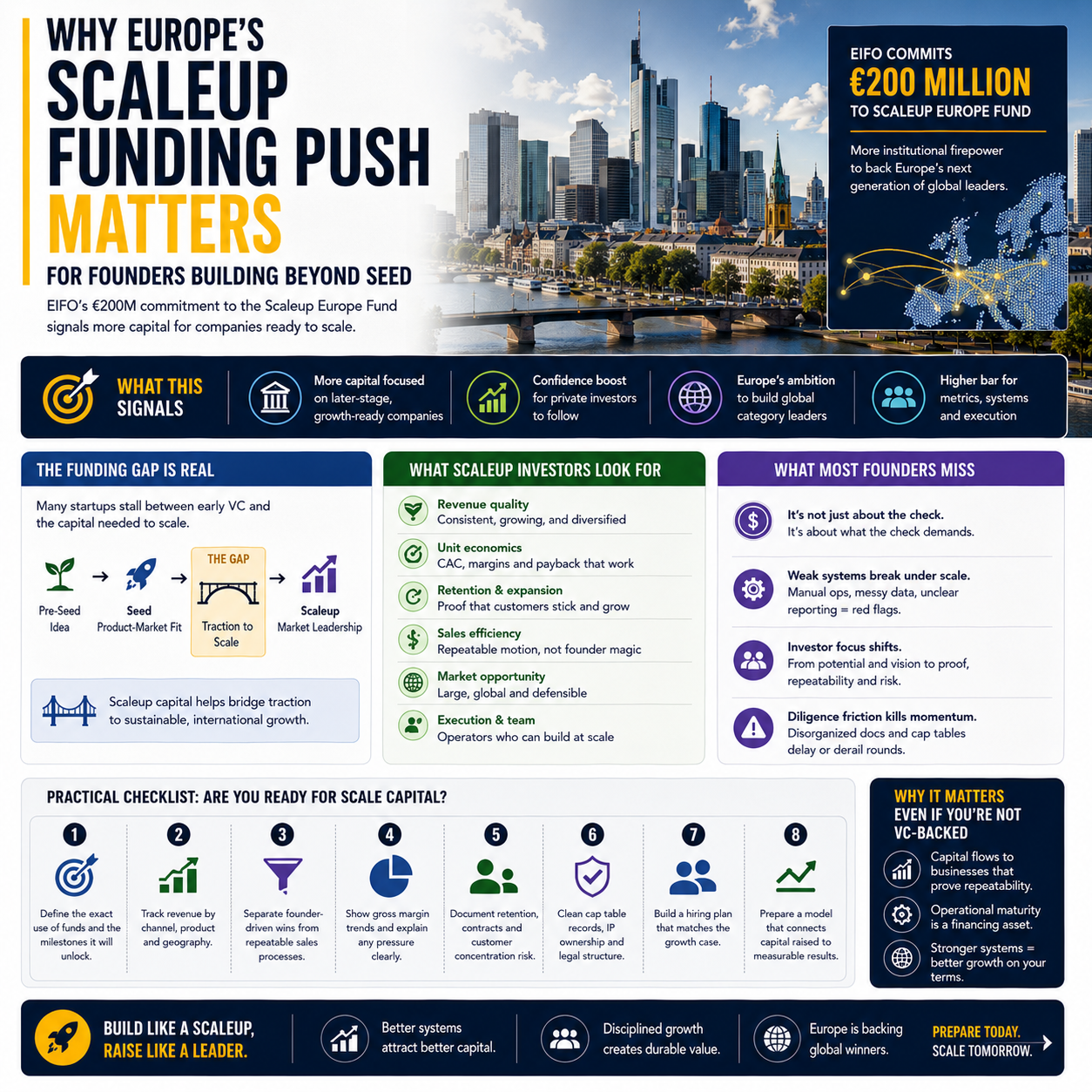
Europe’s startup funding story is often told through seed rounds and early product launches. But the bigger operational question for founders is what happens once a company needs to move from promising traction to repeatable scale. EIFO’s €200 million commitment to the Scaleup Europe Fund is a useful signal because it points to more institutional attention on the funding gap between early venture money and the capital needed for expansion.
For founders, this is less about headlines and more about financing strategy: what kind of businesses can absorb growth capital, what proof points investors now expect, and how to prepare a company for scale without weakening unit economics.
What EIFO’s commitment actually signals
The EIFO announcement is important not because one investor added another pool of capital, but because it reinforces where European capital is trying to go: later-stage tech companies with the ability to expand across markets, hire aggressively, and compete internationally. The Scaleup Europe Fund is positioned around companies that are already past the idea phase and need capital to turn product-market fit into market share.
That matters for founders because the fundraising bar changes as a company grows. Early-stage investors can underwrite vision, team quality, and a narrow set of traction metrics. Scaleup investors, by contrast, are often looking at revenue quality, customer concentration, gross margin, retention, sales efficiency, regulatory exposure, and how much capital the business needs to reach the next milestone.
When a public or quasi-public investor commits meaningful capital, it can also improve confidence for private backers. That may not make fundraising easy, but it can make later rounds more available for companies that can show disciplined growth rather than just fast spending.
How founders should read the market shift
The practical takeaway is that Europe is trying to build more companies that stay in Europe while growing globally. That means the best-funded teams will not just be the ones with the sharpest pitch decks; they will be the ones with operational models that can survive scrutiny from growth investors.
For small and mid-sized founders, this creates a useful decision point. If your business is still pre-scale, you do not need to chase scaleup capital. But if you are already seeing repeat buyers, a working acquisition channel, and a product that can expand into adjacent markets, it may be time to build the company as if the next round will be a scaleup round, not a rescue round.
That means tightening reporting, documenting your funnel, and showing where capital would actually go. Investors backing scaleups need to understand whether new money is being used to expand sales coverage, improve retention, enter a new geography, or shorten product delivery cycles. Vague growth plans are harder to finance when larger checks are intended to create measurable expansion.
What most people miss
The funding conversation usually focuses on who is writing the check. Operators should focus on what the check demands in return.
Scaleup capital often exposes weak systems. A company can look strong at seed stage while still relying on founder-led sales, scattered financial reporting, or manual operations that break when headcount grows. Once investors start evaluating a business for scale, these gaps become visible quickly.
That is why the real value of this kind of market move is not just more capital. It is the pressure it creates for founders to build companies that can be financed repeatedly. If your business cannot explain how it turns cash into growth with enough clarity, larger funding will be harder to secure even if the market is open.
What operators should build before they raise again
Founders preparing for a larger round should think in systems, not slogans. The company needs to show that it can absorb capital without losing control of margins or execution.
That starts with financial visibility. You need monthly reporting on revenue by channel, customer acquisition cost where relevant, gross margin, and runway. If the business sells into multiple markets, segment the numbers so investors can see which geography or product line is pulling its weight.
It also means documenting growth mechanics. If sales depends on a small founder network, a single channel, or bespoke deal-making, investors will ask whether the model scales. If your growth engine is repeatable, show the process, the conversion points, and the bottlenecks. Companies that can explain the machine behind growth are easier to finance than companies that only show the output.
Finally, make sure the company can survive diligence. That includes clean cap tables, clear IP ownership, organized customer contracts, and a credible hiring plan. Later-stage capital is often delayed not by lack of interest, but by friction in the data room and uncertainty around execution.
Why this matters even if you are not a venture-backed startup
The broader market signal here is not limited to high-growth tech companies. Even small business owners can learn from it because it highlights a simple truth: capital is flowing toward businesses that can prove repeatability. Whether the funding comes from venture, private equity, debt, or strategic investors, the logic is similar.
If you run an e-commerce brand, SaaS company, digital agency, or specialized services business, the same questions apply. Can you show that growth is repeatable? Can your margin support expansion? Can your systems handle more volume without constant founder intervention?
That makes this more than a funding story. It is a reminder that operational maturity is becoming a financing asset. The stronger your reporting, process design, and growth model, the easier it becomes to raise on better terms or to grow without external capital at all.
Practical checklist for founders preparing for scale capital
- Define the exact use of funds: sales expansion, product development, market entry, or operations.
- Track revenue by channel, product, and geography so investors can see where growth comes from.
- Separate founder-driven wins from repeatable sales processes.
- Show gross margin trends and explain any margin pressure before it becomes a due diligence issue.
- Document customer retention, contract structure, and concentration risk.
- Clean up cap table records, ownership documents, and intellectual property assignments.
- Build a hiring plan that matches the growth case, not just the org chart you want.
- Prepare a simple model that connects capital raised to milestones you can actually measure.