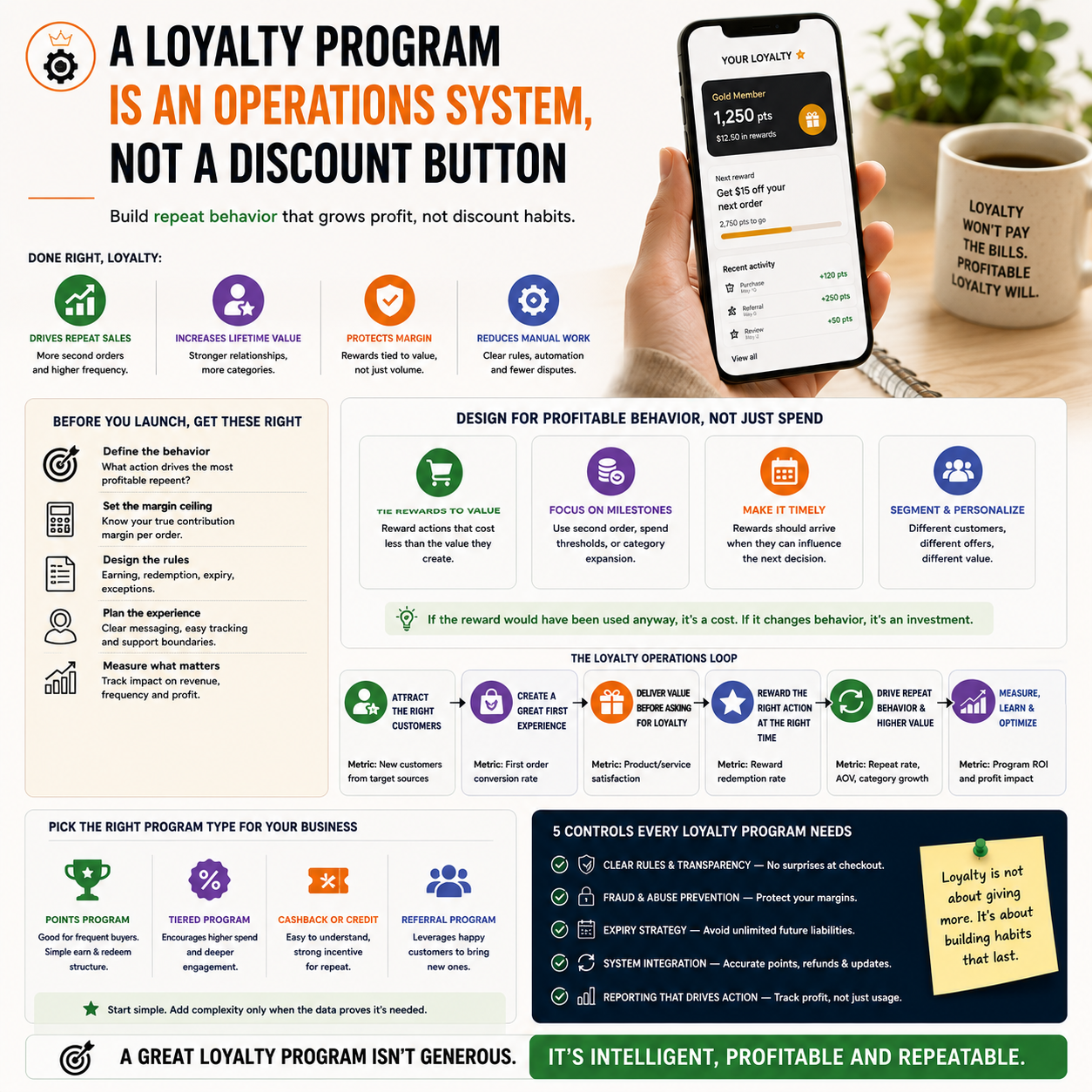
A loyalty program can quietly improve repeat orders, or it can become an expensive discount habit that trains customers to wait for rewards. The difference is not the software. It is whether the business treats loyalty as a measurable operating system with rules, costs, customer service boundaries and margin controls.
This is for small e-commerce sellers, service businesses, local operators with online booking, and digital teams deciding whether to launch or rebuild a customer loyalty program. The decision is not simply whether rewards sound attractive. The decision is whether the program can create profitable repeat behavior without adding manual work, support disputes or uncontrolled liabilities.
The real decision: are you buying repeat behavior or giving away margin?
Many small businesses approach loyalty programs as a marketing feature: points, stamps, birthday offers, tiers or referral credits. That framing is too shallow. A loyalty program changes pricing behavior, customer expectations, refund handling, support scripts, cash flow timing and reporting.
The first operator question is: what customer behavior are you trying to change?
- For an e-commerce seller, the goal may be a second purchase within a defined window after first order.
- For a consumable product business, the goal may be shorter reorder intervals.
- For a service business, the goal may be pre-booked repeat appointments rather than last-minute demand.
- For a digital product or subscription business, the goal may be lower churn or upgrades after usage milestones.
If the behavior is not specific, the program usually defaults to discounting. A generic points system may make the business feel more mature, but it can also reward customers who would have bought anyway. That is the margin leak most small operators miss.
The Small Business Trends overview of customer loyalty program services is useful as a starting point because it frames loyalty programs around retention and repeat relationships, not only promotions. But the implementation decision for a small operator should go further: each reward needs a business reason, a cost ceiling and a workflow owner.
Start with the margin ceiling before choosing software
Before comparing loyalty tools, calculate how much reward cost the business can tolerate per order. This does not require a complex finance model. It requires knowing contribution margin after product cost, payment fees, shipping subsidy, packaging, marketplace fees, ad cost allocation and expected returns.
For example, an online store selling skincare products may have healthy gross margin on paper, but if it offers free shipping, pays card fees, runs paid acquisition and handles returns, the available margin for rewards may be much smaller than expected. A 10% points reward can be too high if it stacks with a welcome discount, seasonal sale and free shipping threshold.
A better starting calculation is:
- Average order value before discounts
- Gross margin per order
- Fulfillment and payment cost per order
- Average discount already used
- Return or refund exposure
- Maximum reward cost allowed without damaging contribution margin
The loyalty budget should come from incremental behavior, not from every transaction by default. If the program gives rewards on every purchase, including low-margin items and discounted orders, the business may be paying customers to do what they already intended to do.
What most people miss
Points are a liability until they expire, are redeemed, or are otherwise resolved under the program rules. Even when the amounts are small, they create future obligations. For a small business with tight cash flow, that matters. A reward issued today may reduce revenue on a future order, often during a promotional period when margin is already compressed.
Operators also miss the support cost. Customers will ask why points did not appear, whether rewards apply to sale products, what happens after a refund, whether a referral was tracked, and why a coupon failed at checkout. If the rules are unclear, the business pays twice: once through the discount and again through staff time.
Choose the program type based on purchase rhythm
The right loyalty mechanic depends on how often customers naturally buy. A coffee shop, a cosmetics store, a B2B supplies seller and a web design service should not use the same structure.
High-frequency purchases: keep rewards simple and automatic
If customers buy often, the program should be easy to understand and low-touch. A simple points-per-spend system, stamp-style reward or automatic credit can work because customers encounter it frequently enough to remember it. The operational risk is reward stacking. The system should prevent points from being earned on tax, shipping, gift cards, refunded orders and, where appropriate, heavily discounted items.
For Shopify, WooCommerce, Square, Lightspeed or similar setups, the business should check whether the loyalty tool can read order status properly. Points should not become available until the order is paid and outside any high-risk cancellation window. If the system awards points instantly and the order is refunded later, the operator needs an automated clawback rule or a manual reconciliation process.
Low-frequency purchases: reward milestones, not every order
If customers buy only a few times per year, traditional points often fail because the customer forgets the balance. A better structure may be milestone-based: second-order credit, annual member perk, service bundle discount, upgrade reward or referral credit after a completed purchase.
For example, a small furniture retailer may not benefit from giving customers points they will rarely use. A post-purchase program that offers a measured credit toward accessories, assembly, care products or a future room package may be more useful. The reward is tied to a plausible next purchase rather than an abstract balance.
For a service business, a loyalty program may look less like points and more like booked continuity. A pet grooming business, repair specialist or beauty service can reward pre-booked repeat appointments. The operational value is smoother demand planning, fewer empty slots and more predictable staffing.
The workflow should be designed before the reward
A loyalty program touches several systems. If those systems are not mapped, the launch will create exceptions that staff have to handle manually.
At minimum, define the workflow across these moments:
- Customer joins the program
- Customer earns a reward
- Reward becomes available
- Customer redeems it
- Customer returns, cancels or changes an order
- Customer contacts support about a missing or disputed reward
- Program rules change
The best small-business setup is usually not the most feature-rich tool. It is the tool that integrates cleanly with the checkout, CRM or email platform already in use. If the store runs on WooCommerce, the operator should confirm how the loyalty plugin handles coupons, refunds, user accounts, guest checkout and tax display. If the business uses Shopify, it should test whether reward prompts appear clearly in checkout and whether customer segments sync to email or SMS tools.
For a small team, avoid any program that requires staff to manually approve routine rewards. Manual approval may seem safer at launch, but it quickly becomes a bottleneck. Use manual review only for high-risk cases: unusually large rewards, suspected referral abuse, repeated refund behavior or B2B accounts with negotiated pricing.
Where automation helps and where humans should stay involved
Loyalty operations are a strong fit for automation, but not every decision should be delegated to software. Automation should handle predictable rules. Humans should handle exceptions that affect trust, fairness or abuse prevention.
Automate:
- Enrollment confirmation
- Reward earning after eligible order status
- Point expiry reminders
- Segmented win-back offers based on last purchase date
- Referral reward release after completed purchase
- Removal of points after refunds where rules allow
- Dashboard reporting on redemption and margin exposure
Keep human review for:
- Customers disputing missing rewards after a technical failure
- Fraud patterns involving referrals or repeated returns
- VIP account exceptions
- Program rule changes that may upset existing customers
- Complaints where loyalty status affects perceived fairness
This is where conflict handling becomes part of the operating model. The Small Business Trends article on conflict resolution is not about loyalty programs specifically, but its relevance is practical: reward disputes are customer conflict events. If frontline staff do not have a clear script and authority limit, a small issue can turn into discount escalation.
For example, a support agent should know whether they can manually add missing points, issue a one-time credit, deny a claim based on program rules, or escalate the case. Without that boundary, the business may train customers to negotiate every reward problem.
A practical scenario: replacing blanket discounts with controlled loyalty
Consider a small online seller that currently sends frequent 15% discount codes to past customers because repeat purchase volume drops after the first order. The store wants a loyalty program, but the real problem is not lack of rewards. The problem is that customers have learned that the brand discounts often.
A better rollout would not simply add points on top of existing discounts. The operator could redesign the repeat purchase workflow like this:
- First order: no points redemption yet, but the customer is invited into the program after payment.
- After delivery: an email explains the reward rules and suggests the most common reorder path.
- Second order within a defined period: the customer receives a modest credit on a future purchase, not an immediate large discount.
- Subscription or bundle purchase: higher reward value because it improves predictability and fulfillment planning.
- Sale items: points can be redeemed but not earned, or the reverse, depending on margin.
- Refunded orders: earned rewards are reversed automatically when the order status changes.
This changes the economics. The business is no longer paying every customer with a discount code. It is using rewards to guide a specific repeat purchase path. The program also becomes easier to measure because the operator can compare customers who joined and completed the second-order workflow against customers who did not.
The metrics that decide whether the program survives
A loyalty program should have a dashboard from the first week. The dashboard does not need to be sophisticated, but it must separate activity from profit. Many programs look successful because sign-ups and point balances rise. That does not prove the business is making more money.
Track these metrics:
- Enrollment rate from eligible customers
- Second purchase rate among enrolled customers
- Repeat purchase interval
- Average order value before and after rewards
- Reward cost as a percentage of net revenue
- Redemption rate by reward type
- Gross margin on orders using rewards
- Refund rate on rewarded orders
- Support tickets related to points, coupons or referrals
- Expired points and outstanding reward liability
The most important comparison is not enrolled customers versus all customers. Enrolled customers may already be more loyal. A more useful view is cohort-based: customers acquired in the same month, separated by whether they joined the program, redeemed rewards, or ignored them. This helps reveal whether the program changes behavior or simply records existing loyalty.
For paid acquisition businesses, also watch whether loyalty reduces dependence on ads. If returning customers still require paid retargeting and a reward discount, the business may be paying twice for the same order.
Program rules that prevent margin leaks and support disputes
Small businesses should write loyalty rules as operational controls, not legal-looking filler. Customers need simple language, but the internal version should be precise enough for staff and software configuration.
Decide these rules before launch:
- Are points earned on discounted orders?
- Are points earned on shipping, tax, gift cards or fees?
- When do rewards become available?
- What happens after a refund, partial refund or exchange?
- Can rewards be combined with coupons?
- Do rewards expire?
- Are wholesale, B2B or custom-priced accounts included?
- Are marketplace orders included, or only direct website orders?
- Can customers transfer rewards between accounts?
- What is the maximum reward value per order?
The marketplace question matters for e-commerce operators. If a business sells through its own website and a marketplace, it may not have the same customer data, margin or communication rights in both channels. A loyalty program that works on a direct store may be hard to apply to marketplace buyers without violating marketplace rules or creating messy manual processes.
When not to launch a loyalty program yet
Sometimes the correct decision is to delay. A loyalty program will not fix poor product-market fit, slow shipping, confusing returns, weak customer support or bad reorder timing. It can actually expose those weaknesses by increasing customer expectations.
Delay the launch if:
- You do not know gross margin by product category.
- Your discounting is already uncontrolled.
- Your order data is fragmented across systems and cannot be trusted.
- Your team cannot explain refund and coupon rules consistently.
- Your products are mostly one-time purchases with no natural follow-on offer.
- You cannot track repeat purchase behavior by customer cohort.
In those cases, fix the operating base first. Clean up product margins, standardize discount rules, connect order data to email or CRM records, and define the second-purchase journey. The loyalty tool should sit on top of that system, not compensate for its absence.
Rollout sequence for a small team
A controlled launch beats a full-featured launch. The aim is to test whether rewards change customer behavior without creating a support burden or damaging margin.
- Week 1: Set the economic boundary. Calculate maximum reward cost per order and decide which products, order types and customer groups are eligible.
- Week 2: Map the reward workflow. Define earn, redeem, refund, expiry and support rules. Write both customer-facing language and internal staff notes.
- Week 3: Configure the tool. Connect the loyalty app or plugin to checkout, email and customer accounts. Test guest checkout, refunds, coupon stacking and mobile checkout.
- Week 4: Launch to a narrow segment. Start with repeat customers or a single product category rather than the entire database. Watch support tickets and redemption behavior.
- Week 5: Review margin and behavior. Compare repeat purchase interval, rewarded order margin and support workload against the previous period.
- Week 6: Expand only if the numbers work. Add tiers, referrals or expiry reminders only after the basic earn-and-redeem flow is stable.
The operating principle is simple: a loyalty program should earn its place in the business system. If it increases repeat purchases profitably, reduces reliance on blunt discounting and gives the team cleaner customer behavior data, it is doing its job. If it mainly creates coupons, disputes and reporting confusion, it is not a loyalty strategy. It is a margin leak with a dashboard.