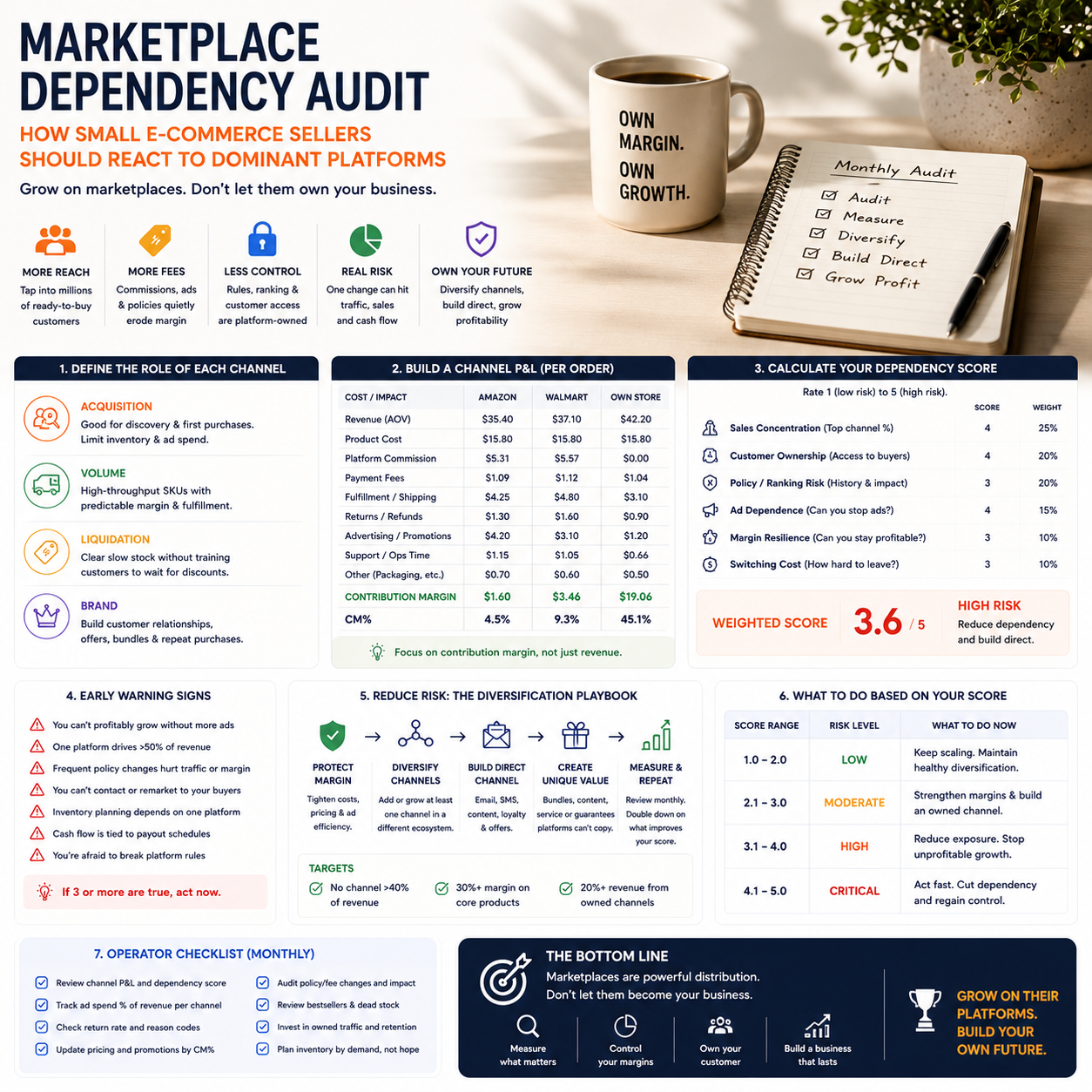
Dominant e-commerce platforms are not just sales channels. For a small seller, they can quietly become the pricing engine, customer data layer, fulfillment standard, returns policy and advertising tax collector.
The practical question is not whether Amazon, Walmart, eBay, Etsy, TikTok Shop or other major channels matter. They do. The question is how much of your operating system you should let them own before your margin, customer access and cash flow become too fragile.
The real risk is not marketplace fees. It is operating dependency.
Many small e-commerce sellers treat marketplace expansion as a traffic decision: list products where shoppers already are, pay the fees, learn the rules, and push for volume. That logic is incomplete. A marketplace is not only a storefront. It changes how the business behaves.
When a large platform controls demand, it can also influence your discounting cadence, delivery promises, return tolerance, ad spend, packaging requirements, customer messaging and product ranking incentives. The seller still owns inventory risk. The platform owns much of the customer interface.
That split matters.
For an operator, the correct unit of analysis is not gross marketplace revenue. It is contribution margin after platform fees, payment fees, advertising spend, fulfillment cost, return cost, support time, inventory write-downs and the operational cost of staying compliant with the channel. A product that looks healthy in a sales report can be weak once every channel-specific cost is loaded into the calculation.
The Small Business Trends coverage of e-commerce market share points to a market where a handful of major players shape how online buying happens. Its separate discussion of changing consumer behavior highlights why sellers are under pressure to meet expectations around speed, convenience, trust and digital buying habits. Together, those signals create a specific operational problem for small sellers: customers are becoming harder to reach directly at the same time the largest platforms are becoming harder to avoid.
Decide which role each channel is allowed to play
A small e-commerce business should not classify channels only as “profitable” or “unprofitable.” That is too blunt. A channel can be useful even if margin is lower, provided its role is clear and capped.
There are four practical channel roles:
- Acquisition channel: useful for first purchases, product discovery and category validation, but not allowed to dominate repeat revenue.
- Volume channel: useful for high-throughput SKUs where fulfillment is standardized and margin is predictable.
- Liquidation channel: useful for clearing slow inventory without training direct customers to wait for discounts.
- Brand channel: useful for customer data, repeat purchases, bundles, subscriptions, support control and higher-margin offers.
A marketplace may be a strong acquisition channel and a poor brand channel. Your own Shopify, WooCommerce or custom store may be a weaker acquisition channel but a better repeat-purchase machine. Wholesale may have lower gross margin but better forecasting. The danger appears when the business expects one channel to do every job.
That is where operators get trapped. They push more inventory into the marketplace because it moves faster, then increase advertising because organic rank weakens, then reduce prices to protect conversion, then accept thinner margin because the channel has become the main cash source. The business is still growing on paper. The owner is losing strategic control.
Build a channel P&L before you add another marketplace
Before adding a new major platform, build a simple channel profit and loss view for each existing sales channel. Do not start with a complex finance system. Start with a spreadsheet that forces uncomfortable visibility.
For each channel and SKU group, track revenue, product cost, platform commission, payment fee, fulfillment and shipping, packaging, returns, advertising spend, promotional discounts, support time, chargebacks or disputes, and inventory loss. Then calculate contribution margin per order and contribution margin per SKU.
Support time is often missing. It should not be. If one channel produces unclear tracking questions, return disputes or policy-driven customer service issues, that channel is consuming labor. In a small business, labor is not theoretical. It is the founder’s evening, a contractor’s monthly invoice or a support hire that becomes necessary earlier than expected.
Advertising spend must also be separated by intent. Spending to test a product is different from spending to defend a ranking position. Spending to launch a SKU is different from spending every month because the channel has trained you to pay for visibility. A seller who cannot distinguish between those categories is not managing marketing. They are renting demand without knowing the lease terms.
Practical scenario: the product that sells well but weakens the business
Consider a small seller with a compact home accessory that performs well on a large marketplace. Orders are steady. Reviews are good. The platform dashboard looks encouraging. The founder increases inventory purchases and starts relying on the channel for cash flow.
Then a competitor enters with a lower price. The seller raises marketplace ad spend to protect visibility. A platform policy change increases the cost of returns handling. The product still sells, but contribution margin shrinks. Because most buyers remain inside the marketplace environment, the seller cannot easily move them into a higher-margin bundle, warranty registration, replenishment flow or direct relationship.
No single event destroys the business. The margin just gets thinner, month by month. That is the common pattern.
The operational fix is not to abandon the marketplace. The fix is to define the marketplace role. For example: keep the product listed, cap ad spend by contribution margin, use packaging inserts only where platform rules permit, develop a direct-store bundle with accessories, and measure whether repeat customers can be moved into a brand-owned channel through legitimate post-purchase touchpoints.
The customer behavior shift changes what you should automate
Changing consumer behavior does not mean every small seller needs a larger marketing stack. It means the business needs faster feedback loops. Buyers compare more easily, expect clearer delivery information, read reviews more carefully, and switch channels without caring about the seller’s preferred workflow.
Automation should therefore start where delay creates cost. Inventory sync, order routing, shipping notifications, review monitoring, price change alerts, customer support tagging and abandoned checkout recovery are stronger first moves than complex personalization projects.
If you sell on multiple channels, overselling is one of the first operational risks to eliminate. A central inventory system connected to your store and marketplaces is not glamorous, but it protects cash, ratings and support time. Even a lightweight setup using Shopify, WooCommerce extensions, marketplace connectors, a shipping platform and a shared dashboard can be enough if the SKU count is manageable.
Price monitoring is another practical automation. Not dynamic pricing for its own sake. A simple alert that flags when competitor pricing, marketplace fees, ad cost or return rates push a SKU below a minimum contribution margin. The alert should not automatically drop price unless the business has a clear rule for protecting margin. Automation that accelerates bad pricing is not operational maturity. It is a faster leak.
What most people miss
The standard advice tells small sellers to meet customers wherever they buy. That sounds sensible. It is also incomplete and sometimes damaging.
You should not list every SKU on every major channel just because shoppers are there. Some products are poor marketplace products. Fragile items, support-heavy items, highly customizable products, low-margin bulky goods and products that need education before purchase can be punished by platform mechanics. They may generate sales while creating avoidable returns, weak reviews, expensive support and pricing pressure.
Manual control is sometimes better. A founder may want a product to remain on the brand store only because the buying journey needs explanation, bundling, consultation, installation notes or post-purchase onboarding. That is not old-fashioned. It is margin control.
The unpopular point is this: marketplace scale can hide product-market weakness. If a SKU only sells when you discount aggressively, buy ads constantly and accept high returns, the platform may not be validating the product. It may simply be exposing it to enough traffic for the economics to look temporarily acceptable.
Traffic is not proof.
Set boundaries between human judgment and channel automation
Small sellers often automate too late in operational areas and too early in commercial judgment. The right boundary is simple: automate data collection, alerts and repetitive actions; keep humans in charge of pricing logic, SKU positioning, channel role and exception handling.
Inventory updates, tracking emails, order import, refund status tagging and low-stock alerts should not depend on memory. These are repeatable operations. They belong in software.
But decisions such as whether to discount a hero SKU, whether to match a competitor, whether to send a support-heavy product into a marketplace, or whether to accept lower margin for ranking are judgment calls. Automating those too early can make the business react to platform incentives instead of its own economics.
A useful rule: if the action changes customer perception or unit economics, require human approval until the pattern is proven. If the action only moves accurate information between systems, automate it as soon as the manual process becomes error-prone.
The metrics that reveal whether a marketplace is helping or hollowing out the business
Revenue share by channel is useful, but it is not enough. A marketplace can represent 40% of revenue and still be healthy if it is high-margin, low-support and operationally stable. It can represent 20% and still be dangerous if it drives most of the complexity.
Track these metrics monthly:
- Contribution margin by channel: revenue after product cost, fees, fulfillment, ads, returns and discounts.
- Ad spend as a share of channel revenue: especially the portion required to defend existing sales rather than test growth.
- Return rate by SKU and channel: high returns may mean product mismatch, poor listing expectations or channel-inappropriate SKUs.
- Support contacts per 100 orders: a direct measure of hidden labor cost.
- Repeat purchase ownership: how many repeat customers buy through a brand-owned channel versus remaining inside the marketplace.
- Inventory days by channel: whether one channel is forcing stock allocation that weakens the rest of the business.
- Policy exposure: number of SKUs dependent on one platform’s rules, ranking system or fulfillment requirements.
The most important metric is not universal. For a consumable product, repeat purchase ownership may matter most. For a bulky product, fulfillment and return cost may dominate. For a trend-driven product, inventory days and liquidation options may be the key risk. The dashboard should reflect the business model, not a template copied from a larger retailer.
How to redesign the channel mix without damaging cash flow
If a marketplace already drives most of your revenue, sudden withdrawal is usually reckless. The better move is staged dependency reduction.
Start by identifying SKUs that are genuinely marketplace-fit: standardized, easy to ship, low return, clear listing value, acceptable fee-adjusted margin and limited support. Keep those active. Then identify SKUs that are being weakened by the platform: low margin, frequent disputes, expensive fulfillment, complex education or high customization. These should be tested on direct channels, bundles, email flows, B2B offers or controlled campaigns before you keep feeding them into a marketplace engine.
Next, separate acquisition from retention. A first purchase through a marketplace may be acceptable if the product economics work. But a repeat purchase that always returns through the same marketplace may indicate that the business has no customer relationship. For categories where repeat buying matters, that is a structural weakness.
The direct channel does not need to beat the marketplace on traffic. It needs to outperform on margin, customer data, bundles, support quality and lifetime value. That requires a different workflow: clearer product pages, post-purchase education, email capture where compliant, replenishment reminders, loyalty logic that does not destroy margin, and customer service that captures product objections instead of merely closing tickets.
Marketplace dependency audit table for the next 30 days
Use this table as an operating audit, not a strategy workshop. The goal is to decide which channels deserve more inventory, which need margin controls, and which should stop receiving certain SKUs.
| Day range | Operator action | Data to collect | Decision rule | System or tool involved |
|---|---|---|---|---|
| Days 1-5 | Export orders by channel and SKU group for the last complete month. | Revenue, order count, SKU, discounts, refunds and marketplace fees. | If fees and discounts are not visible by channel, fix reporting before changing strategy. | Marketplace reports, Shopify or WooCommerce export, spreadsheet. |
| Days 6-10 | Add true fulfillment and support costs to each channel. | Shipping, packaging, pick-pack cost, return labels, support contacts. | Flag any SKU where support or returns change the apparent margin ranking. | Shipping platform, helpdesk tags, return portal, manual time log. |
| Days 11-15 | Calculate contribution margin by SKU and channel. | Net revenue minus product cost, fees, ads, fulfillment, returns and discounts. | Stop scaling any SKU that grows revenue while reducing total contribution profit. | Spreadsheet or lightweight BI dashboard. |
| Days 16-20 | Assign each channel a role: acquisition, volume, liquidation or brand. | First-time buyers, repeat purchases, margin, operational complexity. | No channel should be treated as both the main acquisition engine and the only retention system without a risk cap. | CRM, email platform, analytics, marketplace customer limits. |
| Days 21-25 | Create automation alerts for operational leakage. | Low stock, margin floor breach, ad spend spike, return rate increase, delayed shipment risk. | Automate alerts before automating price cuts or promotion changes. | Inventory system, connector tools, ad dashboard alerts, Slack or email notifications. |
| Days 26-30 | Decide SKU-level channel rules for the next quarter. | Channel role, margin, return risk, support burden, repeat purchase potential. | Increase inventory only for SKUs that meet margin and workflow standards after all channel costs. | Operating spreadsheet, purchasing plan, channel listing calendar. |


