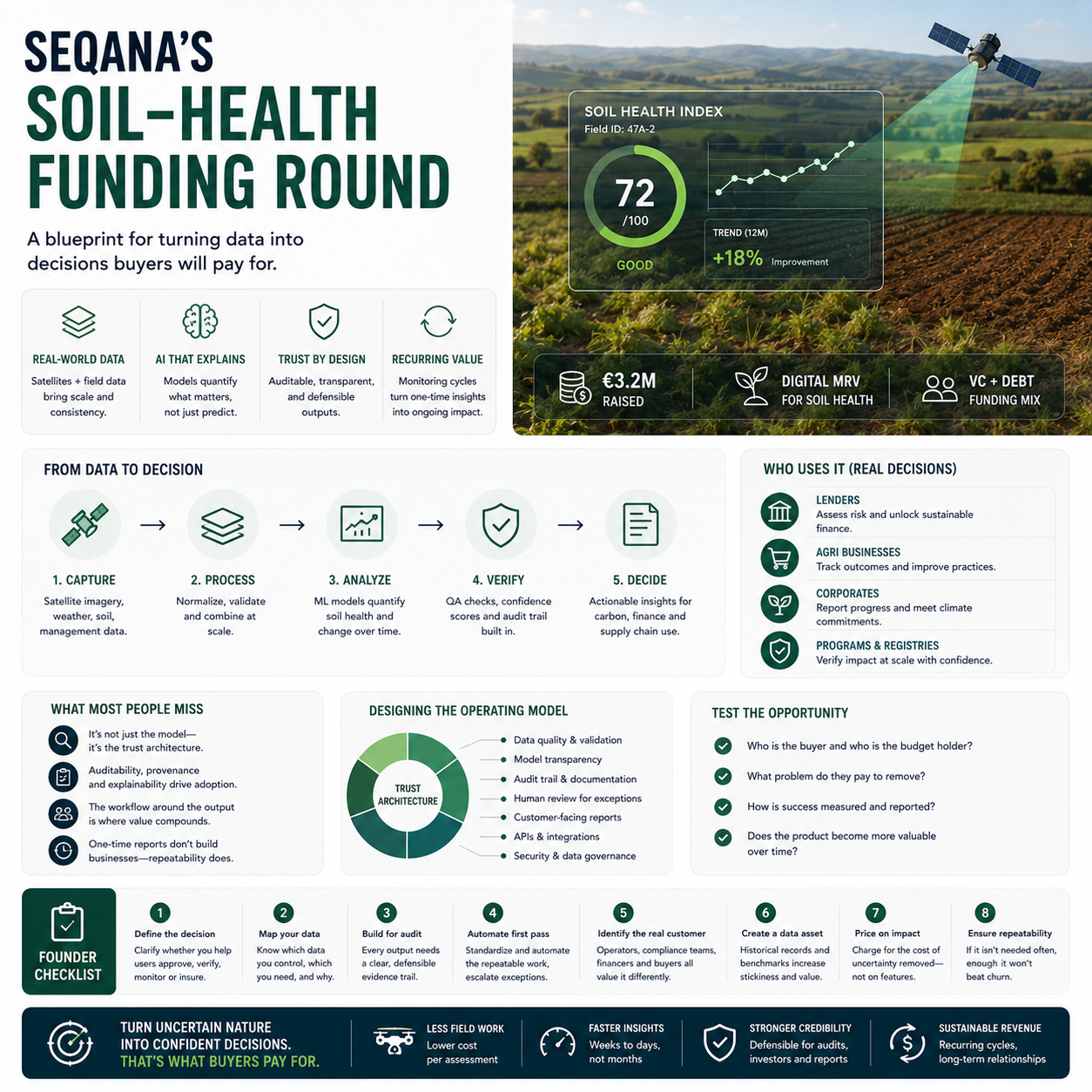
Seqana’s €3.2 million raise is not just another climate-tech funding headline. For operators, it is a useful example of how a company can turn messy physical-world data into something buyers can actually pay for: measurable, auditable decision support. The real lesson is not “soil health is hot”; it is how to build a workflow around verification, credibility and recurring use.
That matters well beyond agriculture. Any founder building in regulated, evidence-driven or asset-heavy markets can study the same pattern: combine data sources, reduce manual assessment work and package the result into a decision product.
Why this round matters for business operators
Seqana is positioned as a digital MRV company, using satellite imagery and machine learning to quantify soil health. That combination tells you a lot about the kind of business model investors will back in these markets: one that turns fragmented environmental data into a repeatable service with operational value.
For founders, the practical insight is simple. Buyers rarely pay for “data” on its own. They pay for a reduction in uncertainty. In Seqana’s case, the uncertainty is whether land management practices are improving soil health in a way that can be measured and reported. That kind of product can support carbon programs, farm financing, sustainability reporting and supplier assurance workflows.
If you are building in this space, you should ask whether your product helps a customer make one of three decisions faster: approve, verify or monitor. If it does not change a decision, it will be harder to defend pricing.
The operating model behind digital MRV
Digital MRV stands for monitoring, reporting and verification. In practice, that means a company has to assemble evidence from multiple sources, process it consistently and deliver a result that someone else can use in a commercial or compliance workflow.
Seqana’s use of satellite imagery and machine learning suggests a few important operating choices. First, the company is not relying only on field inspections, which are expensive and hard to scale. Second, the platform likely needs strong data quality controls, because inaccurate readings would weaken trust quickly. Third, the product probably becomes more valuable as it is embedded in repeated reporting cycles rather than one-off analysis.
This is a useful blueprint for founders outside climate. If your product depends on expert review, consider where software can standardize the first pass and reserve human judgment for exceptions. That is usually where margin improves.
What most people miss
The story is not just about machine learning. It is about trust architecture.
In evidence-based markets, the technical model matters, but the commercial model depends on whether customers believe the output is defensible. A farm group, lender, insurer or sustainability team may not care how elegant the model is if the result cannot survive a procurement review, an audit request or a board question.
That means the product has to be designed around explanation, not just prediction. Founders often spend too much time improving model performance and too little time building the operational layer around the output: audit trails, input provenance, exception handling, customer-facing reports and escalation paths. Those are the features that make a tool usable in real business settings.
For investors and operators, this is also why teams in regulated data markets often raise capital for both product development and market access. You are not only building software; you are building confidence.
How founders should assess a similar opportunity
If you are considering a product in agritech, climate tech, compliance tech or industrial monitoring, Seqana’s funding round suggests a few commercial tests worth running before committing heavily.
First, identify the buyer. End users and budget holders are often different. A sustainability manager may want the data, but a finance team may control the budget. A good product has to speak to both the operational user and the decision maker.
Second, map the verification burden. If the customer still has to manually validate most outputs, your software may only be a reporting layer. That can still work, but pricing and retention will look different.
Third, test whether the product creates an asset over time. Historical records, trend analysis and benchmark datasets can increase switching costs and improve renewal rates. A tool that only produces a one-time answer is easier to replace.
Fourth, assess how much of the workflow is truly automatable. Satellite data and machine learning can compress manual work, but only if the surrounding process is designed to accept automated inputs.
Funding signals and business model implications
Seqana’s round included both venture capital and debt capital. That mix is worth noting because it suggests the company has enough operational maturity or asset structure to support more than pure equity financing. For founders, the financing mix can reveal something about the business itself: whether the company is being built as a software platform, a data infrastructure play, or a service-enabled workflow business.
When capital comes from multiple sources, operators should think about what each source expects. Equity may fund product and market expansion, while debt may require more predictable cash use or clearer operating discipline. That can shape how fast a company hires, how aggressively it sells and how much it can spend to acquire each customer.
For small business builders, the lesson is not to copy the funding structure. It is to understand that capital strategy should match the revenue model. If your product has long sales cycles and high trust requirements, you may need more runway before growth becomes efficient.
Practical checklist for founders
- Define the specific decision your product improves: approve, verify, monitor or insure.
- Map the data inputs you control versus the data inputs customers must provide.
- Build an audit trail for every output that a buyer may need to defend internally.
- Separate the human review layer from the automated layer so exceptions do not slow the whole system.
- Identify whether the real customer is the operator, the compliance team, the buyer of record or the financer.
- Check whether historical records make the product more valuable over time.
- Price the product based on the cost of uncertainty you remove, not on the number of dashboards you ship.
- Only pursue the market if the output can be repeated often enough to support recurring revenue.