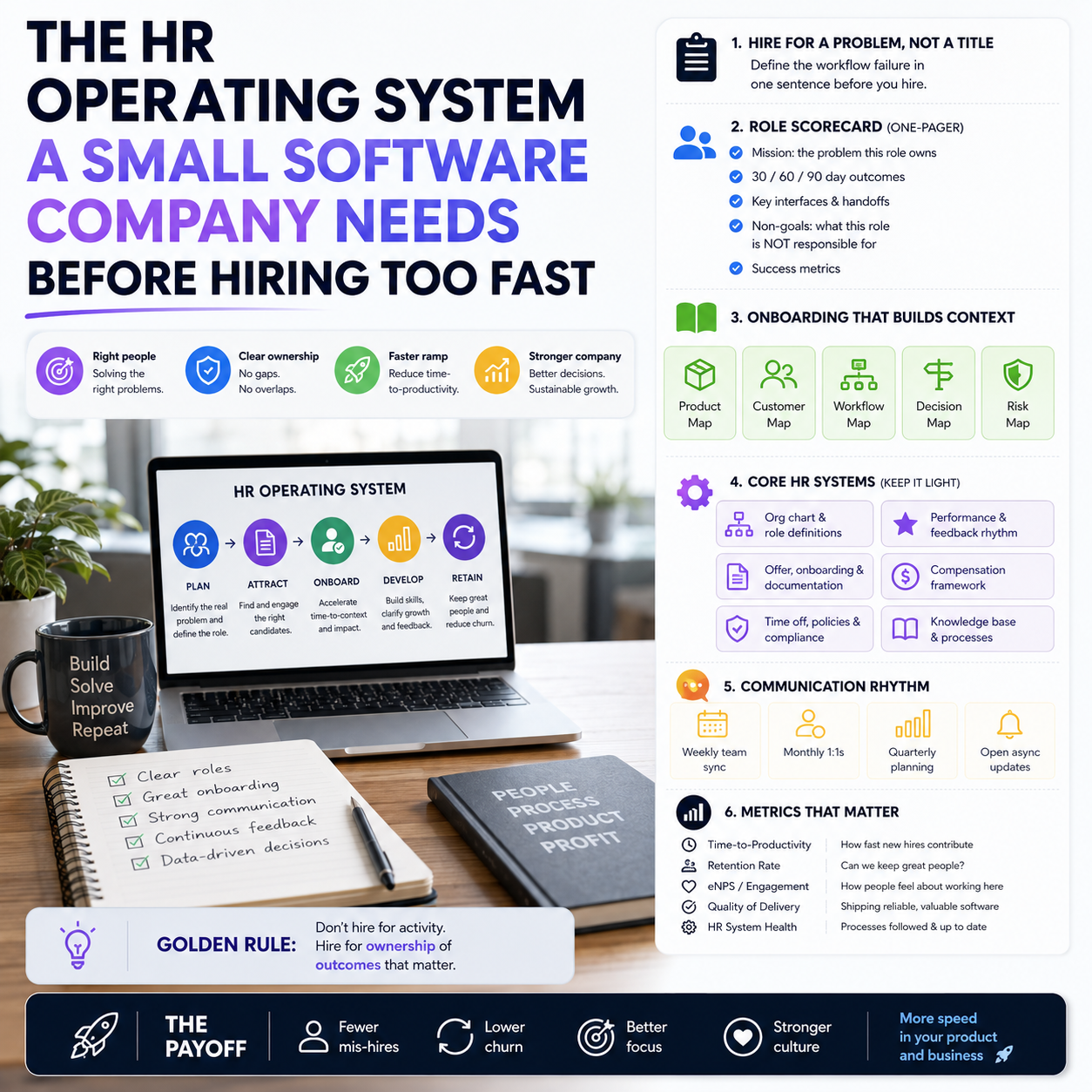
Small software companies usually feel HR problems late: after the wrong developer has been hired, customer support depends on one overloaded person, or product knowledge sits in private chat threads. The useful question is not whether a software company needs “HR practices”. It is which people systems must exist before the next five hires make the business harder to run.
Recent small-business coverage of HR practices for software companies points to familiar areas such as hiring, retention, onboarding and culture. For an operator, the real value is turning those ideas into a lightweight management system that protects delivery speed, payroll discipline and product knowledge.
The first HR decision is not who to hire, but what work must stop breaking
For a small software company, hiring is often triggered by pain: delayed releases, founder-led customer support, slow bug fixes, missed sales follow-ups or overloaded developers. That pain can be real, but it does not always mean the company needs another full-time employee.
Before opening a role, the founder or operator should map the broken workflow in operational terms. If the team says it needs another developer, ask where the constraint sits:
- Backlog grooming is poor, so engineers are waiting for clarified requirements.
- Support tickets are interrupting development because no one owns triage.
- Deployments are risky because testing and release notes are manual.
- Sales is promising custom work without product approval.
- One senior person reviews every pull request and becomes the queue.
Each of these problems has a different answer. One may require a product operations contractor. Another may require QA automation. Another may require a technical support role. Another may require a better intake process between sales and product. Hiring the wrong role creates monthly payroll cost without removing the bottleneck.
A useful rule for small software teams: do not approve a new role until the workflow failure can be written in one sentence. For example: “Customer bugs reach developers without severity scoring, causing roadmap work to stop three times a week.” That sentence tells you more than a generic request for “more engineering capacity”.
Role scorecards prevent founder-driven hiring chaos
Small teams often hire through instinct. The founder meets someone impressive, the team needs help, and the role expands during the interview process. That is how a business ends up with a talented person who does not own a measurable outcome.
A role scorecard is not corporate bureaucracy. It is a short operating document that defines what the hire is expected to improve. For a software company under 30 people, it can fit on one page:
- Mission of the role: the operational problem this person owns.
- First 30 days: systems, codebase, customers or workflows they must understand.
- First 60 days: specific process or delivery ownership they must take over.
- First 90 days: measurable output expected from the role.
- Interfaces: who they work with daily and what handoffs they manage.
- Non-goals: work this role should not absorb.
The “non-goals” line is more important than many founders expect. In small software companies, flexible people become dumping grounds for unresolved management problems. A support lead becomes product manager. A developer becomes release manager, customer success agent and internal IT support. A marketing hire becomes a CRM admin, copywriter and sales assistant. Flexibility is useful; uncontrolled role sprawl is expensive.
What most people miss
The hiring mistake is often not the candidate. It is the missing definition of ownership. If three people think they partially own onboarding, nobody owns onboarding. If support, sales and product all “help” with feature requests, no one owns the decision queue. HR systems in a software company are really ownership systems: they decide who is accountable for which recurring business problem.
This is why a small software company should create scorecards for existing roles before adding new ones. The exercise often reveals that the company does not need another hire yet; it needs to remove duplicated work, automate a handoff or assign decision rights.
Onboarding should reduce time-to-context, not just welcome people
Software onboarding fails when it focuses on tools but not context. A new hire may receive access to Slack, GitHub, Notion, Jira, Linear, HubSpot or Intercom, yet still not understand how decisions get made. They know where the work lives, but not why the work matters.
For small software companies, onboarding should be designed around time-to-context: how quickly a new person can understand the product, customers, code or workflow enough to make safe decisions. This matters because early confusion creates hidden cost. Senior people spend hours answering repeated questions. New hires make avoidable mistakes. Customer promises get misread. Product priorities become unclear.
A practical onboarding workflow should include:
- A product map: core features, user types, pricing tiers and known product limits.
- A customer map: who buys, who uses, who complains and who renews.
- A workflow map: how work moves from request to decision to delivery.
- A decision map: who approves roadmap changes, discounts, refunds, releases and incident responses.
- A risk map: security rules, data access rules, production access and escalation paths.
This can be built in a lightweight knowledge base. The tool matters less than the maintenance rhythm. A Notion page that nobody owns becomes stale. A Google Drive folder with ten versions of the same process creates confusion. A project management board without decision notes becomes a task graveyard.
The operator should assign one owner for onboarding content and review it after every hire. The review question is simple: what did the new person ask repeatedly that should have been documented?
Performance management must be tied to delivery systems
Performance reviews in small software companies often become awkward because expectations were never made operational. A founder says someone lacks ownership. A developer says priorities keep changing. A support person says they are handling more work than anyone sees. Everyone may be partly right.
Performance management should connect to the systems where work happens. That means the company should not rely only on subjective impressions. It should look at the right operating signals for each role.
Developer roles need quality and flow signals
For developers, avoid reducing performance to lines of code or ticket counts. Those metrics can reward the wrong behavior. Better signals include cycle time, review quality, incident involvement, ability to break work into deliverable pieces, contribution to documentation and reduction of recurring defects.
A junior developer should not be judged like a staff engineer. A senior engineer may create high value by simplifying architecture, mentoring others or reducing release risk. The scorecard should match the role.
Support and customer roles need escalation and feedback signals
For support, the question is not only how many tickets are closed. Useful metrics include first response time, resolution quality, escalation accuracy, repeated issue tagging and product feedback captured in a usable format. If support closes tickets quickly but product never learns from them, the company is paying to hide product problems.
Customer success or account roles should be measured against renewal risk visibility, onboarding completion, product adoption milestones and revenue expansion only where expansion is truly part of the role. Mixing support, success and sales without clear boundaries creates poor incentives.
The automation boundary: what HR tools should handle and what managers cannot delegate
Small software companies are naturally tempted to automate HR. That is reasonable. Repetitive admin should not consume founder time. But HR automation works only when the underlying decision process is clear.
Tools can help with applicant tracking, interview scheduling, onboarding tasks, policy acknowledgements, time-off requests, payroll handoffs, equipment checklists and recurring review reminders. They are especially useful when a company is hiring across locations or using contractors alongside employees.
Automation should not decide whether someone is underperforming, whether a role is needed, whether a salary band makes sense, or whether a manager is avoiding a hard conversation. Those are judgment calls. A workflow can surface the issue; leadership still has to make the decision.
A small company can keep the HR stack lean:
- Applicant tracking: a simple ATS or structured pipeline in an existing project tool.
- Knowledge base: one maintained source for onboarding, policies and workflows.
- HR records: a secure system for contracts, leave, payroll data and employment documents.
- Performance notes: structured monthly check-ins linked to role scorecards.
- Access management: checklist-based onboarding and offboarding for software tools.
The dangerous version is tool sprawl: one platform for hiring, another for onboarding, another for reviews, another for engagement surveys, and no shared operating model. A small company does not need enterprise HR architecture. It needs fewer places where important people decisions disappear.
Compensation discipline matters more when cash flow is uneven
Many software companies do not fail because one salary is too high. They get into trouble because compensation decisions are made one negotiation at a time. A strong candidate asks for more. A current employee hears about market salaries. A contractor becomes essential. Suddenly payroll has expanded without a clear model.
Small software companies need salary bands earlier than they think. Bands do not need to be complex. They can define ranges by role level and geography, with notes on what moves a person from one band to another. The purpose is to stop every hiring decision from becoming a custom deal.
The cost model should include more than base salary. For each planned hire, the operator should calculate:
- Gross salary or contractor fee.
- Employer taxes, benefits, pension or local employment costs where applicable.
- Recruiting cost, whether agency, job boards or internal time.
- Equipment and software seats.
- Management time during onboarding.
- Expected delay before the hire reaches productive output.
This is where small companies often underestimate the cost of hiring. A new employee may require paid tools, security access, laptop setup, documentation time, code reviews, customer training and manager attention. If the role does not remove a measurable bottleneck, the business has added cost and coordination drag.
The finance view should sit beside the people view. Before approving a role, ask: what recurring cost does this add, what operational metric should improve, and when should we expect to see the improvement?
A practical scenario: the eight-person SaaS team that thinks it needs two developers
Consider an eight-person SaaS business with a founder, four developers, one support person, one salesperson and one part-time finance contractor. The roadmap is slipping. Customers are reporting bugs. The founder believes the company needs two more developers.
A quick workflow review shows a different picture. Developers are interrupted by support because the support person has no severity framework. Sales has been logging feature requests directly into the product backlog. The founder approves urgent customer requests in private messages. Releases happen irregularly because testing depends on whoever has time.
Hiring two developers would add capacity, but it would not fix the operating leak. A better first move might be:
- Create a support triage system with severity levels and escalation rules.
- Move feature requests into a product review queue owned by one decision-maker.
- Assign one developer as release owner for a fixed rotation.
- Document the top recurring bugs and link them to product debt.
- Hire a technical support or product operations person only if the triage load remains too high after the workflow is fixed.
This scenario shows why HR is not separate from operations. Hiring is one lever. Workflow design, automation, documentation and decision rights are other levers. The operator’s job is to choose the cheapest lever that removes the constraint without creating a new one.
The management debt dashboard for software teams under 30 people
A small software company does not need a heavy HR department to manage people well. It does need a dashboard that shows whether people systems are supporting delivery or quietly creating risk. The dashboard can be reviewed monthly by the founder, operations lead or management team.
Track these signals:
- Open roles by bottleneck: every role must be linked to a named workflow problem.
- Time-to-context for new hires: how long until a new person can complete useful work without constant interruption.
- Manager load: number of direct reports and recurring decisions sitting with each manager.
- Role drift: tasks people are doing that are outside their scorecard.
- Support interruption rate: how often developers are pulled into customer issues.
- Release reliability: whether people/process issues are causing missed or risky releases.
- Knowledge gaps: repeated questions that should be documented.
- Access risk: tools still active for people who changed roles or left.
- Compensation exceptions: salaries or contractor rates outside agreed bands.
The point is not to produce an HR report. The point is to catch management debt before it becomes payroll waste, retention risk or delivery slowdown.
Role approval checklist before the next software hire
Before a small software company approves its next hire, use this checklist in the hiring meeting. If the team cannot answer these questions clearly, the role is not ready to open.
- What workflow is currently failing, and how often does it fail?
- What customer, revenue, delivery or risk metric is affected?
- Have we tried fixing the workflow before adding headcount?
- Which tasks will this person own that nobody owns today?
- Which tasks will this person explicitly not own?
- What tools, software seats and access rights will the role require?
- Who will onboard the person, and what documentation must exist before day one?
- What should improve by day 30, day 60 and day 90?
- What is the full monthly cost of the role, including tools, benefits, management time and recruiting cost?
- Which existing role scorecard will change when this person joins?
If the answers are specific, the hire is more likely to reduce pressure rather than add coordination cost. If the answers are vague, the company may be trying to solve an operating problem with payroll.