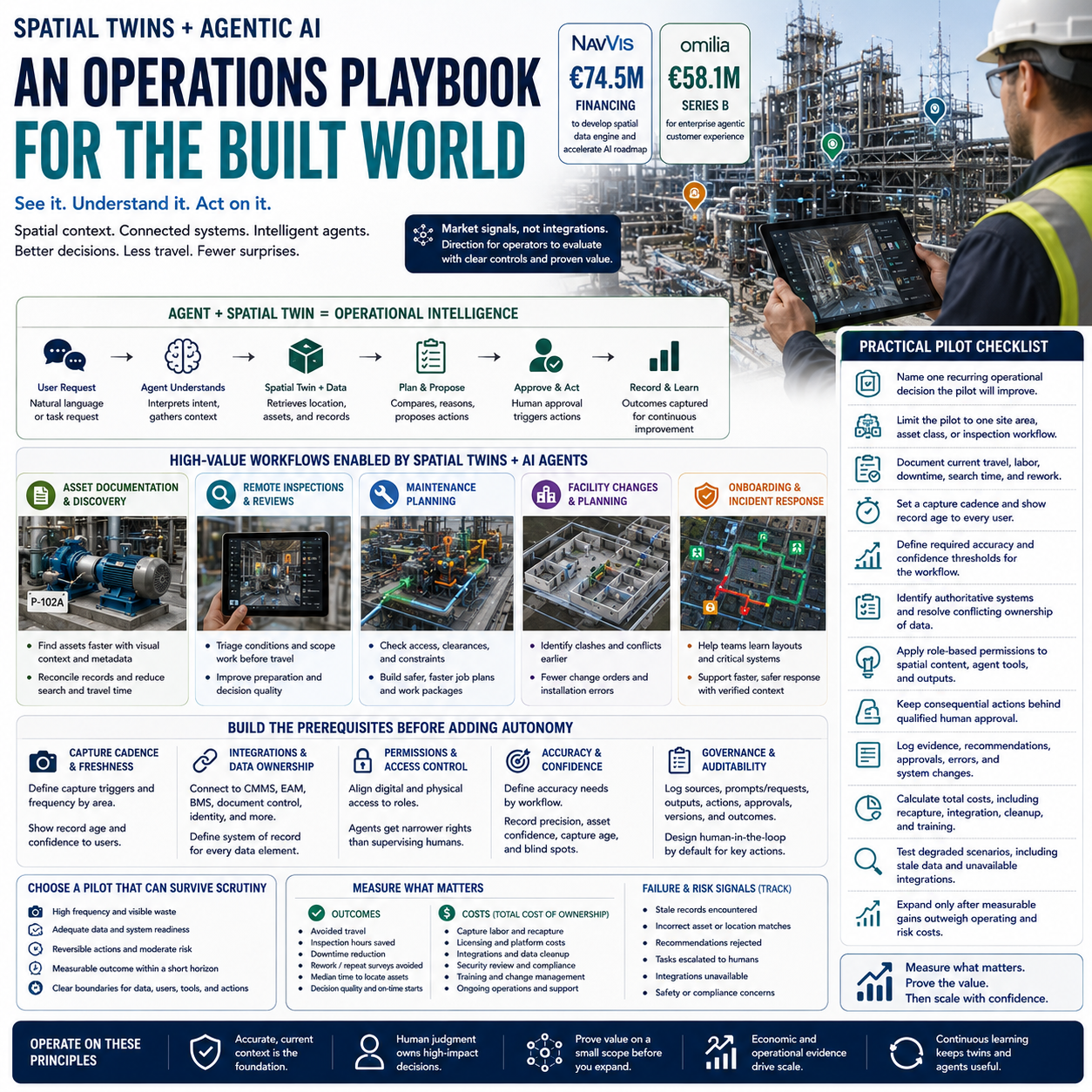
Spatial twins are becoming more than visual replicas of buildings. Combined with AI agents, they could provide an operational layer through which teams inspect sites, find equipment, plan maintenance, document changes, and coordinate responses without starting every task with a physical walkthrough.
NavVis’s reported €74.5 million financing to develop its spatial data engine and accelerate its AI roadmap is a useful market signal. Omilia’s reported €58.1 million Series B for enterprise agentic customer experience is a second, broader signal: enterprise software is moving toward agents that learn from context and perform multi-step work. These developments do not establish a joint product or integration. They suggest a direction operators should evaluate carefully: agents grounded in current spatial records, connected systems, and explicit permissions.
Start with the operational layer, not the digital twin
A spatial twin can organize imagery, geometry, locations, and asset context around a navigable representation of a facility. An agent can interpret a request, retrieve information, compare records, propose actions, and coordinate approved steps across software. The combination is potentially valuable because the agent gains physical context: where an asset is, what surrounds it, and what a technician may encounter.
That does not mean every facility needs a comprehensive twin. A photorealistic model that is rarely updated may become an expensive presentation tool. The better starting point is a recurring operational decision. Ask what people cannot currently see, find, verify, or plan without travel, delay, or rework.
For example, a maintenance planner might ask for all pumps of a certain type in a production area, their visible access constraints, recent work orders, and the safest sequence for inspection. A proposed system could combine spatial records with an asset register and maintenance platform, then prepare a route and work package for approval. This is a possible cross-platform workflow, not an announced capability of NavVis or Omilia.
Prioritize workflows with measurable friction
Asset documentation: Teams can associate equipment records, photographs, annotations, manuals, and locations. The test is whether this reduces time spent searching for assets and reconciling conflicting documents.
Remote inspections: Engineers, insurers, vendors, or managers may review site conditions before deciding whether travel is necessary. Spatial data will not replace every physical inspection, particularly where touch, live measurements, or regulatory presence is required. It can improve triage and preparation.
Maintenance planning: A twin can expose access routes, clearances, adjacent equipment, and staging constraints. An agent might assemble relevant records or flag missing information, while a qualified person approves the job plan.
Facility changes: Teams planning equipment moves or office reconfigurations can review current conditions and identify clashes earlier. Value appears through fewer repeat surveys, change orders, and installation errors—not through model sophistication alone.
Onboarding and incident response: Navigable site context can help new employees learn layouts and help responders locate isolation points or exits. Emergency use requires particularly strict validation, resilience, access control, and human command. Stale geometry or an incorrect recommendation can create safety risk.
Build the prerequisites before adding autonomy
Capture cadence is the first constraint. A twin is only as operationally useful as its freshness. High-change production zones may require capture after material modifications; stable offices may need less frequent updates. Define who triggers recapture, how changed areas are detected, and how users see the date and confidence of each record.
Next, map integrations. Spatial context becomes actionable when linked to authoritative systems such as computerized maintenance management, enterprise asset management, building management, document control, identity, and incident platforms. Establish which system owns each field. Otherwise, an agent may confidently repeat outdated or contradictory data.
Permissions should reflect both digital and physical risk. Contractors may need visual access to one zone but not process details elsewhere. Agents require narrower rights than the humans supervising them, auditable actions, and clear restrictions on changing work orders, controlling equipment, or sharing sensitive imagery.
Accuracy must be defined by workflow rather than a universal promise. Locating a room, checking approximate access, and validating installation dimensions demand different tolerances. Record spatial precision, asset-identification confidence, capture age, and known blind spots. Low-confidence outputs should trigger review instead of automation.
What most people miss
The critical design problem is not whether an agent can answer a question. It is whether the organization can prove which evidence the answer used, how current that evidence was, and who approved the resulting action. Human approval should therefore be designed into the workflow: specify which recommendations are informational, which require confirmation, and which actions are prohibited. Preserve source links, model versions, prompts or requests, outputs, approvals, and downstream changes in an audit trail.
Select a pilot that can survive scrutiny
Score candidate workflows on five dimensions: frequency, baseline cost, data readiness, consequence of error, and ability to measure an outcome. Favor a frequent task with visible waste, adequate records, reversible actions, and moderate risk. Avoid starting with emergency control, autonomous equipment operation, or a site-wide transformation.
A strong pilot might cover remote pre-inspection of one warehouse zone or locating and planning service for one asset class. Set boundaries for location, users, data sources, and allowed agent actions. Run the existing process long enough to establish a baseline, then compare matched work during the pilot.
Measure avoided travel, inspection hours, downtime, rework, repeat surveys, and median time to locate an asset. Include capture labor, licensing, integration, data cleanup, security review, training, and ongoing recapture in the cost side. Also track failure rates: stale records encountered, incorrect asset matches, agent recommendations rejected, and tasks escalated to humans.
Expansion should require both economic and operational evidence. A pilot that saves inspection time but creates heavy model-maintenance work may not scale. Conversely, moderate direct savings may justify expansion if better documentation materially reduces downtime or change-related rework.
Practical pilot checklist
- Name one recurring operational decision the pilot will improve.
- Limit the pilot to one site area, asset class, or inspection workflow.
- Document current travel, labor, downtime, search time, and rework.
- Set a capture cadence and show record age to every user.
- Define required accuracy and confidence thresholds for the workflow.
- Identify authoritative systems and resolve conflicting ownership of data.
- Apply role-based permissions to spatial content, agent tools, and outputs.
- Keep consequential actions behind qualified human approval.
- Log evidence, recommendations, approvals, errors, and system changes.
- Calculate total costs, including recapture, integration, cleanup, and training.
- Test degraded scenarios, including stale data and unavailable integrations.
- Expand only after measurable gains outweigh operating and risk costs.