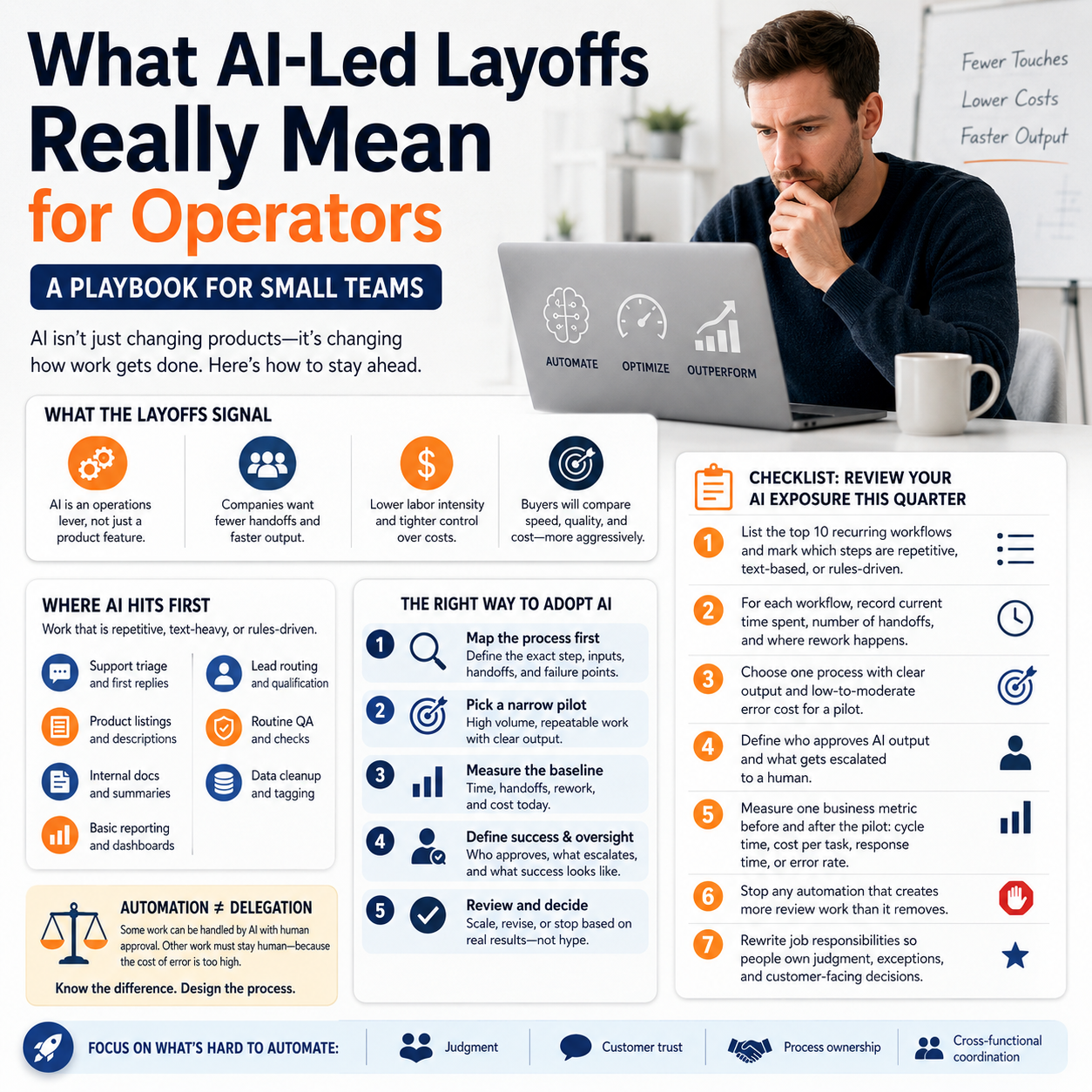
When large tech companies say AI is part of the reason for layoffs, the headline is not just about headcount. It is a signal that management is reorganizing around automation, lower labor intensity, and faster output per employee.
For founders and operators, the useful question is not whether AI is “taking jobs” in some abstract sense. It is which workflows are becoming cheaper to automate, which roles are becoming harder to justify, and what systems you should put in place before margins tighten.
What the layoffs signal for smaller businesses
The TechCrunch roundup of AI-linked layoffs shows a pattern that matters beyond big tech: companies are increasingly treating AI as an operations lever, not just a product feature. That means they are looking for fewer manual handoffs, faster content or code production, and tighter control over labor costs.
Small businesses should read that as a budgeting signal. If larger firms are reorganizing around AI-supported workflows, then service businesses, e-commerce operators, agencies, and SaaS teams should assume buyers and competitors will start comparing outputs, turnaround times, and cost per task more aggressively.
The practical implication is that labor-heavy processes need a review. If a task can be standardized, partially automated, or moved into a system with human review at the end, it should be measured that way now rather than later.
Where AI usually changes the cost structure first
Not every job is equally exposed. The first savings usually appear in work that is repetitive, text-heavy, or dependent on pattern matching rather than judgment. For small businesses, that often includes support triage, product listing generation, internal documentation, basic reporting, lead routing, and routine QA checks.
This is why the conversation should shift from “Can AI replace a person?” to “Can AI reduce the number of touches?” A founder does not need a fully autonomous department to create value. Even a 20% reduction in manual handling can change delivery times, staffing plans, and margins.
That also means AI investments should be judged against workflow cost, not novelty. If a tool saves time but creates more review work, more errors, or more context switching, it may raise operating costs instead of lowering them.
What most people miss
The biggest mistake is buying AI tools before mapping the process. Most waste comes from adding software to a broken workflow. If the handoff points are unclear, the prompts are weak, or the approval layer is slow, the AI layer just accelerates confusion.
Operators should first define the exact step that is being automated, who reviews the output, and what failure looks like. That turns AI from a vague efficiency promise into an operational control.
How founders should respond without overcommitting
There is no need to automate everything at once. The smarter move is to identify one process with a high volume of repeatable work and test whether AI can reduce labor time without increasing error rates. Good candidates are internal summaries, first-draft copy, support replies with clear escalation rules, and structured data cleanup.
Start by measuring the current baseline. How long does the process take? How many handoffs are involved? What does rework cost? Without that, you cannot tell whether the tool is improving anything.
Then define a narrow success criterion. For example: reduce response preparation time, lower content production cost, or cut manual tagging steps. A narrow metric keeps the pilot honest and helps you decide whether to scale, revise, or stop.
It also helps to separate “automation” from “delegation.” Some work can be handed to AI with human approval; other work should stay manual because the cost of error is too high. This distinction matters in finance, compliance, customer trust, and any client-facing workflow where mistakes are expensive to fix.
Why this matters for hiring and role design
AI-driven layoffs at larger companies also affect how small businesses should write job descriptions. If a role is built around producing first drafts, sorting incoming information, or repeating a fixed sequence of tasks, that role should be redesigned around oversight, exceptions, and decision-making.
That does not mean hiring less thoughtfully. It means hiring for work that is harder to automate: process ownership, customer judgment, sales conversations, quality control, and cross-functional coordination. These are the areas where a small team can still outperform a larger, more automated competitor.
For existing teams, the useful move is to review responsibilities by task type. Which duties are repetitive enough to systemize? Which require discretion? Which should be documented so a new hire or AI tool can assist without breaking the process?
What to watch next in the market
If more companies publicly frame layoffs around AI, expect a second-order effect: vendors will market automation as a budget defense, not just a productivity boost. That will put pressure on software buyers to justify every tool against labor savings or revenue impact.
For e-commerce operators and service firms, this could change how tools are evaluated. A platform will no longer be judged only by features; it will be judged by whether it reduces the number of people needed to run a workflow, lowers cycle time, or improves output consistency.
That makes measurement more important than enthusiasm. The founders who win will be the ones who can show where AI reduced cost, where it created new risk, and where human review still matters.
Checklist: how to review your own AI exposure this quarter
- List the top 10 recurring workflows in your business and mark which steps are repetitive, text-based, or rules-driven.
- For each workflow, record current time spent, number of handoffs, and where rework usually happens.
- Choose one process with clear output and a low-to-moderate error cost for a pilot.
- Define who approves AI-generated output and what gets escalated to a human.
- Measure one business metric before and after the pilot: cycle time, cost per task, response time, or error rate.
- Stop any automation that creates more review work than it removes.
- Rewrite job responsibilities so people own judgment, exceptions, and customer-facing decisions, not only repetitive execution.


