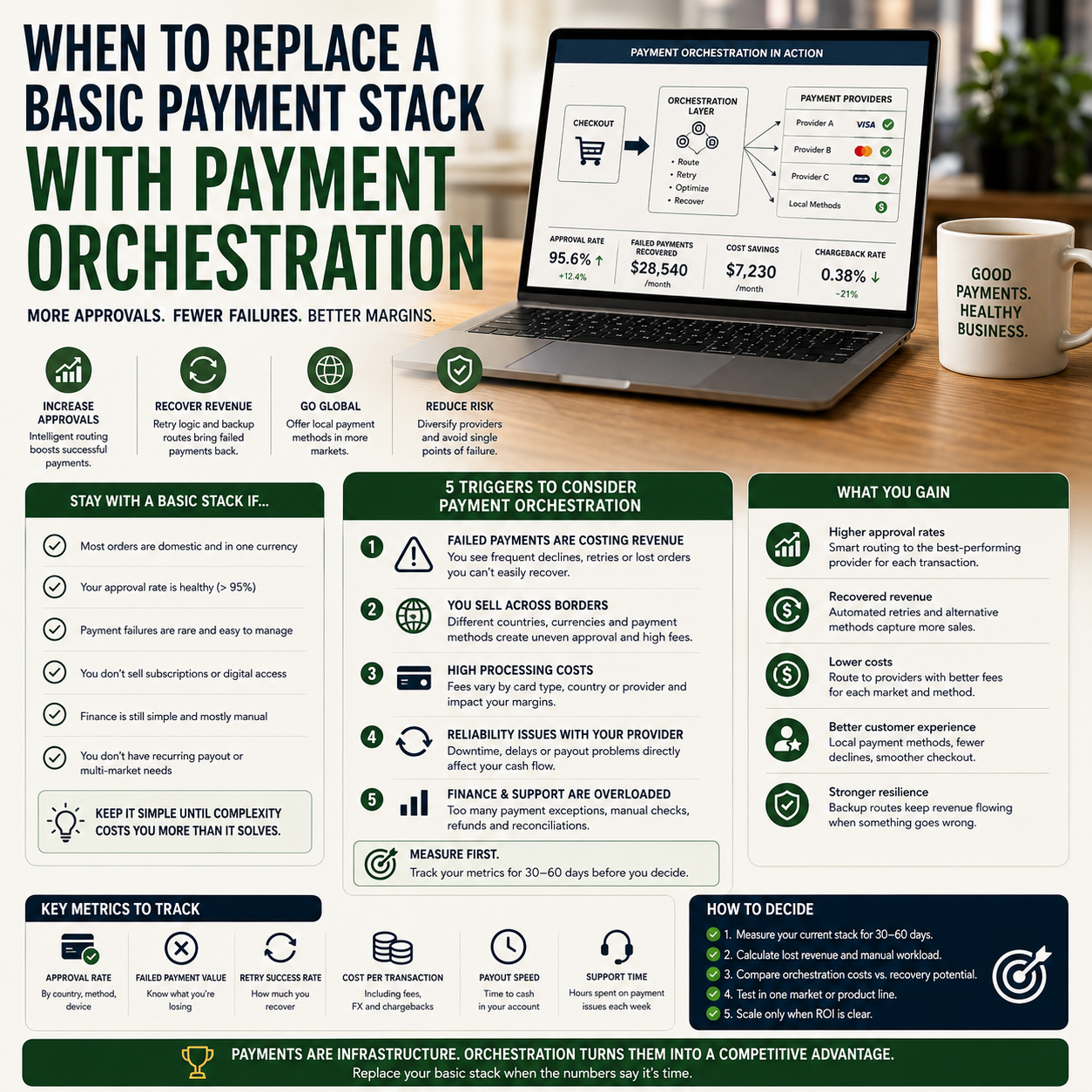
Primer’s new funding round is not useful to a small e-commerce operator because of the funding itself. It is useful because it shows where payment infrastructure is moving: away from a single checkout provider and toward systems that route, monitor and recover payment flows across multiple tools.
For a small seller, the question is not whether to copy a venture-backed payments company. The question is whether payment orchestration has become worth considering before failed payments, processor dependency, cross-border fees and manual finance work start eating into margin.
The decision is not about payments software, it is about margin leakage
Most small e-commerce businesses start with one payment provider because it is fast, familiar and bundled into the platform. A Shopify, WooCommerce, PrestaShop or marketplace-led seller often accepts the default setup and moves on to traffic, product pages and fulfilment. That is sensible at the beginning. A simple payment stack is usually cheaper to manage than a flexible one.
The problem appears later, when the business has enough order volume for small payment issues to become operational costs. A failed card payment is not just a technical event. It can mean a lost order, support contact, abandoned subscription, manual invoice follow-up, or delayed cash collection. A cross-border card transaction can carry different acceptance behaviour and fees than a domestic one. A single payment provider outage can stop revenue collection even if the store itself is working.
Payment orchestration sits between the checkout and the payment processors. Instead of sending every transaction through one route, the business can define routing logic: use one provider for domestic cards, another for specific countries, retry failed payments through a backup route, offer local payment methods in selected markets, and reconcile data across systems. That is the operational promise. The risk is adding complexity before the business has a real payment problem.
The signal from Primer’s Series C announcement, which specifically mentions AI capabilities for payments and finance teams, is that orchestration is becoming less of a pure enterprise topic. But small operators should treat this as a decision framework, not a buying trigger.
Stay with a basic stack if checkout is not your bottleneck
A basic payment stack is still the right answer for many small businesses. If monthly order volume is low, most customers are domestic, refunds are easy to track, and payment failures do not create visible support work, a second processor may add more mess than value.
The hidden cost of orchestration is not only the platform fee. It includes setup time, extra testing, finance reconciliation changes, more reporting fields, additional failure modes, and a sharper need for documentation. A small team that cannot yet maintain clean product data, shipping rules or inventory sync should usually fix those problems before complicating payment routing.
Operators should stay simple when:
- Most orders come from one country or one currency.
- The existing processor has acceptable approval rates and stable payout timing.
- Chargebacks and refunds are manageable without dedicated operations time.
- There is no subscription billing, deferred payment, marketplace payout or multi-region setup.
- The finance process is still handled manually in spreadsheets and would not benefit from richer payment routing data.
This is not a conservative argument against tooling. It is a sequencing issue. A business should not install a control layer for a problem it has not measured.
The first trigger: failed payments become a recoverable revenue line
The clearest reason to evaluate orchestration is when failed payments become frequent enough to track as their own metric. Many operators look only at completed orders. That hides the value of payment recovery.
A better dashboard separates checkout abandonment from payment failure. They are different problems. Checkout abandonment may come from price shock, shipping uncertainty, delivery timing or poor product confidence. Payment failure happens after the buyer has already tried to pay. That makes it more operationally actionable.
Useful metrics include:
- Payment approval rate by country, payment method and device.
- Failed payment value, not only failed payment count.
- Retry success rate after a failed first attempt.
- Orders lost during processor downtime or degraded performance.
- Support tickets linked to payment problems.
- Refund processing time and manual finance workload.
If these metrics are unavailable in the current setup, that is itself a warning. A seller cannot decide whether orchestration pays off if payment failure is buried inside generic abandoned checkout data.
What most people miss
Payment orchestration is often sold as a technical upgrade, but the business case usually starts in finance and support. The value is not only routing payments faster. It is reducing the number of exceptions that humans must investigate.
A failed payment may trigger a customer email, a duplicate order attempt, a support ticket, a manual refund, a stock reservation problem or an accounting mismatch. If the business sells subscriptions, memberships, digital products or B2B repeat orders, payment failure can also interrupt access and create customer management work. The checkout page may look fine while the back office absorbs the cost.
That is why small operators should calculate payment problems as workflow load, not just lost conversion. If one person spends several hours per week checking failed payments, matching refunds, explaining duplicate authorisations or manually nudging customers to retry, the payment stack is already creating labour cost.
The second trigger: cross-border selling creates uneven acceptance and fees
Cross-border e-commerce is where a single payment provider can become a blunt instrument. A seller may be profitable in its home market but lose margin in other countries because of card fees, low approval rates, currency conversion, local payment expectations or refund handling.
Payment orchestration can help when the seller has enough international order flow to justify country-level routing decisions. For example, a business selling digital templates, cosmetics, replacement parts or niche apparel across the EU may discover that customers in different markets prefer different payment options. One provider may perform well in one region and poorly in another. A single average approval rate can hide that pattern.
The practical question is: can routing improve net collected revenue after fees and operations? That means the operator needs more than a list of payment methods. They need a comparison by country and payment route:
- Gross order value attempted.
- Approved order value.
- Processor fee and currency cost.
- Refund rate and chargeback handling.
- Settlement timing.
- Manual work needed to reconcile payouts.
If a second payment route improves approvals but creates messy reconciliation, the gain may disappear inside operations. The finance team, even if it is one founder and an accountant, must be part of the decision.
The third trigger: one provider outage would stop the business
Small businesses often underestimate concentration risk in payments. They think about website uptime, hosting and fulfilment, but not payment dependency. If every transaction depends on one provider, a processor issue becomes a revenue outage.
This matters most for stores with paid acquisition, launch calendars, influencer campaigns, limited drops, seasonal peaks or subscription renewal days. If a payment provider has a problem during a campaign, the business may still be paying for traffic while orders fail. A backup route can reduce that risk, but only if it has been tested before the incident.
A backup processor that is technically connected but never tested is not resilience. The business needs a written failover process:
- Which transaction types move to the backup route?
- Who has permission to switch routing rules?
- How will the team detect the issue quickly?
- How will support respond to customers with failed attempts?
- How will finance reconcile payments across both providers afterward?
This is where orchestration becomes an operations system rather than a payments feature. The tool is only useful if the team knows what to do when the primary route fails.
Where AI belongs in the payment workflow, and where it should not
The Primer announcement points to AI for payments and finance teams. That direction makes sense, but operators should be precise about which tasks are suitable for automation.
AI can help with pattern detection, anomaly alerts, payment failure classification, reconciliation support and operational summaries. For example, an AI layer may flag that approval rates dropped for a specific country, payment method or processor. It may help finance identify mismatched payouts or unusual refund patterns. It may also reduce the time needed to investigate payment exceptions.
But AI should not be allowed to silently change core payment rules without human oversight. Routing affects revenue, customer experience, fraud exposure and accounting. A small business should know why a payment path changed and should be able to reverse it.
Human approval should stay around money movement
The safest model for small teams is assisted automation. Let the system recommend routing changes, detect exceptions, prepare reconciliation notes and surface risk signals. Keep humans responsible for changing processor priority, accepting higher-risk payment methods, adjusting fraud thresholds, refund policy exceptions and payout-related decisions.
This boundary matters because payment optimisation can create tradeoffs. A route that raises approval rates may also increase fraud exposure. A local payment method may improve conversion but slow settlement. A retry rule may recover revenue but annoy customers if poorly timed. These are business decisions, not only technical settings.
A practical scenario: the seller that has outgrown the default checkout
Consider a small EU-based e-commerce seller using a standard platform checkout and one payment provider. The business sells physical products to its home country and several nearby markets. At first, the setup works. The founder checks payouts weekly, refunds are manageable, and payment fees are accepted as a cost of doing business.
Then paid acquisition expands into two more countries. Revenue grows, but the founder notices three problems. First, customer support receives more messages about failed card payments. Second, payout reconciliation takes longer because refunds, partial captures and currency conversion are harder to match. Third, campaign days are riskier because a checkout issue during traffic spikes could waste ad spend.
This is the point where orchestration may be worth evaluating. Not because the company needs enterprise infrastructure, but because the cost of payment exceptions is now visible. The founder does not need to replace everything. A sensible first move would be to audit payment data for the last 60 to 90 days, separate failures by market, estimate lost order value, and calculate the weekly labour spent on payment-related support and finance tasks.
If the audit shows that one or two markets are causing most failures, the business can test a limited routing change rather than redesigning the entire checkout. If reconciliation is the bigger problem, the priority may be cleaner finance reporting rather than adding another payment method. If outage risk is the concern, the first project may be a backup route and incident process.
The important point is scope control. Payment orchestration should start with one measurable problem, not a broad platform migration.
How trust and onboarding infrastructure fits into the same decision
Prelude’s funding round around onboarding and trust infrastructure is a useful parallel signal. Payments, identity checks, user verification and fraud controls are becoming more connected. For operators, that means checkout decisions cannot be isolated from trust decisions.
This is especially relevant for marketplaces, digital services, rental platforms, B2B portals and businesses with user accounts. A payment may fail because of technical routing. It may also be blocked because of fraud rules, identity risk, account behaviour or weak verification. If a business only sees the payment processor’s final decline message, it may misdiagnose the problem.
Small operators do not need a complex trust platform from day one. But they should map where customer verification, fraud screening, payment acceptance and support workflows overlap. For example, high-value orders may need stricter checks than low-value digital purchases. New customer accounts may require different risk rules than returning customers. Manual review may be acceptable for a few expensive orders but impossible for high-volume low-margin products.
The practical takeaway is that payment optimisation without fraud and trust context can backfire. More approvals are not always better if they bring chargebacks, abuse or fulfilment risk. The metric should be profitable approved revenue, not just payment acceptance.
The cost model before signing an orchestration contract
Before adopting a payment orchestration layer, operators should build a simple internal cost model. It does not need to be perfect. It needs to prevent tool enthusiasm from outrunning the business case.
Include these cost lines:
- Platform or orchestration fees.
- Payment processor fees by route and market.
- Developer or implementation time.
- Checkout testing and quality assurance.
- Finance process changes and accountant communication.
- Support team training and customer response scripts.
- Ongoing monitoring time.
- Potential fraud, chargeback or refund changes.
Then estimate the recoverable value:
- Failed payment value that could realistically be recovered.
- Fee savings from smarter routing.
- Reduced manual reconciliation time.
- Lower outage exposure during sales peaks.
- Improved settlement visibility for cash planning.
The word realistically matters. Not every failed payment can be recovered. Some customers have insufficient funds, some orders are abandoned intentionally, and some declines are protective. The business case should use conservative assumptions and focus on observed pain.
The rollout sequence for a small operator
A small business should not begin with a full orchestration redesign. The safer path is a staged rollout with clear stop points.
Step 1: Audit the current payment flow
Export payment data by country, method, device, order value, processor response, refund and chargeback where available. Match it with support tickets and finance workload. The goal is to identify whether the main problem is approval, fees, reconciliation, resilience or fraud exposure.
Step 2: Define one payment problem worth fixing
Choose a narrow target. Examples include improving approval rates in one market, adding a backup processor for campaign days, reducing manual refund reconciliation, or separating subscription retry logic from one-off purchases.
Step 3: Test with limited routing rules
Do not route everything through a new setup immediately. Start with a country, payment method, product category or traffic segment. Compare approved revenue, fees, refunds, chargebacks and support contacts against the previous setup.
Step 4: Document the finance and support process
Every new payment route creates questions: where payouts appear, how refunds are matched, what customers see on statements, how failed payments are explained, and who investigates exceptions. Write this down before scaling the setup.
Step 5: Keep a monthly payment operations dashboard
The dashboard should show approval rate, failed payment value, payment fees, refund rate, chargebacks, settlement timing, processor incidents, retry recovery and manual operations time. If the dashboard is not reviewed, orchestration becomes another invisible system cost.
The decision to move beyond a basic payment stack should be based on measured friction: recoverable failed payments, cross-border margin pressure, outage risk, finance workload or trust-related payment loss. If those signals are visible, orchestration deserves a serious look. If they are not, the better investment may still be cleaner data, better reporting and a checkout process the team can actually maintain.


