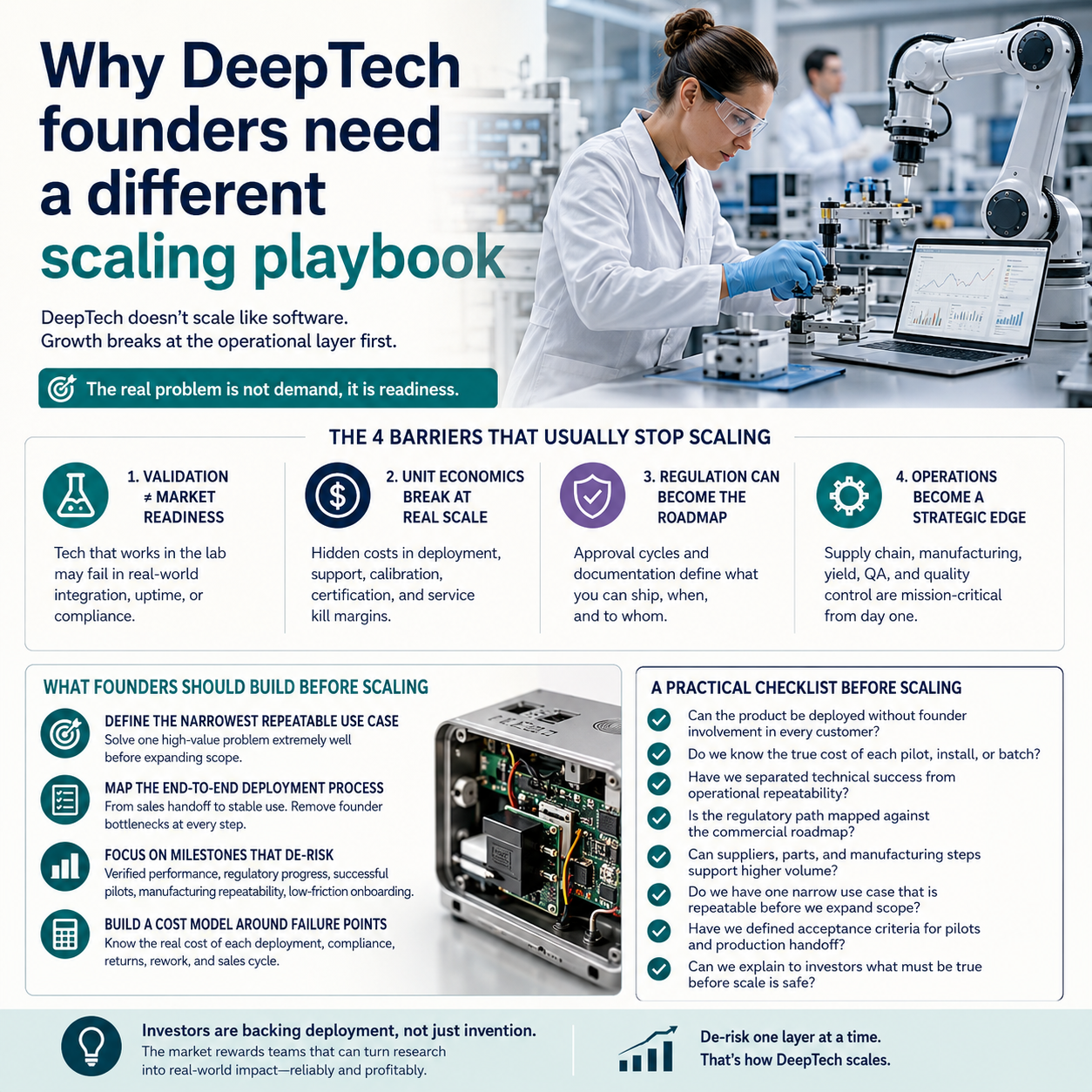
DeepTech companies do not scale like software startups. When the product is tied to hardware, regulation, lab validation, manufacturing, or long sales cycles, growth usually breaks at the operational layer first, not the marketing layer. That means founders need a different expansion plan: one built around de-risking, not just traction.
The real problem is not demand, it is readiness
The strongest signal in the candidate articles is not simply that DeepTech is attracting capital. It is that investors and founders are both focusing on how lab-born technology becomes deployable in the real world. Ruya Ventures’ new fund is explicitly aimed at helping DeepTech move from the lab into deployment, while EU-Startups’ analysis of scaling barriers highlights the operational friction that appears before a company can grow reliably.
For founders, this changes the main question. The question is not “Can we sell this?” It is “Can we deliver this repeatedly, compliantly, and profitably enough to survive scale?”
The four barriers that usually stop scaling
DeepTech businesses tend to hit the same four bottlenecks, even when early proof points look strong.
What most people miss
Many founders treat DeepTech as if fundraising or initial pilot wins are the hard part. In practice, the hard part is often everything after the first yes: certification, quality control, supply chain reliability, customer integration, and the cost of each additional deployment. A startup can look promising on paper and still be unscalable if one install, one batch, or one clinical workflow creates too much operational drag.
1. Technical validation does not equal market readiness. A prototype that works in controlled conditions may still fail when customers require uptime, integration, service levels, or compliance evidence. Founders need to test not just whether the technology works, but whether the business can support it under real customer constraints.
2. The unit economics often break at the first real scale step. DeepTech teams frequently underestimate the cost of field deployment, support, calibration, certification, or production ramp-up. If every new customer requires founder involvement, the company has not built a repeatable model yet.
3. The regulatory path can become the product roadmap. In categories such as medtech, industrial systems, energy, and biotech, approval cycles and documentation requirements can define what can ship, when, and to whom. A strong commercial plan must be built around that timeline, not around a standard SaaS launch rhythm.
4. Supply chain and manufacturing discipline become strategic. Once the product leaves the lab, component sourcing, test procedures, yield, and quality assurance can matter as much as the core invention. This is where many teams realize that “innovation” and “operations” are the same business.
What founders should build before they try to scale
DeepTech founders should think in terms of readiness layers. Each layer reduces the chance that growth turns into expensive chaos.
First, define the narrowest repeatable use case. Do not generalize too early. A product that solves one regulated, high-value, operationally painful problem is easier to validate than a broad platform promise.
Second, map the deployment process from sales handoff to stable use. List every step: procurement, technical integration, training, installation, validation, servicing, and replacement. If the process needs founder intervention at every stage, the company is not ready to scale.
Third, decide which milestones matter more than revenue in the early phase. For DeepTech, progress markers often include verified performance, regulatory progress, successful pilots with defined acceptance criteria, manufacturing repeatability, and low-friction customer onboarding.
Fourth, build a cost model around failure points. A pilot that technically succeeds but requires too much support is not a scalable win. Founders should know the cost of each deployment, the cost of compliance, the cost of returns or rework, and the cost of long enterprise sales cycles.
Why investors are paying attention to deployment, not just invention
Ruya Ventures’ fund shows how capital is shifting toward companies that can turn research into deployment. That matters because the market is rewarding teams that can cross the gap between scientific credibility and operational repeatability. For founders, this means investors will increasingly ask for evidence that the company understands manufacturing, customer rollout, and timing risk, not just technical novelty.
In practice, this changes fundraising conversations. A strong deck is not enough if the company cannot explain how it will move from pilot to production, how it will control quality, or how it will support customers at the next order size. The more complex the technology, the more important the operating system becomes.
How small teams should structure the next 12 months
Instead of chasing broad expansion, founders should sequence the business around de-risking. That usually means reducing unknowns in one category at a time.
If the bottleneck is regulation, put resources into certification, documentation, and compliance partners before sales acceleration. If the bottleneck is manufacturing, focus on yield, supplier stability, and repeatable test procedures. If the bottleneck is customer adoption, narrow the target segment and standardize onboarding.
For small teams, the best growth move is often not more demand generation. It is making the company easier to deploy, support, finance, and audit. That is what turns a promising technical asset into a real business.
A practical checklist before scaling a DeepTech company
- Can the product be deployed without founder involvement in every customer?
- Do we know the true cost of each pilot, install, or batch?
- Have we separated technical success from operational repeatability?
- Is the regulatory path mapped against the commercial roadmap?
- Can suppliers, parts, and manufacturing steps support higher volume?
- Do we have one narrow use case that is repeatable before we expand scope?
- Have we defined acceptance criteria for pilots and production handoff?
- Can we explain to investors what must be true before scale is safe?


