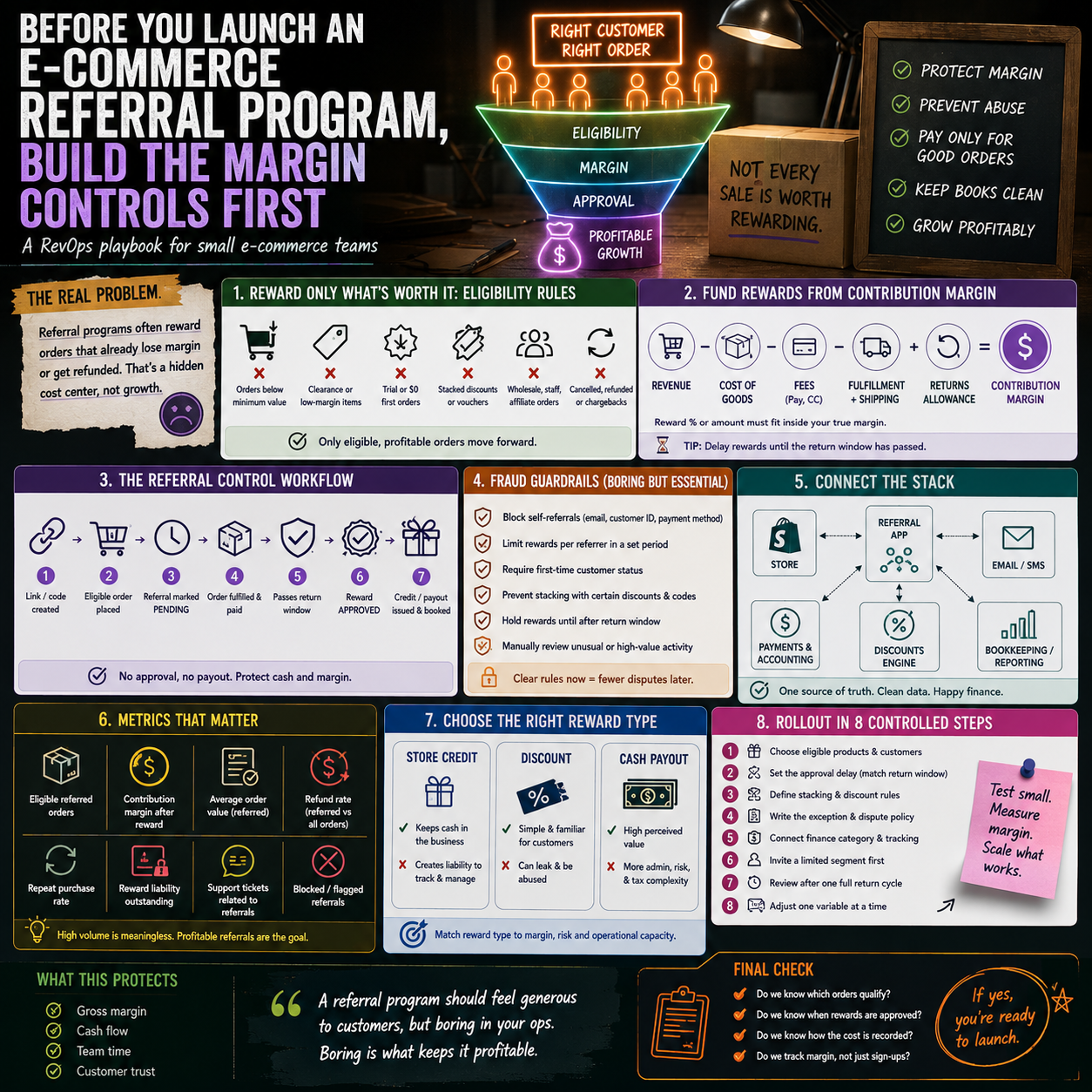
A referral program can look cheap until it starts paying rewards on orders that were already discounted, returned, cancelled or bought by the same customer under a second email address. For a small e-commerce seller, the operational question is not whether word-of-mouth works. It is whether the reward structure can survive your margins, fulfilment costs and accounting process.
This playbook is for Shopify, WooCommerce, marketplace-adjacent and direct-to-consumer operators who are considering a customer referral program but do not yet have a proper control layer around discounts, attribution, refunds and bookkeeping.
The decision is not “should we launch referrals?” but “which orders are worth rewarding?”
Many referral programs are designed backwards. The store owner starts with an attractive offer, such as “give 20%, get 20%”, then tries to make the numbers work later. That creates a hidden problem: the program may reward orders that do not produce enough contribution margin after product cost, payment fees, pick-and-pack cost, shipping subsidy, returns and the reward itself.
The first decision should be eligibility. A referral reward should not automatically attach to every transaction. A small store should decide which orders deserve a referral cost and which should be excluded because the economics are too thin.
Common exclusions include:
- Orders below a minimum basket value.
- Products already sold at clearance margin.
- Subscription trial orders where the first payment does not cover acquisition cost.
- Orders using stacked discounts or marketplace vouchers.
- Wholesale, staff, affiliate or influencer-code purchases.
- Orders later refunded, cancelled or charged back.
This is where referral design becomes an operations issue rather than a marketing campaign. The store needs a rule that says: “We only pay for referred orders that meet our margin and fulfilment conditions.” If the software cannot enforce those conditions, the business needs a manual review step or a different tool.
Build the reward from contribution margin, not from revenue
A referral reward should be funded from contribution margin, not top-line sales. Revenue is the wrong base because it ignores the costs that make e-commerce fragile: fulfilment, returns, damaged items, card fees, duties, packaging and customer service time.
A simple internal calculation can prevent an expensive mistake:
- Average order value after discounts.
- Minus product cost.
- Minus payment processing cost.
- Minus fulfilment, packaging and shipping subsidy.
- Minus expected return or replacement allowance.
- Equals estimated contribution margin before referral reward.
If that number is small, a percentage discount for both the referrer and the referred customer may be too aggressive. A fixed reward may be safer because the business can cap the exposure. For example, a store selling low-margin accessories may be better with a small store-credit reward after the referred customer’s second purchase, rather than an immediate discount on the first order.
The timing matters. Paying or issuing credit immediately after purchase creates risk if your return window is long. A better design is to approve the reward only after the order passes the refund period. That may feel less exciting than instant credit, but it protects cash and avoids bookkeeping clean-up later.
What most people miss
The referrer reward is not the only cost. The referred customer often receives a discount too. That means the program may carry two costs on one order: the discount used to convert the new buyer and the future liability owed to the existing customer. If the existing customer then uses that reward on another discounted order, the margin damage can continue into a second transaction.
Small stores also miss the operational cost of support. Customers ask where their link is, why a reward did not trigger, whether a friend’s purchase counted, and why a cancelled order removed credit. If the policy is vague, the support inbox becomes the control system. That is a bad use of a small team’s time.
The workflow should decide when a referral becomes payable
A referral program needs a status flow, not just a link generator. The useful workflow is closer to an order approval pipeline:
- Referral link or code created for the customer.
- New customer places an eligible order.
- System marks the referral as pending.
- Order passes payment, fulfilment and return checks.
- Reward becomes approved.
- Credit, coupon, points or payout is issued.
- Bookkeeping records the cost in the right category.
The pending stage is the control point. Without it, the store may issue rewards before knowing whether the order is real, profitable or retained. For digital products and low-refund categories, the approval window may be short. For apparel, cosmetics, home goods or cross-border orders, the business may need to wait until the return period has passed.
This is also where the choice of reward type affects operations. Store credit keeps cash inside the business but creates a liability to track. Cash payouts may motivate referrers, but they introduce payment administration, fraud risk and possible tax or reporting questions depending on the country and structure. Discount codes are simple, but they can leak to coupon sites and be used by customers who were not truly referred.
Referral fraud is usually boring, not cinematic
Small e-commerce fraud does not always look like a dramatic attack. Often it is ordinary customer behaviour exploiting weak rules. A buyer creates a second account. Friends in the same household refer each other repeatedly. A discount code is posted publicly. A customer refers themselves using a different email. A high-discount referral offer gets combined with a seasonal promotion.
The operational response is not paranoia. It is basic guardrails:
- Block self-referrals by email, customer ID and payment method where your tools allow it.
- Limit rewards per referrer within a defined period.
- Prevent referral rewards from stacking with certain discount codes.
- Require first-time customer status for the referred buyer.
- Hold rewards until the order is outside the refund window.
- Review unusually high referral activity before issuing credit.
These rules should be written before the campaign goes live. If the team invents rules after customers start referring, the business risks disputes and inconsistent treatment. The policy does not need legal language, but it does need operational clarity: when rewards are earned, when they are voided, what counts as a new customer, and whether rewards can be combined with other offers.
Where the referral tool must connect to the rest of the stack
The referral app is only one part of the system. For an operator, the real question is whether it connects cleanly to the store, customer records, discount engine, email platform and finance process.
At minimum, the stack needs to answer four questions without manual detective work:
- Which customer referred this buyer?
- Which order triggered the reward?
- Was the order eligible after discounts, refunds and returns?
- Where was the reward recorded financially?
On Shopify or WooCommerce, that usually means checking whether the referral tool can pass order and customer metadata into the commerce platform or CRM. The email platform should be able to send referral links, reward status updates and reminders without forcing the operator to export spreadsheets every week. The discount engine must prevent stacking if that is part of the margin rule.
The finance side is often ignored. A referral reward is not simply “marketing activity” in a practical sense. It can be a discount, a store-credit liability, a coupon redemption, a customer acquisition cost or a payout, depending on how the program is structured. The finance side is often ignored. A referral reward is not simply “marketing activity” in a practical sense. It can be a discount, a store-credit liability, a coupon redemption, a customer acquisition cost or a payout, depending on how the program is structured. Referral rewards still need a clear bookkeeping treatment. If discounts, credits and payouts are not categorised consistently, the owner will not know whether the program is actually profitable.
A useful automation boundary
Automate the repetitive parts: link generation, email delivery, pending reward status, expiry reminders and approved credit creation. Keep human review for exceptions: high-value referrals, suspicious repeat patterns, bulk orders, orders with refunds, and customers challenging eligibility.
This boundary works because full automation can overpay, while full manual review kills the program with admin work. A small team does not need an enterprise fraud department. It needs a queue that highlights the handful of referrals that deserve review before value leaves the business.
A practical scenario: the low-margin store should not copy the high-margin brand
Consider a small online store selling physical products with modest gross margin and a meaningful return rate. It sees a competitor offering generous referral discounts and considers copying the offer. That would be a risky move if the store’s best-selling items already use free shipping and seasonal discounting.
A safer structure might look like this:
- The referred customer receives a discount only above a minimum basket value.
- The referrer receives store credit, not cash.
- The referrer credit is approved only after the referred order is outside the return window.
- Clearance and bundle products are excluded.
- Referral credit cannot be combined with sitewide discount codes.
- Rewards expire after a defined period to reduce open liabilities.
This design may produce fewer headline sign-ups than a generous instant-reward offer. But it gives the operator something more useful: a program that can be reconciled, controlled and improved. The store can then adjust the reward only after seeing whether referred customers buy again, return less, or need less paid advertising support.
The dashboard should track margin behaviour, not vanity referral counts
Referral count alone is a weak metric. A program can generate many referred orders and still damage profit. The dashboard should show whether the channel brings customers the store actually wants.
Useful metrics include:
- Eligible referred orders, not just total referral clicks.
- Average order value of referred customers after discounts.
- Contribution margin after referral reward.
- Reward liability outstanding if store credit is used.
- Refund rate for referred orders compared with normal orders.
- Repeat purchase rate of referred customers.
- Support tickets related to referral disputes.
- Percentage of referrals blocked or manually reviewed.
The owner should review these metrics by product category and promotion period. A referral program may work well for full-price replenishment products and poorly for heavily discounted items. It may also perform differently during holiday campaigns, when customers are more discount-sensitive and more likely to stack offers.
If the dashboard cannot separate these patterns, the store may make the wrong decision. It might shut down a useful program because one promotion distorted the numbers, or it might scale an unprofitable structure because order volume looked strong.
The bookkeeping setup has to be ready before the first reward is issued
Referral rewards create small accounting decisions that become messy at volume. The store needs a consistent way to record discounts, credits and payouts. Otherwise, marketing performance becomes difficult to compare against paid ads, affiliate commissions and influencer codes.
Before launch, decide how the following will be treated in your bookkeeping process:
- Discount given to the referred customer.
- Store credit issued to the referrer.
- Expired store credit.
- Cash payouts, if used.
- Refunded orders where a reward was pending or already issued.
- Manual adjustments made by support.
This is not about turning the founder into an accountant. It is about making sure the owner can answer a basic operating question: did this referral program acquire profitable customers at a cost we can afford? If rewards are buried in general discounts or manually adjusted without notes, the answer becomes guesswork.
Rollout sequence for a controlled referral launch
Use a staged rollout rather than launching the richest offer to the entire customer base. The first version should be built to expose operational problems before they become expensive.
- Step 1: Choose eligible products. Start with products where margin, fulfilment and return behaviour are already understood.
- Step 2: Set the approval delay. Match reward approval to your refund and cancellation reality, not to the referral app’s default setting.
- Step 3: Define stacking rules. Decide which discounts, bundles, subscriptions and sale items cannot combine with referral rewards.
- Step 4: Write the internal exception policy. Support should know what to do with self-referrals, cancelled orders, duplicate accounts and customer disputes.
- Step 5: Connect the finance category. Make sure discounts, credits or payouts can be identified in bookkeeping and reporting.
- Step 6: Invite a limited customer segment. Start with repeat buyers or high-trust customers rather than every email subscriber.
- Step 7: Review after one full return cycle. Do not judge the program before refunds, reward approvals and second purchases have had time to appear.
- Step 8: Adjust one variable at a time. Change minimum basket value, reward amount, expiry period or eligible products separately so the operator can see what actually moved the numbers.
The practical test is simple: if a referred order comes in tomorrow, the team should know whether it qualifies, when the reward is approved, how the cost is recorded, and which metric will prove whether the program should continue. If those answers are unclear, the referral offer is not ready; the control system is.


