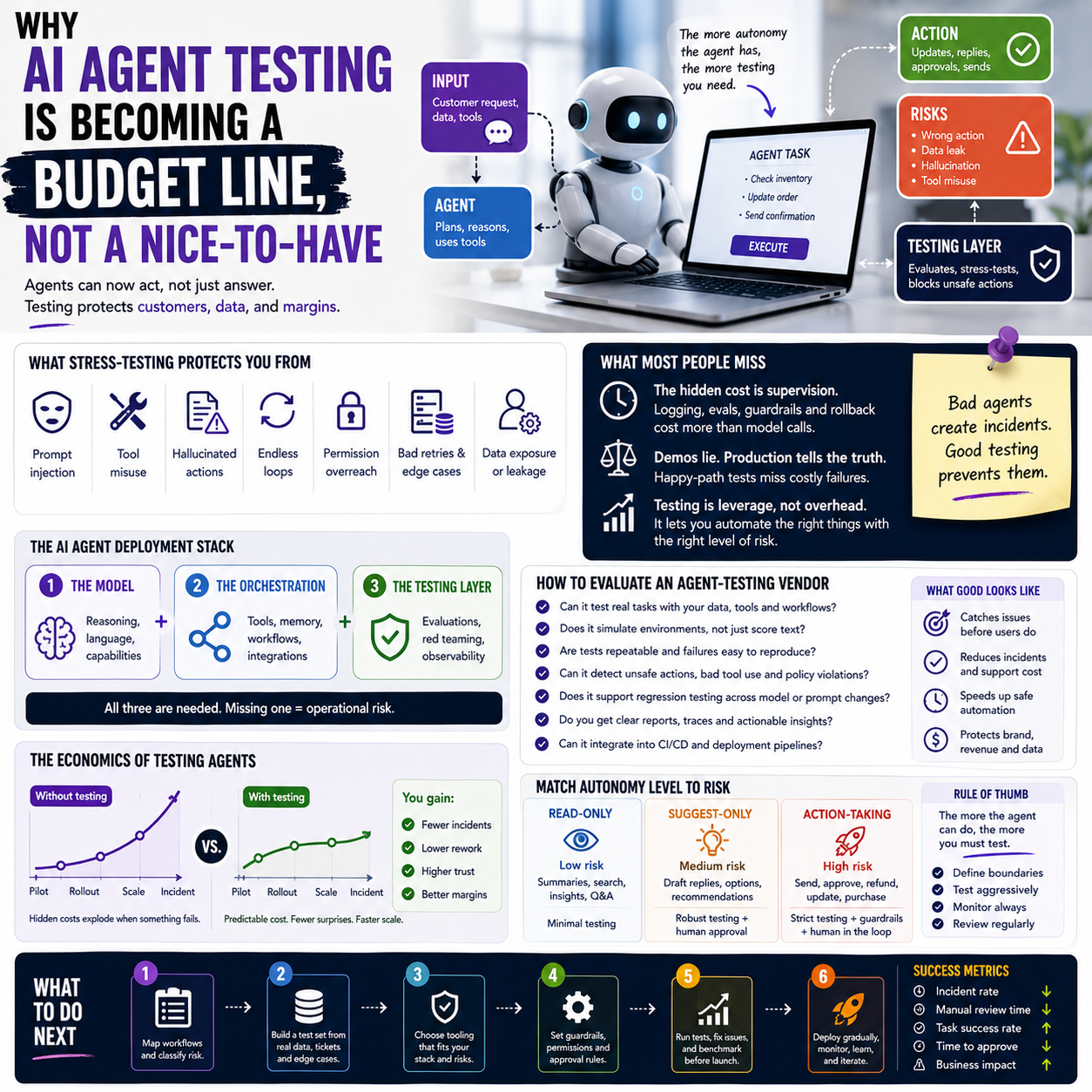
AI agents are moving from demos into workflows that touch customers, operations, and internal decisions. That shift changes the buying question: not “Can this agent do the task?” but “How do we know it will behave safely, consistently, and within our risk tolerance?”
The latest funding and policy signals around AI model release and agent evaluation point to the same operational reality: testing is becoming a separate line item, not an afterthought. For founders and operators, the practical issue is not whether to adopt agents, but how to avoid deploying systems that look smart in a demo and fail in production.
Why agent testing is moving into the operating budget
Patronus AI’s raise is a useful signal because it reflects buyer demand, not just investor enthusiasm. If companies are funding “digital worlds” that stress-test AI agents, it suggests a pattern many operators already feel: the cost of an agent failure can be much higher than the cost of the model itself.
That matters for businesses using agents in support, sales ops, internal search, order handling, procurement, or content workflows. A bad response from a chatbot is annoying. A bad action from an agent that can click, send, approve, or modify records becomes an operational risk. The more autonomy you give the system, the more you need a verification layer around it.
For small businesses, this means the question is no longer just “Which model should we buy?” The better question is “What testing infrastructure do we need before this agent touches real work?”
What stress-testing actually protects you from
Agent testing is about catching failure modes that are easy to miss in normal demos. These include tool misuse, prompt injection, hallucinated actions, bad retries, permission overreach, and weird edge cases that only show up when the agent is under pressure.
Founders often underestimate how quickly an agent can turn from assistant into liability. If an agent can access inboxes, CRM records, product catalogs, refunds, or supplier communications, then you need to know not only whether it works on happy paths, but whether it can be manipulated, confused, or pushed into unsafe output.
What most people miss
The hidden cost is not the model call. It is the supervision and rollback layer around it. Once an agent is allowed to act, you need logs, test cases, escalation rules, and a way to stop or reverse actions when something goes wrong. That usually matters more than shaving a few cents off inference cost.
How founders should evaluate an agent-testing vendor
If you are shopping for AI evaluation tooling, do not start with feature lists. Start with your own workflows. A vendor is only useful if it can test the actual tasks your team plans to automate.
Ask whether the tool can simulate realistic environments, not just score text outputs. For many businesses, the important failure is not “did the model answer correctly?” but “did the agent choose the wrong tool, loop endlessly, expose data, or take an irreversible action?”
You should also care about how the vendor handles repeatability. If one test run passes and the next fails for unclear reasons, you do not have a testing system; you have a guessing system. Good evaluation tools help you reproduce failures, compare versions, and separate model issues from workflow issues.
For operators, the buying decision should include three layers: the model, the orchestration layer, and the testing layer. If a vendor only addresses one of those, the setup may still be fragile.
How this changes the economics of deploying agents
Testing adds cost, but it also changes the economics of deployment in a useful way. Without structured evaluation, businesses tend to overbuild guardrails manually or underbuild them entirely. Both outcomes are expensive: one slows teams down, the other creates incident risk.
When testing is done properly, you can decide which workflows are safe for full automation, which need human approval, and which should remain assistive only. That segmentation is where the real ROI sits. A founder does not need every process to be agentic. They need the right level of autonomy for the right task.
This also affects vendor lock-in. If your testing stack can benchmark behavior across model versions and providers, you are less exposed when a supplier changes release policy, availability, or safety thresholds. That is especially relevant as model access becomes more selective and controlled.
What the release-slowdown signal means for operators
The reporting around OpenAI’s slower rollout of a new model over safety concerns is relevant for business leaders because it shows that model availability can shift for reasons outside your control. If a provider changes who gets access, when, or under what conditions, your automation roadmap can slip even if your internal team is ready.
That is another reason to separate “AI adoption” from “AI dependency.” A business that embeds models into core workflows needs contingency plans: fallback providers, manual override paths, and a clear understanding of which processes fail gracefully and which do not.
For smaller companies, the real decision is often whether to build on the latest model at all or to standardize on a stable one with a better testing harness. The newest model is not always the best operational choice if your workflows depend on reliability, auditability, or change control.
What to do next if you are considering AI agents
- Map every agent workflow to a risk level: read-only, suggest-only, or action-taking.
- Require a test set built from your own real prompts, tickets, product data, and edge cases.
- Check whether the agent can be forced into unsafe tool use, repeated loops, or bad approvals.
- Keep a human approval step for any workflow that can move money, change records, or message customers externally.
- Make rollback and logging part of the deployment requirement, not a future improvement.
- Benchmark model changes before upgrades so a provider release does not break operations unexpectedly.
- Buy testing infrastructure only if it helps you decide which workflows are safe to automate, not just if it produces a score.